How Arizona Heat Damages Your Roof Faster Than You Think
→ QUICK ANSWER
Spring 2026 was Phoenix's hottest on record. Your roof absorbed every one of those days. Here's what UV and extreme heat actually do to asphalt, tile, and foam roofs in the East Valley before monsoon.

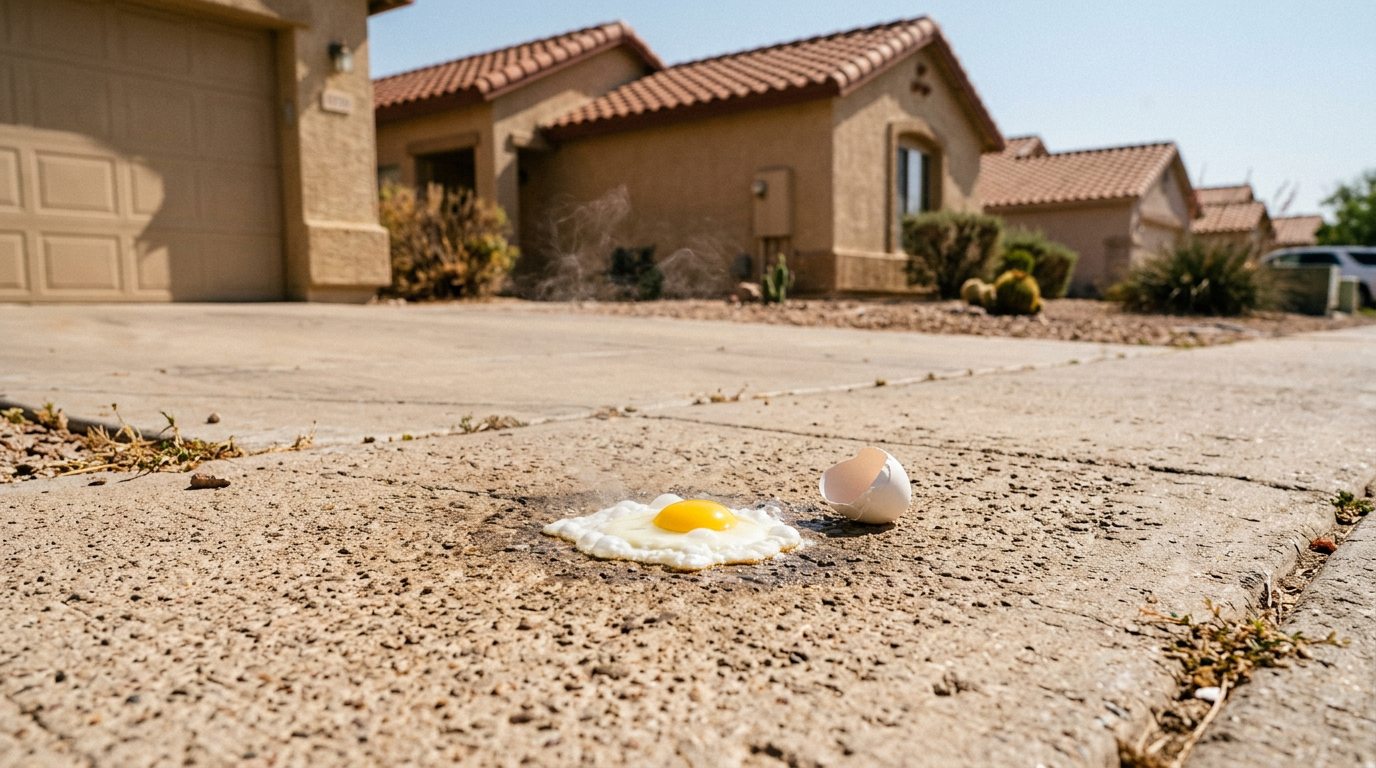
Spring 2026 set a record most people felt in their AC bills before they thought about their roofs. Phoenix averaged 80.2 degrees across March, April, and May. That's 6.4 degrees above normal. The previous record was 77.7 degrees, set in 1989. March 18 hit triple digits, the earliest 100-degree day in Phoenix history. All of it happened before a single monsoon storm touched the East Valley.
Nobody tells you when the news covers the heat record: your roof absorbed every one of those days. And it's not storm damage that sneaks up on you. It's the quiet, relentless destruction that UV and extreme heat do long before clouds even form.
What Record Spring Heat Actually Does to a Roof in Arizona
This isn't a weather story. It's a structural one.
When air temperature reaches 110 degrees, a dark asphalt shingle roof surface can hit 170 degrees or higher. At 115 degrees outside, shingle surfaces reach into the 190s. That's not a brief spike. On a full-sun day in Phoenix, shingles hold those temperatures for hours at a time.
Concrete tile holds up better against UV than asphalt. But the underlayment beneath it doesn't. And that's where most tile roofs in Gilbert, Chandler, and Mesa eventually fail.
Foam roofs (SPF) have their own version of the problem. The foam substrate is solid indefinitely if it's protected. The coating on top degrades. In states with milder climates, a recoat is typically needed every 10 to 12 years. In Arizona, the climate demands a recoat every 5 to 7 years, sometimes sooner.
The spring of 2026 didn't just break a weather record. It almost certainly shortened the remaining life on millions of roofs across the East Valley. Here's what that means, by roof type.
Asphalt Shingles: The UV Problem Nobody Talks About
Most conversations about asphalt roofs in Phoenix focus on storm damage. Missing shingles after a haboob, granules in the gutter after monsoon. That's real. But the thing that ages asphalt here isn't the storm. It's the months of sustained heat before and after it.
A 3-tab asphalt shingle rated for 25 years in Ohio realistically lasts 15 to 20 years in Phoenix under normal conditions. Architectural shingles do better, running 20 to 30 years in the Phoenix climate, but they still fall short of their rated lifespan compared to what you'd see in a cooler state. A heat-record spring compresses that timeline further.
What's actually happening: UV breaks down the asphalt binder at the molecular level. The ceramic and mineral granules that protect the asphalt underneath start releasing. Once the granule layer thins, the asphalt mat is exposed to direct sun and degrades much faster. Meanwhile, the adhesive strips that hold shingles sealed start softening under sustained heat. Edges begin to lift. By the time monsoon winds arrive, a heat-softened shingle with loose edges is already in trouble.
What to look for right now if you have an asphalt roof 10 or more years old: granules collecting in gutters or at the base of your downspouts, shingles that look lighter or "bald" in patches on south- or west-facing slopes, and any edge cupping visible from the ground.
Tile Roofs: Why the Tiles Are Fine but the Underlayment Isn't
Tile is the dominant roof type in the East Valley, and it deserves its reputation. Concrete and clay tile handles UV and sustained heat far better than asphalt. A solid tile installation lasts 40 to 50 years. Individual tiles, in good conditions, can outlast the house.
But there's a layer most homeowners never see and most contractors don't mention until there's a leak: the underlayment.
The tiles don't waterproof your home. They deflect most of the sun and rain. The underlayment is a membrane installed on the roof deck beneath the tiles, and it's the actual waterproof barrier. In Arizona's heat, it degrades considerably faster than any generic national estimate would suggest.
Traditional felt underlayment in Arizona typically needs replacement every 15 to 20 years. Under aggressive heat exposure, on south-facing pitches with poor attic ventilation, in extreme heat years, it can start failing earlier. The felt dries out, becomes brittle, cracks. Wind-driven monsoon rain pushes under the tiles and finds its way through.
Here's what makes this tricky: you can look at a tile roof from the street and see absolutely nothing wrong. The tiles look great. Color's fine. No visible damage. The underlayment underneath, though, can be dried-out and cracked, just waiting for a storm to find it.
If your tile roof is 15 or more years old, especially if it was built between the mid-1990s and early 2000s when Gilbert, Chandler, and Queen Creek were being built out fast, a tile-lift inspection before this monsoon season makes a lot of sense.
Foam Roofs: Heat Expansion and Coating Degradation
Foam roofing (spray polyurethane foam, or SPF) is genuinely well-suited to the Arizona climate. It's seamless, provides solid insulation, and handles thermal expansion better than most systems because there are no seams to stress. A lot of flat or low-slope homes across the East Valley have it.
The issue is always the coating on top.
The foam itself can't survive direct UV exposure. It chalks out, becomes brittle, and starts absorbing moisture. So every foam roof has a protective coating applied over it, silicone or elastomeric. That coating is the real weather barrier, and it has a limited life.
In other states, that coating holds up for 10 to 12 years. In Arizona, 5 to 7 years is what the climate actually allows. We've been on roofs in Mesa and Gilbert where homeowners hadn't recoated in a decade or more and the foam was already chalking and showing soft spots. At that point, the coating has failed and water is the next problem.
After a spring like 2026, any foam roof that was coated five or more years ago is worth a look before July hits.
How to Tell If Heat Has Already Shortened Your Roof's Life
Some of the most useful things to check, you can do from the ground or from inside your attic. You don't need to be on the roof.
For asphalt shingles: Check the gutters for granule buildup, especially near downspout exits. Look at the south- and west-facing slopes from ground level. Lighter-colored patches, cupping edges, or any shingle that looks "bald" compared to the rest all warrant a closer look. Inside, unexpected heat in the attic during spring can be an early sign the shingle layer is losing its thermal resistance.
For tile roofs: Interior signs often show up first. A water stain in a ceiling corner after rain, even a light rain, is frequently the first signal that underlayment has failed somewhere. This happens well before any tiles show visible damage. If your tile roof is 15-plus years old, don't wait for the stain to appear.
For foam roofs: Walk the perimeter and look at any accessible flat sections. A coating that leaves white chalk on your finger when you run it across the surface, or one that shows visible cracking or blistering, is past its useful life.
Why This Year Is Different: Spring 2026 by the Numbers
The National Weather Service confirmed spring 2026 as the hottest on record for Phoenix. March averaged 78.8 degrees, more than 15 degrees above normal for the month. April averaged 77.6 degrees, seven degrees above normal. May came in at 84.1 degrees. The overall spring average was 80.2 degrees, beating the prior record by 2.5 degrees.
Phoenix hit 100 degrees on March 18. That was the earliest triple-digit day in recorded Phoenix history.
For roofs, the issue isn't just the peak temperature. It's the length. Every week of elevated spring heat adds to the thermal cycling count. Roofs expand in the afternoon and contract at night. In a typical spring, that cycle builds gradually from April onward. In 2026, it started in March. That's roughly 8 to 10 extra weeks of high-stress thermal cycling that most of these roofs haven't experienced before in a single spring.
Thermal cycling, not just peak temperature, is what stresses seals, fasteners, and adhesive strips. An extra two months of it adds up.
The East Valley Pre-Monsoon Check You Should Be Doing Right Now
We're in the window between the record spring heat and the first monsoon. This is the time to look. Once July arrives and storms start, you're reacting instead of preventing.
For asphalt roofs under 10 years old: Walk the perimeter and look at south- and west-facing slopes from the ground. Check gutters for granule accumulation. If anything looks off, it's worth an inspection before the season starts.
For asphalt roofs 10 to 15 years old: Get eyes on it now. Not because it's definitely failing, but because this is the age range where heat damage moves from cosmetic to functional. One pre-monsoon inspection either gives you peace of mind or gives you a clear picture of what to plan for.
For tile roofs 15 or more years old: Ask about a tile-lift inspection. A roofer removes a few representative tiles and looks directly at the underlayment condition. From the street, tile roofs give nothing away. The only way to know is to look underneath.
For foam roofs coated 5 or more years ago: A recoat evaluation is worth scheduling before the heavy UV months of July and August.
If you're in Gilbert or anywhere across the East Valley, we'll send someone out to take a real look. No upsell, no scare tactics.
Tuuta Pulotu is the CEO and co-founder of All Storm Roofing + Construction. He was born and raised in Arizona. His mom is from Hawaii, his dad from Tonga, and Tuuta grew up in the trades working alongside his father, who's been running a landscaping and masonry crew in the Valley for over thirty years.
Before founding All Storm in 2021, Tuuta spent years in solar sales. Long enough to watch too many East Valley homeowners get pushed into roof decisions they didn't fully understand. He started All Storm to flip that conversation: be the contractor who tells homeowners what's actually going on with their roof, even when the truth costs him the job.
He runs All Storm out of Gilbert, where he lives with his wife and four kids.
AZ ROC #345156. Tamko Diamond Certified. The only Tamko Diamond Certified roofing contractor in Arizona.
WRITTEN BY
Tuuta Pulotu is the CEO and co-founder of All Storm Roofing + Construction. He was born and raised in Arizona. His mom is from Hawaii, his dad from Tonga, and Tuuta grew up in the trades working alongside his father, who's been running a landscaping and masonry crew in the Valley for over thirty years. Before founding All Storm in 2021, Tuuta spent years in solar sales. Long enough to watch too many East Valley homeowners get pushed into roof decisions they didn't fully understand. He started All Storm to flip that conversation: be the contractor who tells homeowners what's actually going on with their roof, even when the truth costs him the job. He runs All Storm out of Gilbert, where he lives with his wife and four kids. AZ ROC #345156. Tamko Diamond Certified. The only Tamko Diamond Certified roofing contractor in Arizona.
Worried about your roof?
Get a free, no-pressure inspection from a Gilbert team that gives honest answers — not pressure to replace.
Schedule Free Inspection