Emergency Roof Repair After a Monsoon: What Phoenix Homeowners Need to Do in the First 24 Hours
→ QUICK ANSWER
A monsoon just hit your East Valley neighborhood and your ceiling is leaking. Here's exactly what to do in the first 24 hours: stop the water, document for insurance, and avoid the storm chasers.

Short answer: After a Phoenix monsoon, stop active water intrusion first, then document all damage before touching anything. Licensed roofers can usually complete emergency tarping same day, with permanent repairs following within 48 to 72 hours. Avoid door-knockers promising to waive your deductible—that is insurance fraud under Arizona law. All Storm Roofing is licensed Arizona ROC #345156 and Tamko Diamond Certified.
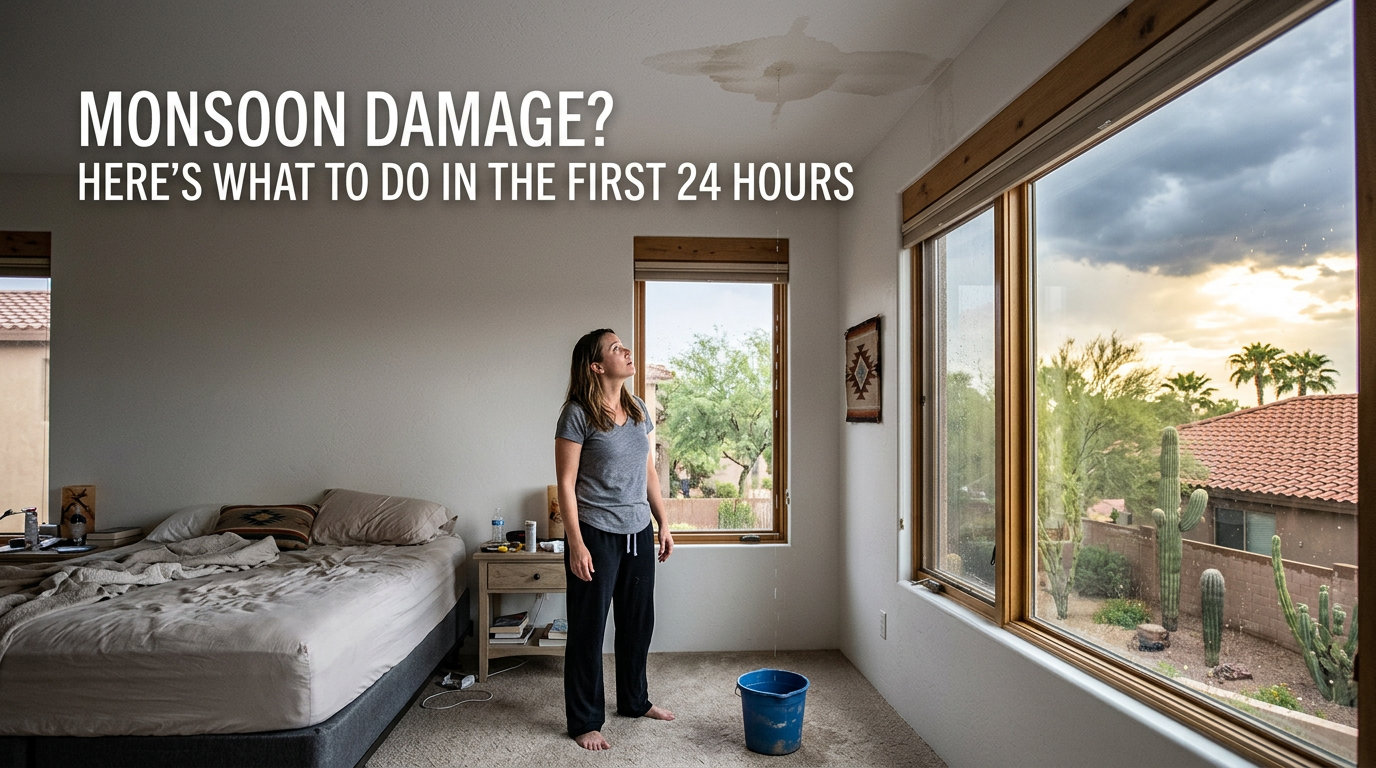
The storm came through Gilbert around 11 p.m. Wind over 60 mph. That kind of haboob that paints the whole sky brown before the rain even starts. Now it's morning and there's a water stain spreading across your bedroom ceiling. The weekend forecast has another storm in it.
So, what do you do?
Stop the water. Document before you move anything. Call a licensed local roofer. Not the one who knocked on your door this morning.
Those first 24 hours are what separate a quick fix from a months-long headache. We've seen both sides of that line, and it almost always comes down to what the homeowner did in the hours right after the storm.
Step 1: Safety First, Then Stop the Water
Stay off the roof. Concrete tile after a monsoon is genuinely dangerous, and this isn't a disclaimer we put in to cover ourselves. Tiles crack under foot traffic even when dry. After a storm with possible deck damage underneath, you shouldn't be walking on it. We don't walk on storm-damaged roofs without proper equipment, and we do this every day.
Inside: buckets under active drips. Get furniture and electronics away from wet areas. If water is near an electrical panel or a soaked ceiling fixture, clear out of that area and call an electrician before anything else. That part really does matter.
From outside, look up. Most of the time you can see what's wrong from the driveway. Binoculars help. Look for missing tiles on the south-facing pitch, shingles lifted at the edges, debris sitting on any flat foam section. You don't need to be on the roof to get a basic read on the situation.
If you've got an obvious opening and water is actively coming in, you need a licensed roofer for emergency tarping. A properly installed tarp holds for several weeks while permanent repairs get scheduled. Most insurance carriers expect homeowners to stop active water intrusion after a storm event. Skipping that step can hurt the claim, sometimes significantly.
Step 2: Document Before You Touch Anything
This is where homeowners consistently cost themselves money. The instinct is to clean up, move things around, make the damage look less bad. Resist it. Your adjuster needs to see what the storm actually left.
Photos from multiple angles. Interior ceiling stains. The attic if you can access it safely. The exterior from the ground. Any debris in the yard. Your phone timestamps everything in the file data automatically, which matters when your insurer asks when the damage happened.
Focus especially on: tiles missing or shifted on the south- and west-facing slopes, which take the hardest hit from monsoon wind direction. Lifted or buckled shingles anywhere across the roof. Separated flashing around chimneys, skylights, or HVAC penetrations. Exposed decking or underlayment visible from the yard. Water stains on interior ceilings, particularly near exterior walls.
A dated photo record also protects you if a storm chaser shows up later claiming damage that was actually pre-existing.
Step 3: Call a Licensed Local Roofer, Not the Door Knocker
Last monsoon season, within an hour of a storm clearing in the East Valley, there were trucks in Gilbert and Chandler neighborhoods that nobody recognized. Guys going door to door. Out-of-state plates. Offering to handle everything with your insurance and promising you'd never have to see your deductible.
That's where the conversation should end.
Offering to waive a homeowner's deductible in Arizona is insurance fraud. It's not a gray area and it's not a technicality. The Arizona Registrar of Contractors warns about this pattern specifically every monsoon season. If a roofer promises to handle your deductible, walk away.
Three things we'd check before letting anyone on our own roofs:
License number. Arizona law (ARS Title 32, Chapter 10) requires any contractor doing more than $1,000 in work to be licensed by the ROC. Roof repair always clears that. Verify any license at roc.az.gov or call 1-877-692-9762. It takes about thirty seconds.
Insurance. Liability and workers' comp. If a roofer gets hurt on your property and the contractor doesn't carry workers' comp coverage, that liability can come back to you as the homeowner.
A real local address. Not a PO box. Not a phone number that's been active for ninety days. A business address somewhere in the East Valley that you can look up and actually verify.
How Fast Can Emergency Roof Repair Happen in Phoenix?
Licensed roofers can usually get emergency tarping done same day. Permanent repairs typically run 48 to 72 hours from inspection, depending on material availability and how many homes in the area took damage from the same storm.
After a storm that sweeps through Mesa, Queen Creek, and San Tan Valley in the same night, every licensed roofer in the East Valley is fielding calls at once. Homeowners who call first get scheduled first. That's just the reality of monsoon season.
This is why storm chasers can move so fast. Out-of-state crews mobilize in volume after a named event. They can be at your door before your local contractor even checks voicemail. But being first to the door isn't the same as being accountable six months later when something fails.
Emergency Tarp vs. Permanent Repair
A tarp buys time. That's its only job. Don't make permanent material decisions while you're still stressed and the roof is wet.
Emergency tarping is typically covered as a mitigation expense under homeowner's policies, separately from the main repair cost. Keep every receipt from any emergency service. Your adjuster will want them.
When a licensed roofer does the full inspection, they're looking past what you could see from the driveway. On a concrete tile roof, one blown tile on the south pitch often means cracked or slipped tiles nearby. Wind doesn't pick just one. On an asphalt shingle roof, missing tabs typically mean lifted shingles in adjacent sections with exposed underlayment. On a foam SPF flat section, debris impact can leave punctures that won't show up until the next hard rain.
A full inspection finds what the ground view misses.
Avoiding Storm Chasers and Deductible-Waiver Scams
Here's the actual playbook these guys run. They arrive fast after a named event, they find damage (sometimes more than is there), they push you to sign the same day before you can think it over, they collect payment, and they move to the next ZIP code. Six months later something fails and the number on the business card is disconnected.
We know this because we get calls from Gilbert and Chandler homeowners who hired someone like this and are now trying to figure out who's responsible for the work. It happens every season.
The Arizona ROC fields reports of unlicensed contracting activity every single monsoon season. They issue warnings. They have a complaint process at roc.az.gov. But the process is much harder than just not getting burned in the first place.
End the conversation if you see any of these:
They knocked on your door within hours of the storm. They're promising to waive or "handle" your deductible. They can't show you an ROC license number on the spot. They want you to sign before your insurance adjuster has been out. They're asking for more than 10 to 15 percent upfront before any work begins. No verifiable local address, no real East Valley reviews.
The deductible waiver works like this: the contractor inflates the invoice to your insurer to cover the deductible amount. That's misrepresentation to the insurance company. And the homeowner isn't a bystander in that arrangement. Consequences run to claim denial, policy cancellation, and potential legal exposure for both parties.
Your deductible is your responsibility under your policy. Pay it. Get the work done properly.
Same-Week Emergency Roof Response in the East Valley
We're a roofing company in Gilbert. Our crews run across Gilbert, Chandler, Mesa, and Queen Creek. After a monsoon event, active leaks and emergency tarping come first. Permanent repairs get scheduled right behind that. That's always the right order.
If your roof took damage last night and you're in the East Valley, give us a call. We'll ask what you're seeing, get out to your property, and give you a straight read on the situation before you call your insurer. We're not going to show up with a signed contract already in hand.
Free inspection, no pressure. If it's a minor situation that can wait for a scheduled repair, we'll say so. If there's more weather building and you've got an active problem, we'll move fast.
AZ ROC #345156. Happy to come look. No upsell, no scare tactics.
Tuuta Pulotu is the CEO and co-founder of All Storm Roofing + Construction. He was born and raised in Arizona. His mom is from Hawaii, his dad from Tonga, and Tuuta grew up in the trades working alongside his father, who's been running a landscaping and masonry crew in the Valley for over thirty years.
Before founding All Storm in 2021, Tuuta spent years in solar sales. Long enough to watch too many East Valley homeowners get pushed into roof decisions they didn't fully understand. He started All Storm to flip that conversation: be the contractor who tells homeowners what's actually going on with their roof, even when the truth costs him the job.
He runs All Storm out of Gilbert, where he lives with his wife and four kids.
AZ ROC #345156. Tamko Diamond Certified. The only Tamko Diamond Certified roofing contractor in Arizona.
WRITTEN BY
Tuuta Pulotu is the CEO and co-founder of All Storm Roofing + Construction. He was born and raised in Arizona. His mom is from Hawaii, his dad from Tonga, and Tuuta grew up in the trades working alongside his father, who's been running a landscaping and masonry crew in the Valley for over thirty years. Before founding All Storm in 2021, Tuuta spent years in solar sales. Long enough to watch too many East Valley homeowners get pushed into roof decisions they didn't fully understand. He started All Storm to flip that conversation: be the contractor who tells homeowners what's actually going on with their roof, even when the truth costs him the job. He runs All Storm out of Gilbert, where he lives with his wife and four kids. AZ ROC #345156. Tamko Diamond Certified. The only Tamko Diamond Certified roofing contractor in Arizona.
Worried about your roof?
Get a free, no-pressure inspection from a Gilbert team that gives honest answers — not pressure to replace.
Schedule Free Inspection