Hidden Monsoon Roof Damage: What Your East Valley Roof Isn't Telling You
→ QUICK ANSWER
Your East Valley roof can look completely fine after a July monsoon and still be failing. Lifted underlayment, hairline tile cracks, and displaced flashing all hide until October.

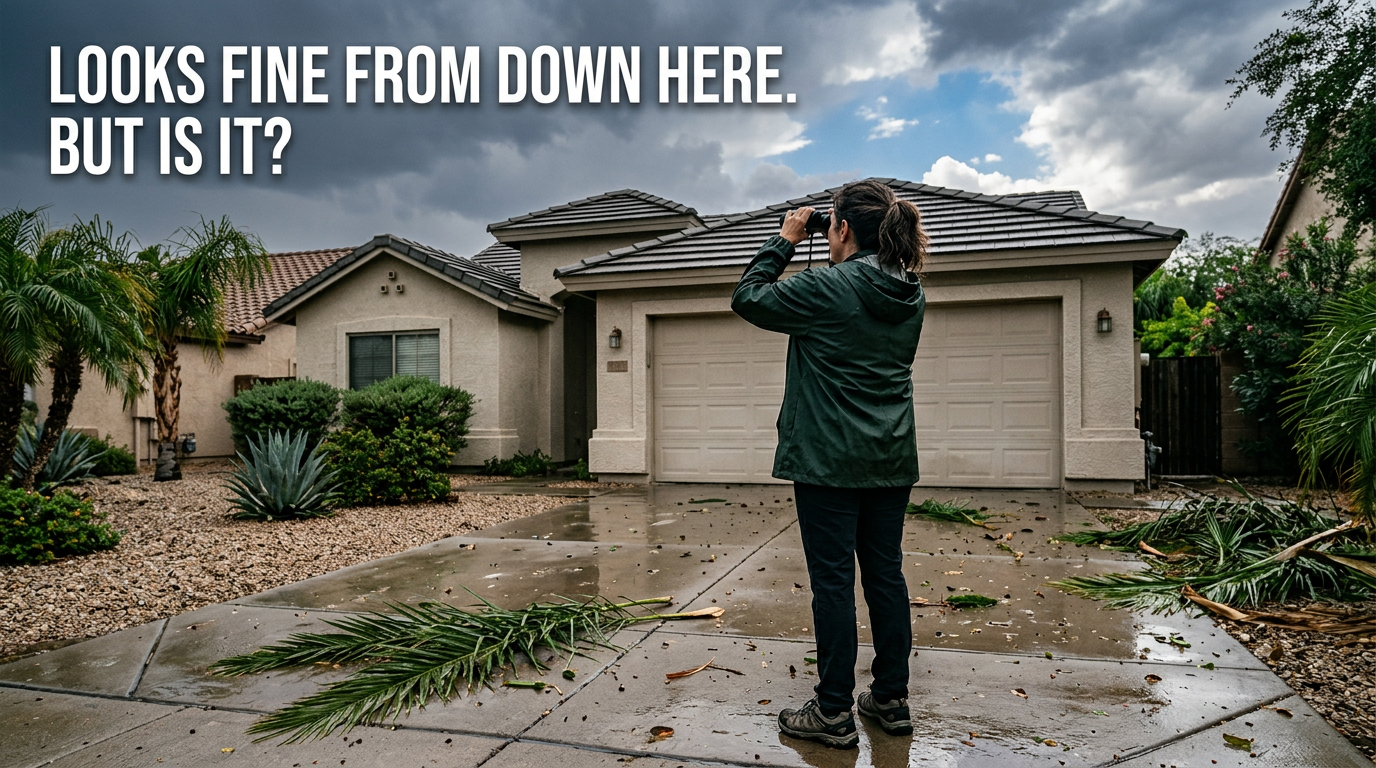
Most homeowners in Gilbert and Chandler step outside after a July storm, look up at their roof, and think: fine. No missing tiles. Nothing obvious. Good. And that's exactly where the problem starts. The worst monsoon damage doesn't announce itself. It hides under tiles that still look seated, in flashing that moved just enough to crack a seal, in underlayment that soaked through three storms back and never dried correctly. That ceiling stain you'll notice in October? Your roof was already compromised in July.
This is the damage profile we see on East Valley roofs every season. Most of it was preventable.
The Damage You Cannot See From the Driveway
East Valley monsoons aren't just heavy rain. The microbursts and haboobs that push through Gilbert, Mesa, and Queen Creek force rain sideways at gusts that can exceed 60 mph. That's not vertical rain landing on a flat surface. That's horizontal water pressure finding every gap, every thin spot, every place your roof's defenses were already close to failing. The storm doesn't create weakness. It finds what was already there.
Four types of damage show up consistently after a significant East Valley monsoon. All four hide well. All four are the kind of thing that gets dismissed until the ceiling stains.
Lifted underlayment. Wind creates uplift at tile and shingle edges. The tile drops back down after the storm and looks undisturbed. But the underlayment beneath it got wet, lifted, and didn't reseat cleanly. On a concrete tile roof, which is most homes in Gilbert and Chandler, the underlayment is your actual waterproof layer. The tile handles UV and sheds surface rain. The membrane underneath keeps the water out of the house. When that membrane fails, you have a leaking roof that looks completely intact from the driveway.
Hairline tile cracks. Hail impact and debris strike crack concrete and clay tiles without shattering them. You can't see the crack from the ground. It won't leak the week it forms. Months later, after Phoenix UV and daily heat cycling have worked on it, that crack opens. Then it leaks. We've seen hairline cracks form in August and produce their first interior water damage the following January.
Displaced flashing. The metal sealing your chimney, skylights, HVAC curb, and valley transitions doesn't have to fly off to fail. A few millimeters of movement from microburst wind cracks the caulk seal. Metal returns to position. Looks right. The seal is gone.
Slow-developing leaks. Water gets in during a July storm and travels along framing and decking for weeks before it shows anywhere inside. By the time a stain appears, the attic system has been wet for months.
Lifted and Cracked Underlayment After Wind-Driven Rain
The underlayment is what keeps the house dry. Not the tile. Not the shingle. What's underneath both of those.
A lot of Gilbert and Queen Creek homes built between 2000 and 2015 are now 20-plus years into the underlayment's life. We think this is one of the more important things East Valley homeowners don't know: Phoenix UV is genuinely harder on roofing membranes than most climates. We're talking about sustained heat above 110°F for months at a stretch, combined with the thermal cycling that happens when the temperature swings dramatically after a monsoon event. Two decades of that makes any roofing membrane more brittle. Not necessarily failed. But with much less tolerance for the kind of horizontal water pressure that comes with a serious storm.
Before a leak shows up, the damage looks like nothing. Tiles in place. No water inside. But in the attic, there's already damp insulation and moisture marks on the framing. That's what we find when we do a post-storm inspection. That's what turns a small underlayment repair into something manageable. Without the inspection, you find out about it when the ceiling shows up with a brown ring in October.
Displaced Tiles and Flashing That Still Look Seated
This one surprises homeowners most, and honestly it should surprise more people than it does.
During strong monsoon wind events, the mechanical fasteners anchoring concrete field tiles to the decking can shear from the uplift force. The tile drops back into its resting position. From the driveway, from a drone, from a ladder right next to it, it looks fine. It is not attached to the deck. The next storm starts the process of working it further. Eventually it cracks, slips, or fully dislodges.
Ridge cap is the most consistent early failure point on East Valley tile roofs during significant wind events. It sits at the highest elevation, takes the most direct exposure, and is the hardest to evaluate from the ground. We find displaced or cracked ridge cap on homes where the rest of the field tile held fine. It goes first, consistently. If someone tells you the tiles all look good after a storm, ask specifically about the ridge cap.
Flashing is the same story. A microburst shifts the metal sealing your chimney, skylights, HVAC curbs, and valley transitions by a few millimeters. Caulk cracks. Metal returns to position. Looks untouched. Water enters sideways during the next event.
Slow Leaks: The Ceiling Stain That Shows Up in October
Every fall, we hear the same thing from East Valley homeowners. "Nothing looked wrong after the storm. Then in October a stain appeared. Out of nowhere."
It was never out of nowhere. The roof got hit in July. Water worked along the decking and framing, moving slowly toward the ceiling. Here's the part people don't think about: Arizona's summer attic heat is high enough that moisture entering the system partially evaporates before it can soak through to the ceiling. So it doesn't show up right away. But it's not gone. It's sitting in the insulation, in the sheathing, in the wood framing. When October arrives and the attic starts cooling down, that trapped moisture finally finds its way through.
By that point, two to three months of water cycling through the attic has already happened. The repair is bigger than it had to be. Every time.
Ground-Level Signs You Can Check Yourself
These checks take about 15 minutes. Worth doing after any storm that brought real wind.
Granules in the gutters. If you have a shingle roof, look at your gutters or the splash zone at the bottom of your downspouts. Normal wear produces some granule loss over time. A heavy deposit showing up after a single storm event means the surface took meaningful impact.
Uneven tile lines. Binoculars from the driveway. Tile rows should run in straight, consistent horizontal lines. If any section looks lifted at one end, bowed, or inconsistent, that's a flag worth acting on.
Debris on the roof surface. Anything left up there after the storm, branches, palm fronds, debris blown in from a haboob, traps moisture and accelerates surface breakdown. It needs to come off.
New sounds. Loose tile and displaced flashing rattle when wind moves them. If your roof started making sounds it wasn't making before the last storm, something shifted.
Attic check. Pull the hatch within a few days of any significant storm. Bring a flashlight. New water marks on rafters, damp or discolored insulation, any trace of mildew smell. Those are the real-time indicators that water found a path in.
When to Get a Post-Storm Inspection and Why Timing Matters for Insurance
Our recommendation: within 7 to 14 days of any significant monsoon event. Not October.
Two reasons. First, damage compounds. A tile that shifted July 15th absorbs water from the July 22nd storm. And the August 3rd storm. What starts as a simple flashing repair or underlayment patch becomes a larger job with each event that adds to it.
Second, insurance documentation only gets harder with time. Arizona policies generally require prompt notification after a covered loss, and many require proof of loss within 60 days. You should check your specific policy for its actual deadline and contact your insurer directly if you suspect damage. The practical problem is that a delayed inspection makes it difficult to connect damage to a specific storm event. Calling in October about a July storm means asking an adjuster to approve an undocumented claim that's three months old. That's a harder conversation than it needs to be.
Our inspection produces written documentation and photos your carrier can use directly. We photograph every issue we find, every detail at every flashing point. If you do have damage worth claiming, that documentation makes the process simpler.
Free Post-Monsoon Damage Inspection in the East Valley
We're based in Gilbert. If you're in Gilbert, Chandler, Mesa, or Queen Creek and had a significant storm come through recently, we'll come out and take a real look. No cost. No sales pitch. No obligation.
We get on the roof, check the underlayment condition, inspect every flashing detail, walk the full ridge, and tell you exactly what we found. Including the things that aren't urgent. If the roof held through the storm and everything is fine, that's the answer you get.
If you want someone to actually get up there and look rather than guess from the driveway, give us a call. We can usually get out within a week. Free inspection, no hard sell. AZ ROC #345156.
About Tuuta Pulotu
Tuuta Pulotu is the CEO and co-founder of All Storm Roofing + Construction. He was born and raised in Arizona. His mom is from Hawaii, his dad from Tonga, and Tuuta grew up in the trades working alongside his father, who's been running a landscaping and masonry crew in the Valley for over thirty years.
Before founding All Storm in 2021, Tuuta spent years in solar sales. Long enough to watch too many East Valley homeowners get pushed into roof decisions they didn't fully understand. He started All Storm to flip that conversation: be the contractor who tells homeowners what's actually going on with their roof, even when the truth costs him the job.
He runs All Storm out of Gilbert, where he lives with his wife and four kids.
AZ ROC #345156. Tamko Diamond Certified. The only Tamko Diamond Certified roofing contractor in Arizona.
WRITTEN BY
Tuuta Pulotu is the CEO and co-founder of All Storm Roofing + Construction. He was born and raised in Arizona. His mom is from Hawaii, his dad from Tonga, and Tuuta grew up in the trades working alongside his father, who's been running a landscaping and masonry crew in the Valley for over thirty years. Before founding All Storm in 2021, Tuuta spent years in solar sales. Long enough to watch too many East Valley homeowners get pushed into roof decisions they didn't fully understand. He started All Storm to flip that conversation: be the contractor who tells homeowners what's actually going on with their roof, even when the truth costs him the job. He runs All Storm out of Gilbert, where he lives with his wife and four kids. AZ ROC #345156. Tamko Diamond Certified. The only Tamko Diamond Certified roofing contractor in Arizona.
Worried about your roof?
Get a free, no-pressure inspection from a Gilbert team that gives honest answers — not pressure to replace.
Schedule Free Inspection