Does Homeowners Insurance Cover Monsoon Roof Damage in Arizona?
→ QUICK ANSWER
Monsoon roof damage is usually covered by Arizona homeowners insurance. But insurers routinely deny claims they can blame on age, wear, or deferred maintenance. Here is what actually gets paid

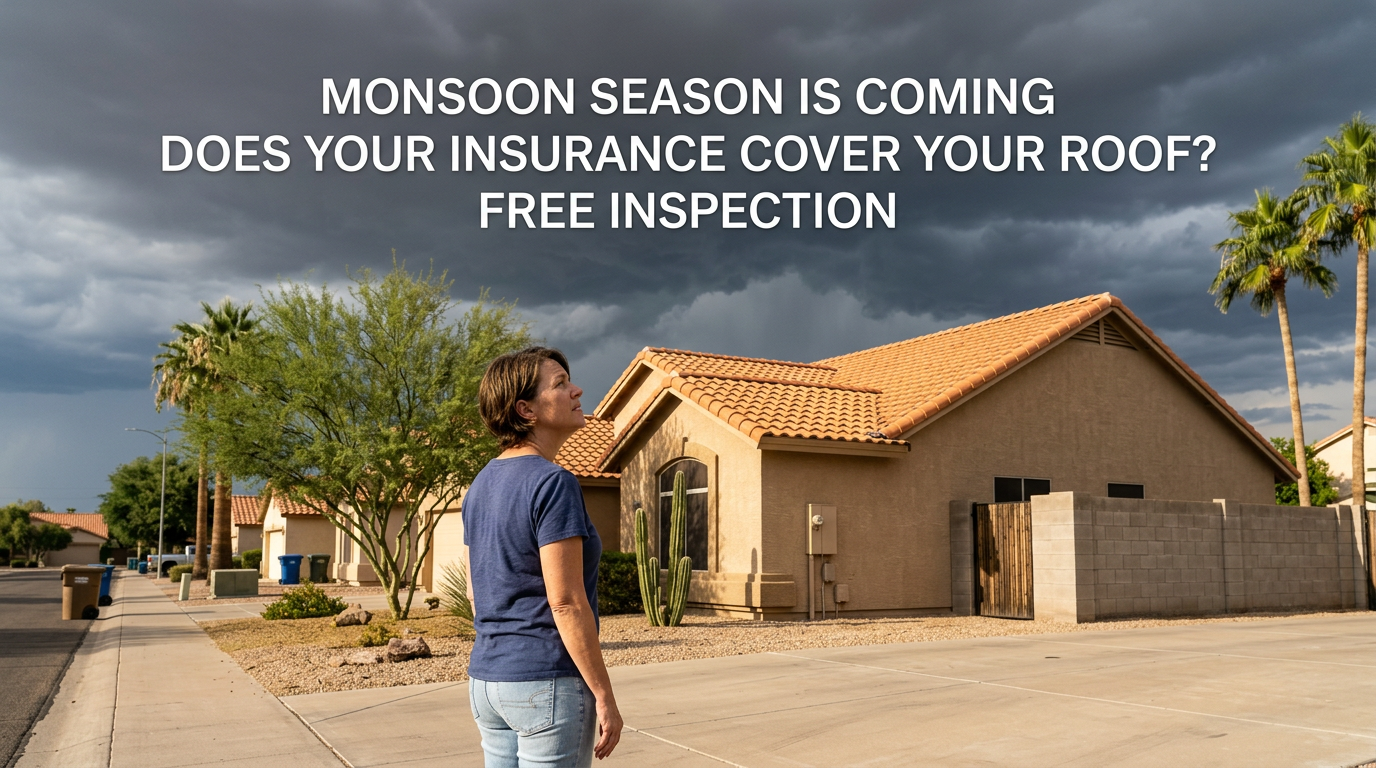
Short answer: Monsoon roof damage is usually covered when it's sudden and storm-caused, like microbursts exceeding 60 mph or hail cracking tile. East Valley insurers deny claims tied to age or gradual deterioration. Depreciation under an ACV policy can reduce a $20,000 settlement to $12,000 or less. All Storm Roofing is licensed Arizona ROC #345156 and Tamko Diamond Certified.
What Is Covered: Wind, Hail, and Sudden Storm Damage
Short answer: yes, monsoon roof damage is usually covered. But "usually" is doing a lot of work in that sentence. Insurers cover what's sudden and storm-caused. They deny what they can pin on age, neglect, or something that was already wrong before the storm hit.
Most Arizona homeowners carry an HO-3 policy. That policy covers sudden, accidental damage from named perils. Wind and hail are named perils. So when a July microburst rips ridge cap off a Gilbert home or hail cracks concrete tile on a Chandler roof, that's exactly what the policy is designed to pay for.
Monsoon season runs June through September out here. In that window, we see microbursts that push gusts past 60 mph, hail that cracks tile and bruises asphalt shingles, and debris that punches through underlayment. All of that is sudden. All of it is event-based. That's what gets covered.
Rain that gets in because wind created an opening is also typically covered. The test is causation: did the storm create the entry point, or was water already getting in through a roof that had been failing for years?
What Is Not Covered: Age, Wear, and Deferred Maintenance
Here's where claims fall apart. Insurers don't sell maintenance plans. They sell protection against sudden events.
If your 3-tab shingles are 18 years old and granules have been washing into your gutters since the Obama administration, that's not storm damage. That's a roof at end of life. An adjuster will see it that way too. Cracked tiles that look like they've been cracked for years, sealant around pipe boots that dried out long before last Tuesday's storm, flashing that was never replaced when you bought the house. Carriers look at that and write "gradual deterioration" on the denial.
The other category is flood. Standard homeowners policies don't cover flooding. If monsoon rain pools in your yard, backs up through a low-lying entry point, and floods your interior, that's a separate coverage. Most East Valley homeowners don't carry flood insurance. That gap catches people off guard every summer.
Why Arizona Roof Claims Get Denied and How to Avoid It
We walk roofs in Gilbert, Chandler, Mesa, and Queen Creek every week. The pattern on denied claims is consistent. It's almost never about what the storm did. It's about what the roof looked like before the storm.
Age is the most common denial trigger. Insurers can use your roof's age to argue that any failure was inevitable, not storm-caused. A 22-year-old shingle roof that leaks after monsoon will get scrutinized hard. If there's existing granule loss, lifted tabs, or cracked seals, the adjuster has ammunition.
Deferred maintenance is the second trigger. Cracked caulking around vents, gutters that haven't been cleaned, tiles left broken after a previous wind event. These give the carrier grounds to reduce your payout or deny outright. The argument is that neglect contributed to the damage.
The word you don't want to see on a denial letter is "gradual." Once an adjuster writes that the damage developed over time rather than from a specific storm, the claim is almost certainly dead.
What helps: know the approximate age and condition of your roof before monsoon season starts. If you've had it inspected in the last two to three years, you have a baseline. That baseline is what separates "storm damage" from "pre-existing condition" in the adjuster's file.
How to Document Roof Damage Before the Adjuster Arrives
Do this before you call your insurer. Before you tarp anything. Walk the perimeter and photograph everything you can see from the ground. Note the date and time. If you can access local weather data showing wind speeds or hail reports for that specific day, save it.
Then get a roofer up there. Not your brother-in-law. A licensed contractor who understands what adjusters are actually looking for. The difference between a homeowner's phone photos and a professional inspection report is often the difference between approval and denial.
Temporary repairs are fine and usually covered. Tarping is fine. Permanent repairs before the adjuster inspects can complicate your claim, so hold off on those.
Keep records of everything. Call times, names of people you spoke with, what was agreed to. Follow phone calls with a quick email confirming what was discussed. That paper trail matters if the claim goes sideways.
One more thing: file promptly. Under Arizona's Unfair Claim Settlement Practices rules (A.A.C. R20-6-801, the regulation behind A.R.S. §20-461), insurers must acknowledge your claim within 10 working days and affirm or deny it within 15 working days of receiving proof of loss. But policies also have their own filing windows. Miss that window and the carrier may deny on timeliness alone.
Actual Cash Value vs Replacement Cost: The Deductible Trap
This is the part most homeowners skip until they see the settlement check.
Your policy pays for your roof one of two ways. Replacement Cost Value (RCV) means the insurer pays what it actually costs to replace the damaged roof with comparable new materials, minus your deductible. Actual Cash Value (ACV) means they pay what the roof was worth at the time of the storm, after depreciation.
That gap is real. Take a 12-year-old asphalt roof. Under RCV, if replacement costs $20,000, you get $20,000 minus your deductible. Under ACV, the insurer applies a depreciation schedule. Depending on the schedule, that same $20,000 roof might net you $12,000 or less before your deductible. You cover the rest.
Arizona doesn't require insurers to use RCV. Many are adding ACV endorsements specifically to roofing components in East Valley zip codes that see above-normal hail and monsoon exposure. It can happen at renewal without much fanfare.
Check your declarations page. Look for "ACV endorsement" on roofing. If you don't see it clearly spelled out, ask your agent directly whether your roof is covered on a replacement cost or actual cash value basis.
The deductible structure is a separate issue. Many Arizona policies now carry wind and hail deductibles calculated as a percentage of your home's insured value, typically 1 to 2 percent. On a home insured at $400,000, that's $4,000 to $8,000 out of pocket before coverage kicks in. That's on top of any depreciation gap under ACV.
When to Get an Independent Inspection First
There's a sequence issue that catches a lot of homeowners: they find a problem after a storm, call their insurer, and file a claim without anyone actually getting on the roof first.
If that claim gets denied, it still shows up on your CLUE report. CLUE is the database carriers use to check your claims history when you shop for coverage. A denial on record can affect your premiums or your ability to switch carriers for years.
Get a roofer up there first. A good contractor will tell you whether the damage looks like something a carrier is likely to cover, or whether you're looking at maintenance issues that will get denied. That fifteen minutes on the roof can save you from a claim that follows you for five to seven years.
If the damage is real and coverable, have that roofer document it before you file. If the adjuster's assessment comes in low, you're in a much stronger position to push back with a professional inspection report in hand. Adjusters miss things. Underlayment damage, flashing failures, compromised decking. A second opinion costs nothing and can add thousands to a supplement.
Free Pre-Claim Roof Inspection in the East Valley
We do free inspections across Gilbert, Chandler, Mesa, and Queen Creek. If you've had a storm come through and you're not sure what's up there, we'll send someone out to take a real look.
We're not going to hand you a scare-tactics damage estimate and push you to file. We'll tell you what we see: what looks storm-related, what looks like wear, and whether we think a claim makes sense. If it does, we can document it properly from the start.
If you're in the East Valley and want a second opinion before you call your insurer, we can be out within the week. No pressure, no sales pitch. AZ ROC #345156.
Tuuta Pulotu is the CEO and co-founder of All Storm Roofing + Construction. He was born and raised in Arizona. His mom is from Hawaii, his dad from Tonga, and Tuuta grew up in the trades working alongside his father, who's been running a landscaping and masonry crew in the Valley for over thirty years.
Before founding All Storm in 2021, Tuuta spent years in solar sales. Long enough to watch too many East Valley homeowners get pushed into roof decisions they didn't fully understand. He started All Storm to flip that conversation: be the contractor who tells homeowners what's actually going on with their roof, even when the truth costs him the job.
He runs All Storm out of Gilbert, where he lives with his wife and four kids.
AZ ROC #345156. Tamko Diamond Certified. The only Tamko Diamond Certified roofing contractor in Arizona.
WRITTEN BY
Tuuta Pulotu is the CEO and co-founder of All Storm Roofing + Construction. He was born and raised in Arizona. His mom is from Hawaii, his dad from Tonga, and Tuuta grew up in the trades working alongside his father, who's been running a landscaping and masonry crew in the Valley for over thirty years. Before founding All Storm in 2021, Tuuta spent years in solar sales. Long enough to watch too many East Valley homeowners get pushed into roof decisions they didn't fully understand. He started All Storm to flip that conversation: be the contractor who tells homeowners what's actually going on with their roof, even when the truth costs him the job. He runs All Storm out of Gilbert, where he lives with his wife and four kids. AZ ROC #345156. Tamko Diamond Certified. The only Tamko Diamond Certified roofing contractor in Arizona.
Worried about your roof?
Get a free, no-pressure inspection from a Gilbert team that gives honest answers — not pressure to replace.
Schedule Free Inspection