How to Choose a Roofing Contractor in Gilbert AZ: 6 Questions That Actually Matter
→ QUICK ANSWER
Hiring a roofer in Gilbert? Before you sign anything, ask these six questions. They separate real local contractors from storm chasers and cut-rate operators

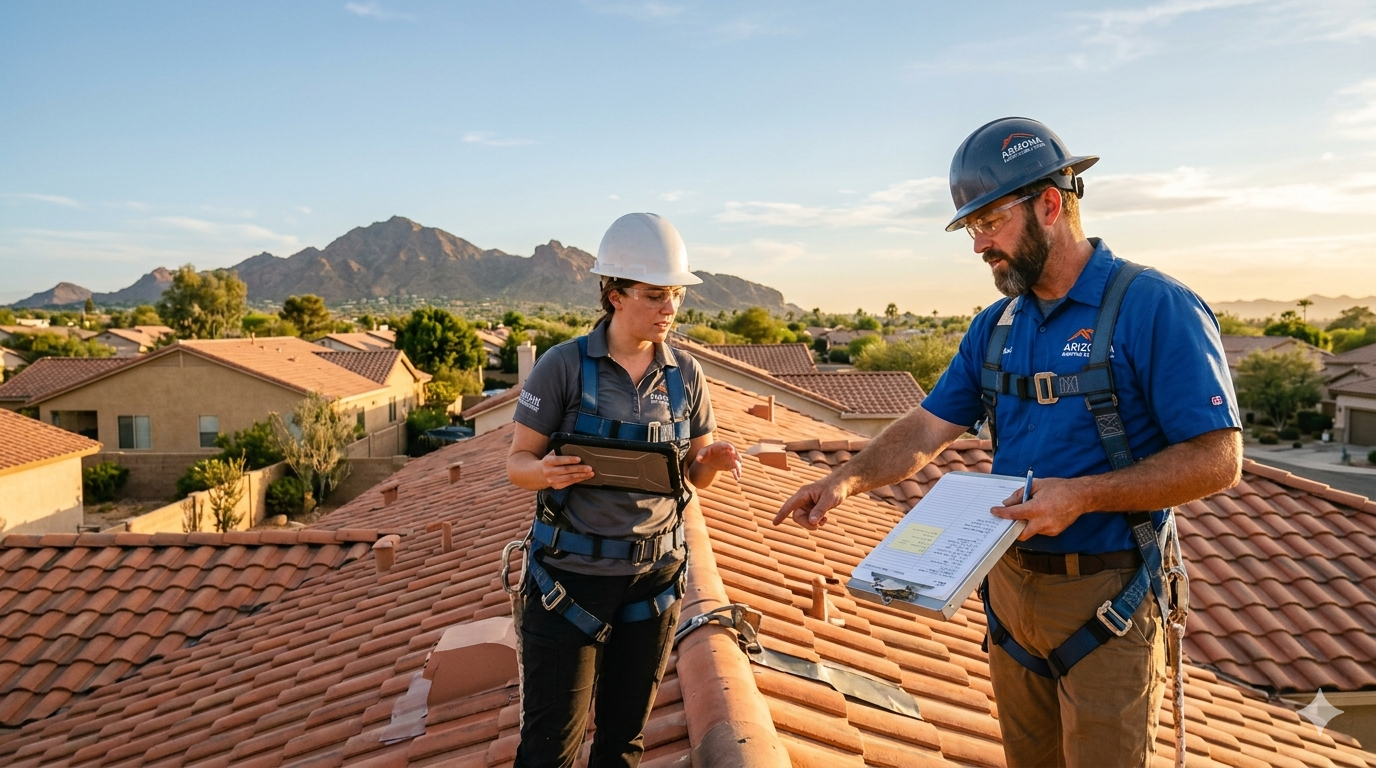
So you need a roofer. Maybe a storm just rolled through and there are tiles missing off the south pitch. Maybe you got a knock on the door from a crew you've never heard of offering a "free inspection." Maybe your home is fifteen years old and you figured it was time.
Here's the short answer: in Gilbert, the difference between a contractor you can trust and one who'll take your money and leave you with a roof that fails in the first monsoon is not obvious from a logo or a truck wrap. It's in the answers to six specific questions. Ask them before you sign anything.
Before you sign anything with a Gilbert roofer, ask these 6 questions.
Most homeowners do the same thing when they're vetting a contractor: they get a couple of bids, compare the numbers, and pick the middle one. We understand that instinct. But price is not the variable that predicts a good outcome. The questions below are.
Question 1: Can I look up your ROC license number right now?
Every roofing contractor working legally in Arizona holds a residential roofing license (classification R42) through the Arizona Registrar of Contractors. That's the classification specifically for roofing work on homes. To earn it, the qualifying party behind the business has to have at least four years of verifiable trade experience and pass two separate exams: one on Arizona contracting law, one on the technical side of roofing.
The license number should be on every bid, every contract, every truck. If a contractor hesitates when you ask for it, that's your answer.
Here's what you do with the number: go to roc.az.gov and look it up yourself. Takes two minutes. You'll see whether the license is active, what classification it covers, and whether any complaints have been filed. The ROC also shows you who the qualifying party is. That matters because if that person left the company, the license can become invalid. Worth confirming the name on the ROC record still works for the company you're talking to.
There's another protection baked into Arizona law worth knowing about: the Residential Contractors' Recovery Fund. If a licensed contractor does bad work and won't fix it, homeowners can potentially recover up to $30,000 through the ROC. That protection disappears entirely if you hired someone without a valid license. An unlicensed crew, whatever they charge, carries zero of that safety net.
Question 2: Are you based in the East Valley, or are you here because of the storm?
After a significant hail event or haboob, Gilbert gets visited by roofing crews from places like Texas, Oklahoma, and Florida. Storm chasers. They show up fast, often with professional trucks and printed materials, and they're gone just as fast once the work is signed.
That's not automatically a disqualifier. Some out of state crews do solid work. But there are real risks.
A contractor without local roots has no reason to stand behind a warranty claim when you call two years from now during a monsoon at 2 a.m. They may not know local building code quirks in Gilbert and Maricopa County. They may not have relationships with Gilbert permit offices. And if something goes wrong, you have almost no practical leverage.
Ask where they're based. Ask how long they've been operating in the Valley. Ask for references from jobs in Gilbert or Chandler, not jobs in Tennessee. A contractor who's been doing roofs in the East Valley for several years has real skin in the local reputation game. That's what you want.
Question 3: What manufacturer certifications do you hold, and what do those actually mean?
This question trips up a lot of homeowners because the answers sound impressive without meaning much. There are dozens of manufacturer programs. Some require real vetting. Others are essentially a sales volume threshold.
The one worth understanding for our part of the country is the Tamko Diamond Certified designation. Tamko Diamond Certified is the highest tier in Tamko's contractor program. To reach it, a contractor has to go through a background check, prove proper licensing and insurance, pass a product knowledge test, and provide homeowner references. Installations can be randomly inspected to confirm the work was done to spec. It's not something you get for placing a big order.
Why does it matter to you as a homeowner? Two reasons.
First, a Tamko Diamond Certified contractor can offer enhanced warranty options that standard contractors simply can't access. Coverage backed by the manufacturer that protects you beyond what most roofers can offer. The kind of warranty that's still standing behind your roof when a problem shows up years later.
Second, the Diamond Certified designation covers the full system, not just the shingles. Underlayment, flashing, ridge cap: all of it has to be installed to Tamko's spec. A manufacturer won't back workmanship on materials that weren't installed correctly. So having that certification on the line actually creates accountability.
All Storm is the only Tamko Diamond Certified roofing contractor in Arizona. We say that not to brag. We say it because if you're comparing contractors and manufacturer certification is one of your comparison points, you should know what you're actually comparing.
Question 4: Can you show me your last 3 jobs in Gilbert or Chandler?
References matter. But most homeowners ask for references in the abstract and then never call them. Change the ask. Make it specific.
"Can you show me three jobs you've done in Gilbert or Chandler in the last twelve months? And can I have the homeowners' contact info?"
A contractor with a real local track record will have this ready. One who's new to the market or who churns through jobs without follow up will stall.
When you call the references, ask two questions beyond the obvious. Ask: "Did anything come up after the job was done, and how did they handle it?" And ask: "Would you use them again?" The second question is really the whole thing. People are polite about describing the work. They're honest about whether they'd repeat the experience.
You can also search the contractor's ROC record for any workmanship complaints. A couple of complaints on a long record isn't necessarily disqualifying. Busy contractors get complaints. What you're looking for is a pattern, or complaints that were never resolved.
Question 5: What does your warranty actually cover when something goes wrong at 2 a.m. during a monsoon?
Roofing warranties are confusing on purpose. There's the materials warranty from the manufacturer. There's the workmanship warranty from the contractor. They cover different things, they have different durations, and they have different processes for making a claim.
The most common frustration we hear from homeowners who had work done elsewhere: they had a leak, called the contractor, got told the leak was a workmanship issue, then called the manufacturer, got told the shingles were installed wrong and the materials warranty was voided. Nobody covered them.
That scenario exists because most workmanship warranties are short. Sometimes as little as one to two years. And the contractor can be out of business or simply unresponsive when the problem shows up.
Here's what to ask: how long is your workmanship warranty? What specifically does it cover? If something goes wrong during a monsoon at 2 a.m., who do I call and what happens? If the answer is vague, that tells you something.
Tamko Diamond Certified contractors can offer workmanship coverage backed by the manufacturer for up to 25 years, depending on the system installed. That's the manufacturer standing behind the installation, not just the shingles. A different category of protection than what most contractors can offer.
Question 6: Why is your bid so much lower than the other guys?
This is the question most homeowners are afraid to ask. They think it'll be awkward. Ask it anyway.
There are legitimate reasons a bid comes in lower. The contractor may have better supplier pricing. They may have lower overhead because they're a smaller crew. They may be bidding a leaner scope.
But some bids are low because something is being left out. Cheap or mismatched underlayment. No ice and water shield on the valleys. Minimal flashing work. Labor from crews who are paid less because they have less experience. The finished roof can look identical for the first six months. Then you get a monsoon.
When you ask the question, a good contractor will explain exactly where the cost difference is. They won't get defensive. If someone gets defensive or dismissive when you ask why they're cheaper, that's a real flag.
Get at least three bids. Compare the scope line by line, not just the number at the bottom.
What most Gilbert homeowners get wrong about hiring a roofer
The myth is that the right question is "who has the best reviews?" Reviews matter. But a high star rating on Google doesn't tell you whether the contractor carries an active residential roofing license, whether they're actually based in Maricopa County, or whether their warranty is worth reading. A lot of contractors with great ratings after a storm event have left the market entirely two years later.
The real question is: who is still going to be here in five years, actually reachable, actually accountable for the roof they put on your house?
For East Valley homes, that means asking about local licensing and local references. It means understanding the difference between a manufacturer certification that carries real accountability versus a logo on a website. And it means reading the warranty before you sign, not after you have a leak.
Why Gilbert roofs are a different conversation than most markets
Phoenix area homes run heavy on concrete tile and foam SPF roofing. East Valley builders have been putting concrete tile on subdivisions in Gilbert, Chandler, and Queen Creek for decades. That matters because tile roofs behave differently than asphalt shingle roofs. They move in heat. They crack differently. The flashings around chimneys and skylights on a fifteen year old tile roof in Gilbert have been through heat cycling most roofers from other climates have never worked with.
The monsoon season also hits differently here. A haboob can deposit enough debris and moisture in a single night to expose every weak point in a roof system. Pre monsoon inspections, typically May through June, are standard practice for anyone who's been doing roofs in this market for any length of time. A contractor who doesn't know to ask when your last inspection was probably hasn't spent much time on East Valley roofs.
We're a Gilbert, AZ roofing company. We do free roof inspections across the East Valley, no sales pitch, no pressure. If you want someone to come out and give you an honest read on what's going on up there before monsoon season, reach out. AZ ROC #345156.
Tuuta Pulotu is the CEO and cofounder of All Storm Roofing + Construction. He was born and raised in Arizona. His mom is from Hawaii, his dad from Tonga, and Tuuta grew up in the trades working alongside his father, who's been running a landscaping and masonry crew in the Valley for over thirty years.
Before founding All Storm in 2021, Tuuta spent years in solar sales. Long enough to watch too many East Valley homeowners get pushed into roof decisions they didn't fully understand. He started All Storm to flip that conversation: be the contractor who tells homeowners what's actually going on with their roof, even when the truth costs him the job.
He runs All Storm out of Gilbert, where he lives with his wife and four kids.
AZ ROC #345156. Tamko Diamond Certified. The only Tamko Diamond Certified roofing contractor in Arizona.
WRITTEN BY
Tuuta Pulotu is the CEO and co-founder of All Storm Roofing + Construction. He was born and raised in Arizona. His mom is from Hawaii, his dad from Tonga, and Tuuta grew up in the trades working alongside his father, who's been running a landscaping and masonry crew in the Valley for over thirty years. Before founding All Storm in 2021, Tuuta spent years in solar sales. Long enough to watch too many East Valley homeowners get pushed into roof decisions they didn't fully understand. He started All Storm to flip that conversation: be the contractor who tells homeowners what's actually going on with their roof, even when the truth costs him the job. He runs All Storm out of Gilbert, where he lives with his wife and four kids. AZ ROC #345156. Tamko Diamond Certified. The only Tamko Diamond Certified roofing contractor in Arizona.
Worried about your roof?
Get a free, no-pressure inspection from a Gilbert team that gives honest answers — not pressure to replace.
Schedule Free Inspection