Pre-Monsoon Roof Inspection Checklist for East Valley Arizona Homeowners
→ QUICK ANSWER
Before the first haboob of July rolls through Gilbert or Chandler, your roof needs a real look. Here's the 7-point checklist our crew runs every spring.

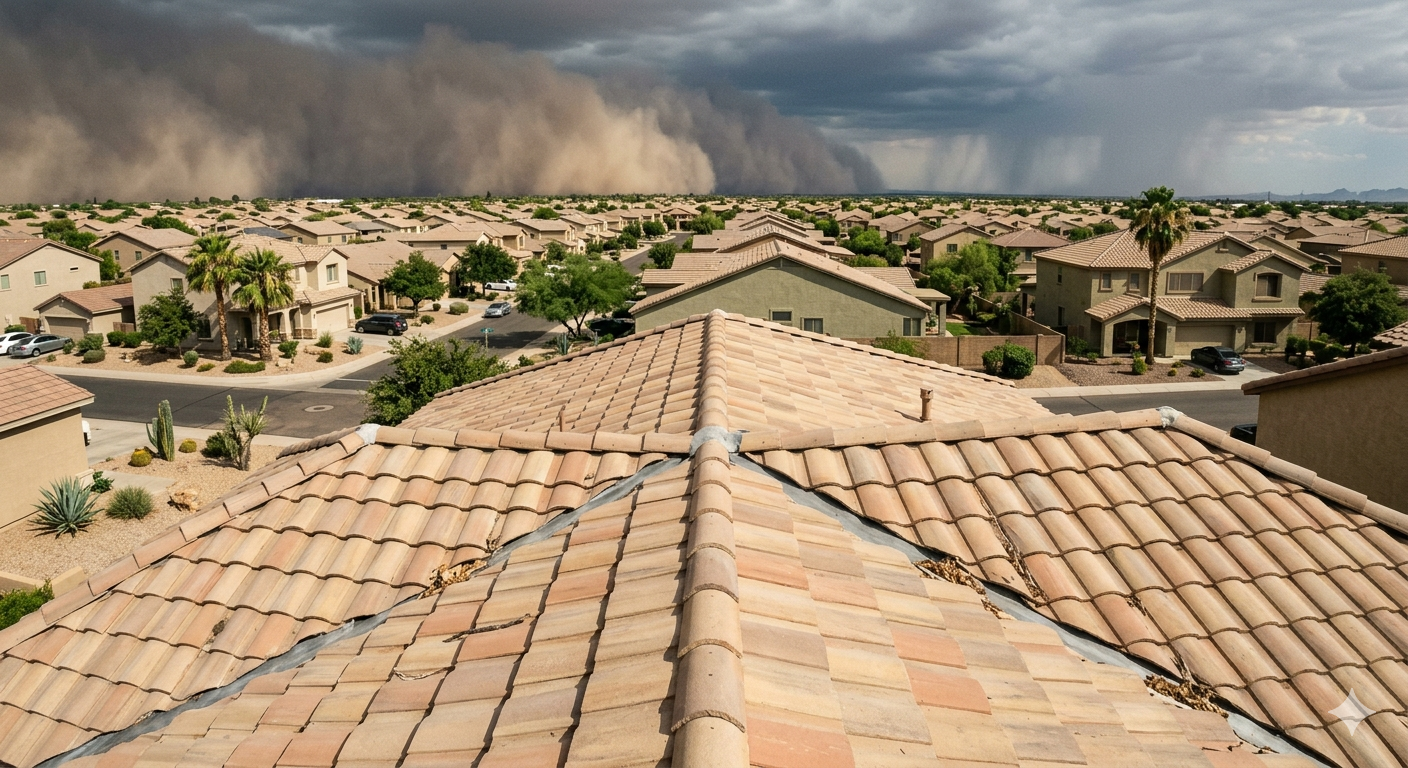
Is your East Valley roof actually ready for monsoon? Here's what to check right now.
Short answer: probably not as ready as you think. June 15 is the official start of monsoon season according to the National Weather Service, but the first real storms typically hit the East Valley in early July. That's not much runway. If you're in Gilbert, Chandler, Mesa, or Queen Creek and you haven't had someone on your roof since last fall, now is the time.
This is what our crew checks on every pre-monsoon inspection. We'll walk through tile, shingle, and foam roofs separately, because they fail in different ways. We'll also cover the one thing homeowners in Agritopia and Power Ranch miss most consistently — and it's not what most people expect.
Why pre-monsoon inspections in Gilbert are different from the rest of the country
A roofer in Cleveland or Charlotte checks for ice damage and moisture. We're checking for something completely different here.
By the time monsoon season hits, your East Valley roof has already survived months of 110°F-plus days. Roof surface temperatures regularly hit 160°F or higher in July. That kind of heat does specific things: it bakes out the oils in asphalt shingles, it dries and cracks the underlayment beneath your tile, and it chalks out the elastomeric coating on foam roofs. All of that happens before a single storm drop lands.
Then the monsoon shows up and does its thing. Microbursts pushing 60 mph. Haboobs that pack the sky wall-to-wall with dust. An inch of rain in a single hour — all landing on a roof that's been cooking for months. That's why small problems become big ones so fast here. A lifted tile in Phoenix weather isn't the same situation as a lifted tile in Portland.
So when we inspect an East Valley roof in May or June, we're not just looking for damage. We're looking for anything that heat already weakened and that a monsoon storm is going to finish off.
The 7-point checklist we run on every East Valley roof before July
1. Ridge cap and hip tiles. These are the highest-exposure tiles on the roof. Wind hits them first in a microburst. We check every ridge cap for cracks, loose mortar, and any signs of shift. One displaced ridge cap is a water entry point.
2. Flashing at penetrations. Skylights, AC units, plumbing vents, satellite mounts — every penetration is a potential leak point. We're looking at the sealant around each one. In the East Valley heat, that caulk cracks and pulls away faster than it would anywhere else. Worn rubber boots around vent pipes get replaced before the storms.
3. Gutters and downspouts. Monsoon rain doesn't come in gentle sheets here. It comes in hard and fast. We run a hose to confirm water moves from gutter to downspout to ground without pooling. Clogged gutters overflow onto fascia boards and into the soffit. That's expensive damage for a $30 fix.
4. Attic check for moisture signs. This one surprises homeowners. We go inside before we go outside. Dark staining on the decking, a musty smell, or damp insulation tells us the roof has already been compromised somewhere. If it's in there now, it's going to get worse in July.
5. South- and west-facing slopes on shingle roofs. These take the hardest UV hit all day. Granule loss in the gutters from these slopes is normal on older roofs, but if you're seeing bare patches or the shingles are curling at the edges, you've got a problem that won't survive monsoon wind.
6. Foam roof coating condition. If you have a flat or low-slope section with a foam SPF system, check the coating. A chalky white residue or visible yellowing of the foam itself means the protective layer is breaking down. A good coating should be reapplied every 5 to 10 years in Arizona's UV environment. If you're past that window heading into monsoon, that's a priority repair.
7. Tree branches within 6 feet of the roofline. A microburst turns a mesquite branch into a wrecking ball. We flag any limbs close enough to damage tiles or punch through shingles in a wind event. That trim job belongs in the pre-season list, not the post-storm list.
What we look for on tile roofs vs. shingle roofs vs. foam roofs
Concrete tile roofs are the most common in Chandler and Queen Creek. The tile itself is durable — concrete tile in Arizona typically lasts 40 to 50 years with proper care. But the tiles are not the waterproofing. The underlayment beneath them is. That felt or synthetic layer is doing all the real water work, and in Arizona's heat, it needs replacement every 15 to 20 years. The tiles can look perfect while the underlayment underneath is shot. We see this constantly on roofs in the 15- to 20-year range in Pecos Ranch and Seville.
On tile, we're lifting sections where we can access them and inspecting the underlayment directly. We're also checking for tile slippage — individual tiles that have shifted out of position are a wind entry point in a haboob.
Asphalt shingle roofs are common in parts of Mesa and Gilbert, particularly on homes built in the 1990s. Here's something a lot of homeowners don't know: a shingle marketed as a "25- to 30-year shingle" realistically lasts 15 to 25 years in Arizona's heat and UV environment. The sun bakes the granules off and makes the asphalt brittle faster than the warranty implies. We focus on the south- and west-facing slopes first, check for curling or cupping at the edges, and look at the ridge caps and eaves — those two spots fail first in high winds.
Foam SPF roofs are common on flat-roof sections and patio additions across the East Valley. They're great systems when properly maintained. The foam itself doesn't fail — the elastomeric coating on top does. Once that coating chalks out or cracks, UV starts destroying the foam directly, and that's an expensive repair. Every 5 to 10 years, that coating needs to be refreshed. We check for ponding water areas, blistering, and any exposed foam before clearing a foam roof as monsoon-ready.
The one thing homeowners in Agritopia and Power Ranch consistently miss
The underlayment conversation.
Homeowners in established communities like Agritopia in Gilbert and Power Ranch in Queen Creek often have tile roofs that look great from the street. The tiles are intact, no obvious damage, no interior leaks yet. But those roofs are 15 to 20 years old, which puts the underlayment right at or past its reliable service life.
Here's what most people don't know: the tile is not your waterproofing. The tile is basically armor. The underlayment beneath it is the actual barrier keeping rain out of your house. And in Arizona, where roof temperatures exceed 160°F and UV radiation seeps through the gaps between tiles, that underlayment ages from below and above at the same time.
We've been on roofs in Power Ranch where the homeowner hasn't had a single interior leak, lifted a section of tile, and found underlayment that crumbles in your hand. The tile protected it from the outside. The heat destroyed it from the inside. One good monsoon storm — the kind that drives rain sideways at 60 mph — would have turned that into a ceiling disaster.
The good news: you often don't need a full re-roof. If your tiles are still in good shape, we can remove them section by section, replace the underlayment, and reset the tiles. It's a much cheaper job than a full replacement. But you have to catch it before the storm, not after.
How to check your own roof safely from the ground
We're not encouraging anyone to get on their roof in Arizona heat, and especially not on tile. Concrete tile can crack under your weight, and dust-covered tile is genuinely slippery. But there's still useful information you can gather from the ground.
Stand back from each side of your house and look at the roof profile. Any visible sag or dip is a red flag. Look for tiles that are clearly out of alignment or cracked from below. Check your gutters after the next windstorm — granule buildup in the gutter from a shingle roof tells you the shingles are aging. Go into your attic on a bright day and kill the lights; if you see daylight coming through anywhere, you have a gap.
Check your ceilings and walls inside the house. Water staining, bubbled paint, or a faint musty smell in a room that never had a plumbing issue — those are interior signs your roof has already let moisture in somewhere.
None of that replaces someone actually getting on the roof, but it can tell you whether a professional inspection is urgent.
When a pre-monsoon inspection becomes an emergency repair
Most pre-monsoon inspections turn up minor stuff. Cracked caulk at a penetration, a few loose ridge caps, some granule loss. We note it, quote the repair, and you can decide what to address before July and what to monitor.
But some inspections turn into same-week jobs. Here's what pushes it to urgent:
Exposed underlayment visible without lifting tiles. That means the tile above it is already missing or broken enough that water has a direct path.
Attic moisture or mold. If the roof has already been leaking, the next storm won't be a small repair. It's a damage-compounding event.
Foam coating that's fully failed with exposed foam visible. A monsoon storm can drive water into the foam substrate at every seam and penetration.
Ridge caps loose enough to shift by hand. One microburst takes those off completely.
If any of those come up in an inspection, we don't recommend waiting. Schedule the repair before the season opens, not during it. Roofers in the East Valley get slammed in July and August. Scheduling time drops, costs go up, and you're waiting for repairs while water gets in.
Free inspection before the storms hit — no pressure, no upsell
We work across Gilbert, Chandler, Mesa, and Queen Creek. If you want a roofer who'll tell you what's actually going on up there — whether you need work or not — give us a call. We do free inspections, no sales pitch, no pressure. We'll put someone on your roof, walk you through what we found, and let you make the call.
AZ ROC #345156. We're based in Gilbert and we'd rather you know the truth about your roof before July.
(602) 806-6806
Tuuta Pulotu is the CEO and co-founder of All Storm Roofing + Construction. He was born and raised in Arizona. His mom is from Hawaii, his dad from Tonga, and Tuuta grew up in the trades working alongside his father, who's been running a landscaping and masonry crew in the Valley for over thirty years.
Before founding All Storm in 2021, Tuuta spent years in solar sales. Long enough to watch too many East Valley homeowners get pushed into roof decisions they didn't fully understand. He started All Storm to flip that conversation: be the contractor who tells homeowners what's actually going on with their roof, even when the truth costs him the job.
He runs All Storm out of Gilbert, where he lives with his wife and four kids.
AZ ROC #345156. Tamko Diamond Certified. The only Tamko Diamond Certified roofing contractor in Arizona.
WRITTEN BY
Tuuta Pulotu is the CEO and co-founder of All Storm Roofing + Construction. He was born and raised in Arizona. His mom is from Hawaii, his dad from Tonga, and Tuuta grew up in the trades working alongside his father, who's been running a landscaping and masonry crew in the Valley for over thirty years. Before founding All Storm in 2021, Tuuta spent years in solar sales. Long enough to watch too many East Valley homeowners get pushed into roof decisions they didn't fully understand. He started All Storm to flip that conversation: be the contractor who tells homeowners what's actually going on with their roof, even when the truth costs him the job. He runs All Storm out of Gilbert, where he lives with his wife and four kids. AZ ROC #345156. Tamko Diamond Certified. The only Tamko Diamond Certified roofing contractor in Arizona.
Worried about your roof?
Get a free, no-pressure inspection from a Gilbert team that gives honest answers — not pressure to replace.
Schedule Free Inspection