Roof Repair vs. Replace in Arizona: The Real Decision Framework
→ QUICK ANSWER
Should you repair or replace your Arizona roof? The answer comes down to three things: material type, age, and what actually failing. Here is the real decision framework roofers use in the East Valley

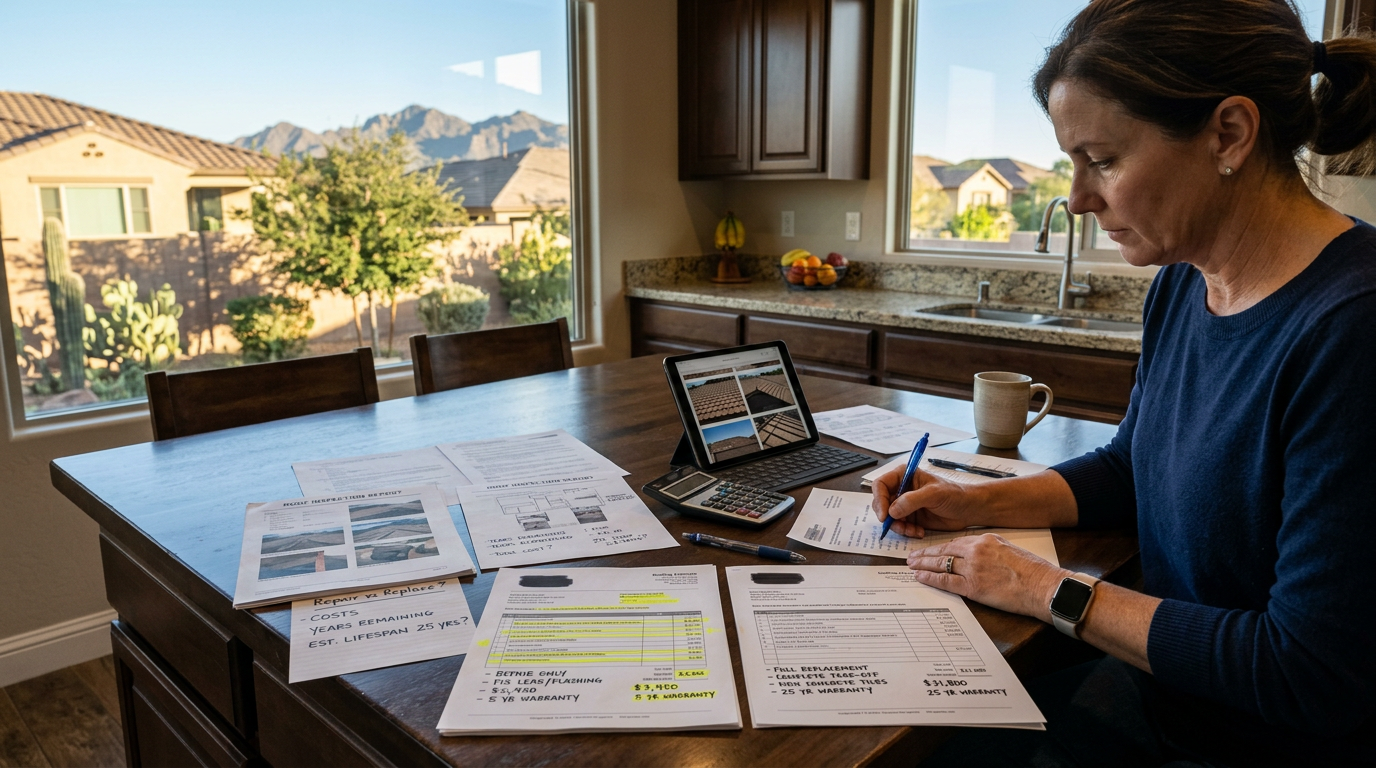
Somebody calls us every week with this exact question. Their tile leaked during a monsoon, or they got a quote that scared them, or a roofer told them they need a full replacement and they're not sure if that's true. The answer isn't complicated once you know the three variables that actually drive it: material type, age, and what is actually failing. The "it depends" answer most contractors give isn't wrong. It's just incomplete. Here's the complete version.
The honest decision framework: how roofers actually think about repair vs. replace
Two things matter before anything else: how much life is left in the roof, and whether the problem you're looking at is isolated or systemic.
A single cracked tile on a 12-year-old tile roof? Repair it. Same tile on a 28-year-old roof with underlayment that hasn't been touched since it was installed? That tile is not your problem. The underlayment is. Fixing the tile and ignoring the underlayment means you'll be calling someone back in six months with a new leak three feet away.
The other number that matters is the repair-to-replacement cost ratio. Most roofing professionals and insurance carriers use a threshold somewhere between 25% and 30%: if the repair quote is approaching that percentage of what a full replacement would cost, replacement is usually the smarter financial move. The logic is simple. You're already spending a big fraction of a new roof. The rest of the system is aging at the same rate. You're not buying five years of relief. You might be buying eight months.
That said, the percentage rule is a starting point, not a verdict. Material type changes everything. So does age. So does whether the damage is in the field of the roof or concentrated at flashings and penetrations.
Age and material: where you actually stand
Here's what we've seen across East Valley homes in Gilbert, Chandler, Mesa, and Queen Creek.
3-tab asphalt shingles: These are the thin, lightweight shingles common in older subdivisions built before the early 2000s. In Phoenix's UV environment, they typically run 15 to 20 years before the protective granules are gone and the asphalt mat is baking unprotected. If you're sitting on a 3-tab roof past year 15, you're in the repair-with-caution zone. Past year 18, you should be planning a replacement, not just patching.
Architectural (laminated) shingles: Thicker and more durable. You can reasonably expect 20 to 25 years in Arizona's climate, sometimes a bit longer with good attic ventilation. Repairs make strong sense under year 15. Past year 20, run the cost math before committing to anything beyond a targeted fix.
Concrete tile: The tile itself commonly lasts 40 to 50 years in Arizona. The underlayment does not. In hot desert conditions, underlayment typically runs 15 to 25 years depending on the product installed. This gap is the whole story with concrete tile roofs in the East Valley.
Foam (SPF) roofs: The foam substrate itself can last 30 to 50 years if the protective coating is maintained. The coating needs renewal every 5 to 10 years. Whether you recoat or replace depends on the condition of the foam itself. More on this below.
Clay tile: More durable than concrete, often lasting beyond 50 years. Underlayment failure is the same story, same timeline.
Asphalt shingles in Arizona: the 15-year crossover point
Let's be direct about this. A 3-tab shingle roof past 15 years in Gilbert or Chandler is getting close to the end. Arizona UV exposure accelerates granule loss and dries out the asphalt oils that keep shingles flexible. Thermal cycling, where the roof expands baking in summer heat and contracts at night, fatigues seal strips and loosens nail heads over thousands of cycles.
The visible sign is granule buildup in your gutters. When you're scooping dark sand out of your gutters regularly, your shingles are losing their sun protection. Once the granules are gone, the asphalt mat underneath cracks, and a monsoon wind event becomes a much bigger problem.
We tell homeowners this clearly: if your 3-tab shingle roof is past 15 years and you're getting a repair quote of a few thousand dollars, ask the roofer how much a full replacement would run. If the repair is creeping toward 25-30% of that number, you should seriously consider putting the repair money toward replacement instead. You're patching a system that's already in the back half of its life.
Architectural shingles give you more runway. But the principle is the same. Repair dollars invested in a roof that's five years from needing full replacement are expensive roof-life insurance.
Concrete tile in Arizona: when it's the underlayment, not the tile
This is probably the single most common misunderstanding we see in Gilbert and Chandler neighborhoods built in the 1990s and early 2000s.
Your concrete tile looks fine from the street. It's probably completely intact. But if your home is 20 or more years old and you got a leak during last year's monsoon season, there is a decent chance your underlayment is the problem, not your tile. The tile is designed to shed water, not waterproof. The underlayment under the tile is your actual barrier. In Arizona heat, that felt or early-generation synthetic underlayment has been cooking at temperatures that can exceed 160 to 180 degrees Fahrenheit beneath the tile. At 20 to 25 years, most of those older products are done.
Here's the good news: in many cases you don't need new tile. Roofers can lift the existing tile carefully, remove and replace the underlayment, reset the tiles, and install new flashings. That's called a re-underlayment or a "re-felt" job. It costs less than a full replacement. It uses your existing tile. And it buys you another 15 to 20 years of protection if done with quality synthetic underlayment.
When does tile replacement make sense? When the tiles themselves are cracked, broken from impact, or a discontinued profile that can't be matched anymore. Also when the underlying deck has moisture damage from years of underlayment failure. In those cases you're already doing most of the labor and it makes sense to put new tile down rather than risk resetting tile over compromised decking.
The key question to ask any roofer quoting a tile roof: are you telling me I need new tile, or new underlayment? Those are very different jobs with very different price tags. A roofer who jumps straight to full tile replacement on a 22-year-old roof with intact tiles is worth a second opinion.
Foam roofs: recoat or replace
Foam roofs in Arizona are common on flat and low-slope sections of homes in Gilbert, Queen Creek, and older Mesa neighborhoods. They're good systems when maintained. The foam substrate itself can outlast almost anything. But the coating on top is the system's only protection from UV, and in Arizona that coating degrades.
Recoat if: The coating shows surface chalking or thinning, you're past your last recoat by more than five years, you have minor surface cracking that hasn't reached the foam beneath, and the foam beneath is firm and dry when you press on it.
Replace or do major repair if: You see yellow or orange foam showing through. That means the coating has failed completely and the foam itself is being degraded by UV. Spongy or wet foam when you press on it means moisture has gotten in. Once foam is saturated, recoating over it seals in the problem. You're looking at cutting out the damaged section or a full tear-off down to the deck. Standing water on the roof more than 48 hours after a storm is also a warning sign. It accelerates coating breakdown in those low spots.
We generally plan recoats every five to seven years on Arizona foam roofs because the UV load here is genuinely brutal. Some contractors say ten years is fine, and that may be true in northern Arizona, but in the East Valley that is often too long.
What percentage of repair cost triggers a replacement conversation?
The 30% threshold is where we start the conversation. If your repair quote is above 30% of what a full replacement would cost, replace. Below 20%, repair almost always wins financially. Between 20% and 30%, it comes down to age and how much life is left in the system.
One number that surprises homeowners: the average repair cost on a tile underlayment job can run 50 to 70% of a full replacement. That sounds alarming until you realize the tile is staying and you're not paying for new material, just labor and underlayment. That job is genuinely worth doing when your tile is in good shape. It's a different calculation than patching a field of failing shingles.
The other scenario that changes the math: if you've had multiple repairs in two or three years on the same roof, add up what you've spent. That cumulative number is relevant. A roof that needs a repair every season is a roof that's sending you a message.
Insurance claim situations: does the math change?
Yes, in a specific way. When insurance is covering storm damage, the replacement calculation shifts because the out-of-pocket cost to you changes. A full replacement funded by a claim at depreciated value is different math than out-of-pocket repair.
A few things worth knowing. If storm damage affects more than 25% of your roof surface, many insurance carriers and most applicable building code provisions will push toward full replacement rather than patchwork repairs. This is not a trick. It is a legitimate threshold tied to code compliance requirements when significant work is permitted.
Also worth knowing: your insurer will look at the age of the roof. On older roofs, they'll pay actual cash value rather than replacement cost, which means depreciation applies. On a 20-year-old shingle roof, the insurer's payment may cover far less than the replacement cost. Get the full breakdown from your carrier before assuming a claim makes replacement a no-brainer.
East Valley specifics: HOA requirements and tile matching in older subdivisions
This matters more in East Valley communities than most homeowners realize.
In Gilbert, Chandler, and Queen Creek planned neighborhoods, most HOAs require you to maintain the existing roof profile and color when replacing or repairing. If you want to switch from barrel tile to flat tile, or from a warm tan to a gray tone, you'll need HOA approval first. That's not a hard process in most communities, but skipping it and having to undo finished work is costly.
The harder problem is tile matching. Concrete tile profiles get discontinued. A subdivision built in 1998 used a specific barrel tile from a manufacturer that may have stopped making that exact product. When 12 tiles crack or break, finding a close match versus an exact match matters for HOA compliance and for the appearance of the repair. On older subdivisions in east Mesa or parts of south Gilbert, this is a real issue. Good roofers who work the East Valley regularly maintain tile inventory or have supplier relationships that help with this. Ask specifically before hiring anyone for a tile repair in a neighborhood built before 2005.
For homeowners considering solar installations, this is the moment to check your underlayment. Solar companies will send a crew onto your roof to install panels. That foot traffic on an aging tile roof with degraded underlayment can cause problems. Many solar installers in the East Valley are now recommending a roof assessment before installation, and the good ones won't proceed on a roof they know is marginal. If your roofer says your tile is fine but your solar installer is hesitant, trust the hesitancy and get a second roofing opinion.
What we actually tell homeowners who ask us this question
Here's the honest version. We lean toward repair in these situations: the roof is under 15 years old, the problem is isolated to one slope or one flashing, you have concrete tile with intact tiles and failing underlayment, and the repair cost is well below 25% of replacement value.
We lean toward replacement in these situations: you're past 18 years on 3-tab shingles with granule loss across multiple slopes, you've had two or more repairs in three years on the same roof, the deck has moisture damage showing in the attic, or you're in the back quarter of the roof's expected life and the damage is not isolated.
We tell homeowners to pause and do the math on: tile roofs with intact tile but failed underlayment (re-felt is often the right answer, not full replacement), any roof where a contractor is jumping straight to full replacement without explaining exactly why the tile or shingles need to be replaced rather than the underlayment, and any claim situation where the insurer is paying actual cash value on an older roof.
The question isn't "repair or replace." It's "what is actually failing and how much life is left in what's not failing."
If you're in the East Valley and want someone to look at your roof and give you a straight answer, we do free inspections across Gilbert, Chandler, Mesa, and Queen Creek. No pressure, no sales pitch. If you need a repair, we'll tell you. If you need a replacement, we'll explain exactly why.
Tuuta Pulotu is the CEO and co-founder of All Storm Roofing + Construction. He was born and raised in Arizona. His mom is from Hawaii, his dad from Tonga, and Tuuta grew up in the trades working alongside his father, who's been running a landscaping and masonry crew in the Valley for over thirty years.
Before founding All Storm in 2021, Tuuta spent years in solar sales. Long enough to watch too many East Valley homeowners get pushed into roof decisions they didn't fully understand. He started All Storm to flip that conversation: be the contractor who tells homeowners what's actually going on with their roof, even when the truth costs him the job.
He runs All Storm out of Gilbert, where he lives with his wife and four kids.
AZ ROC #345156. Tamko Diamond Certified. The only Tamko Diamond Certified roofing contractor in Arizona.
WRITTEN BY
Tuuta Pulotu is the CEO and co-founder of All Storm Roofing + Construction. He was born and raised in Arizona. His mom is from Hawaii, his dad from Tonga, and Tuuta grew up in the trades working alongside his father, who's been running a landscaping and masonry crew in the Valley for over thirty years. Before founding All Storm in 2021, Tuuta spent years in solar sales. Long enough to watch too many East Valley homeowners get pushed into roof decisions they didn't fully understand. He started All Storm to flip that conversation: be the contractor who tells homeowners what's actually going on with their roof, even when the truth costs him the job. He runs All Storm out of Gilbert, where he lives with his wife and four kids. AZ ROC #345156. Tamko Diamond Certified. The only Tamko Diamond Certified roofing contractor in Arizona.
Worried about your roof?
Get a free, no-pressure inspection from a Gilbert team that gives honest answers — not pressure to replace.
Schedule Free Inspection