Should You Replace Your Roof Before the 2026 Monsoon? A Straight Answer for East Valley Homeowners
→ QUICK ANSWER
If your shingle roof is 18 years or older in Gilbert, Chandler, or Mesa, the 2026 monsoon forecast changes the math on waiting. Replace now or wait? Here's the straight answer.

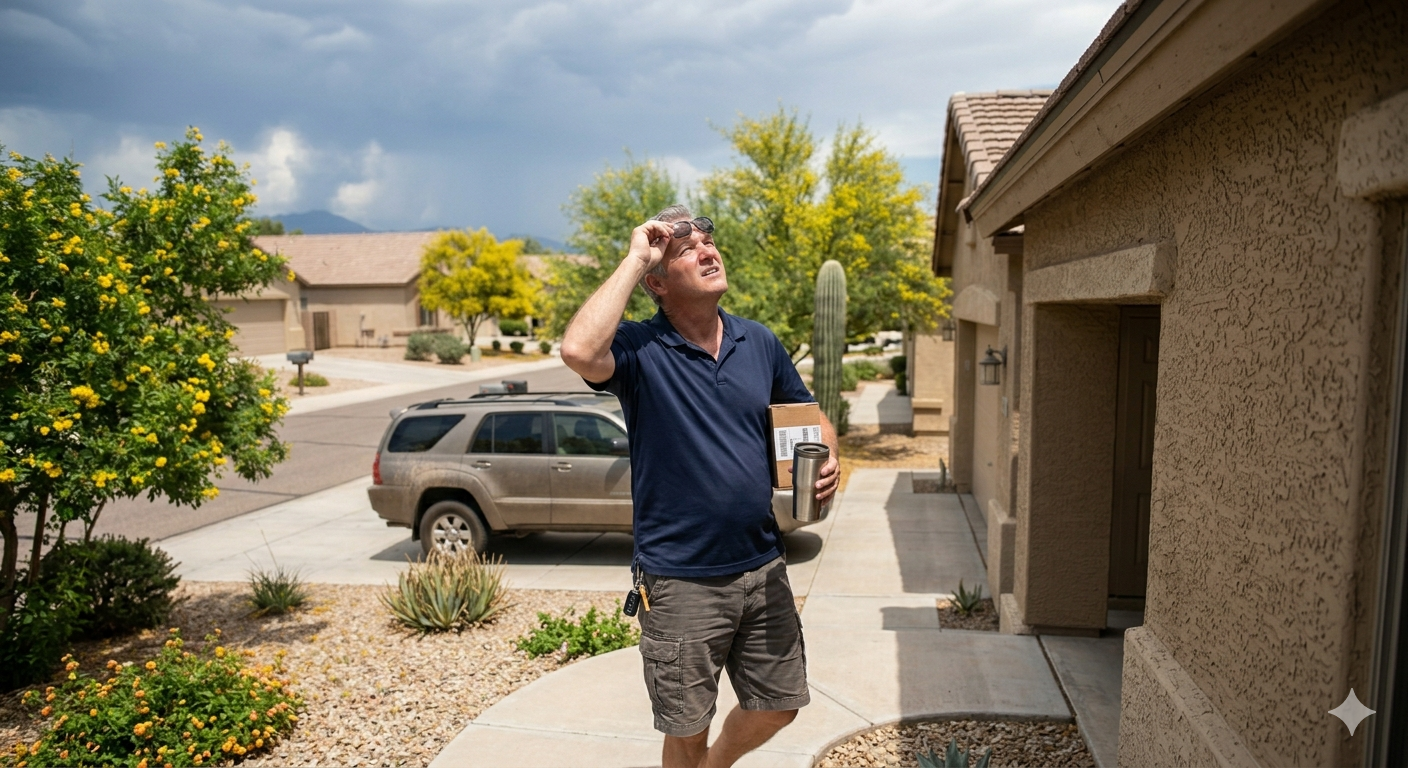
If your roof is pushing 15 to 20 years old in Gilbert, Chandler, or Mesa, this question has probably been in the back of your head since last monsoon. Whether this is finally the summer to deal with it. Here's our straight answer: if that roof is shingle and it's 18 years or older, you're past the question stage. Get someone up there before June 15. The 2026 forecast makes waiting a bad bet.
Should You Replace Your Roof Before the 2026 Monsoon?
Two things drive this decision: how old the roof is and what shape it's actually in. Those are the only two things. But the reason 2026 is different from 2024 is the weather.
The National Weather Service is calling for above normal precipitation across Arizona's monsoon this year. Phoenix specifically carries a 37% chance of above normal rainfall from July through September. The back half of the season, August and September, is showing the strongest signal. That's not a catastrophe forecast. But it's not a dry year either, and for a shingle roof that's already running on borrowed time, that difference is real.
Monsoon season officially starts June 15. Getting a new shingle roof installed before then means inspection, material lead times, city permits, and installation. The full sequence takes two to four weeks. The window for pre monsoon replacement is closing this week.
If your roof is under 12 years old and not showing obvious problems, you can genuinely wait. If it's 18 or older and showing wear, this is your window and it's a short one.
What Record Heat Does to a 20 Year Old Shingle Roof
Most homeowners think about heat in terms of what they feel standing in the driveway. Your shingles aren't experiencing that. When Phoenix hits 110 degrees, dark shingles are running 80 to 90 degrees above the air temperature on the roof surface. We're talking close to 200 degrees up there. Day after day from late May through September, for years.
Three tab shingles in Phoenix typically make 12 to 18 years before UV and thermal cycling causes them to fail. Architectural shingles, the thicker dimensional type installed on most East Valley homes from the 2000s build wave, push 18 to 25 years in our climate. Both numbers are shorter than what the manufacturer's label says. Those ratings were generated in lab conditions, not on south facing Arizona roofs in the middle of July.
The failure mode is pretty mechanical. Heat bakes the oils out of the asphalt. Shingles go brittle. The granules, small chips of crushed stone bonded to the surface that provide UV protection, start shedding into your gutters. Not all at once. Season by season, the protection erodes until the asphalt mat is taking direct sun. At that point a hard monsoon wind doesn't need to be exceptional to start lifting edges and tearing tabs.
The 2026 spring made this worse for a lot of East Valley roofs. Phoenix set early heat records this year. A shingle roof that was already marginal last fall has had months of that added heat since. It's not in better shape today than it was in October. It's in worse shape.
The East Valley Subdivision Timing Problem (And Why 2026 Is Different)
Gilbert and Chandler built massive amounts of housing in a short window. Roughly 2000 through 2010, big master planned subdivisions going up across the East Valley in compressed development cycles. All of that construction is now 16 to 26 years old.
Tract housing ages as a block. That's just the reality of it. A 2003 Chandler subdivision where one homeowner needs a new roof usually has a dozen neighbors who need one too. They all figure it out in the same season, after the same storm. And then every roofer in the East Valley is booked solid for two months.
Getting ahead of that wave isn't a complicated strategy. It's just calling before the monsoon rather than after it.
Two dry monsoon seasons in 2023 and 2024 gave a lot of homeowners more runway than their roofs actually deserved. Then 2025 was wetter than normal. Now 2026 is forecasting above normal activity again, with the late season showing the strongest signal. If your roof has been coasting through dry years, this is probably the year that borrowed time gets called in.
How to Read the Signs on Your Own Roof
You don't need to get on the roof. Most of what matters is visible from the ground or from your gutters.
After any wind event, check the base of your downspout for granules. Fine gritty material, almost like dark sand. That's the protective coating of your shingles washing away. A new roof sheds some in year one and that's normal. A 15 to 20 year old roof that keeps putting granules in the gutters after every storm has mostly lost its UV protection, and the asphalt mat underneath is getting direct sun exposure.
From the driveway, look at the south facing and west facing slopes. Those age first because they take the hardest sun. Faded color compared to the north facing side is just normal wear. But curled or cupped corners on the shingles, where the edges are lifting instead of lying flat, that's thermal damage. Years of expanding in the heat and contracting at night, working on the shingle adhesive and structure. You can usually see it from street level.
Check the attic on a bright afternoon. Turn the lights off and look up. If you see pinpricks of daylight coming through the roof deck, that's an active problem. Call a roofer today, not next week.
And inside: check your upstairs ceilings near chimney penetrations and skylights. Small water stains, even ones that seem old and stable. Water travels along framing before it drops, so the stain on your ceiling is usually not where the entry point is. A small stain inside often means a real gap in the system somewhere on the roof.
Replace Now vs Wait: The Real Math
We're not going to tell you that every 20 year old shingle roof needs to come off immediately. Some of them have more life in them. But here's the actual math on waiting.
A standard asphalt shingle replacement on a typical East Valley single family home runs $9,000 to $15,000, depending on size, pitch, and material grade. Real money. But a monsoon water intrusion event on a failing roof is a different conversation. Mold remediation, insulation replacement, drywall, sometimes structural decking that has to be cut out and replaced. The $15,000 replacement that felt expensive becomes the option you wish you'd taken once interior damage is in the picture. We've seen $15,000 roof decisions turn into $25,000 or larger jobs because a homeowner waited one more season.
The patch and wait math usually doesn't work out either. Patching a 20 year old shingle roof for $2,500 to $3,000 buys you one season. Then you're replacing it anyway, and you've also spent the money on patches. In Arizona's climate, patching past 18 years almost always costs more over two or three years than replacing now does.
The 2026 forecast shifts this further. Two dry monsoons gave East Valley homeowners time. A wetter late season in 2026, which is what forecasters are calling for, takes that time away. The math on waiting was never great. This year it's worse.
What a Replacement Timeline Looks Like Before June 15
The call we get in late May goes like this: "Can we still get a new roof on before monsoon?" The answer is yes, if you call this week.
Inspection and quote take one to two days to schedule, with same day or next day pricing for a standard job. Material lead times for architectural shingles run five to ten business days from order. Permits are required in Gilbert, Chandler, and Mesa, and city processing typically adds three to seven business days. Installation on a standard shingle job is two to four days.
Total from first call to completed roof: plan on three to four weeks. A June 15 target means getting started now. Not after the first storm. Not when a neighbor mentions their roofer.
What We Tell Homeowners Who Ask This Question
Every spring, same question. Does it need to come off, or can we get one more season?
We can't answer without someone actually getting up there and looking. A 20 year old East Valley roof could have a couple of reasonable years left, or it could be one fast moving haboob away from interior water damage. Age is a warning sign, not a diagnosis. Condition is the actual answer.
What we won't do is push a replacement you don't need. All Storm was started in Gilbert around a pretty simple idea: tell homeowners what's actually up there, even when the honest answer costs us the job. We've turned down work that way. That's not changing.
We work across Gilbert, Chandler, Mesa, and Queen Creek. Free inspection, honest assessment, no pressure.
AZ ROC #345156.
About the Author
Tuuta Pulotu is the CEO and cofounder of All Storm Roofing + Construction. He was born and raised in Arizona. His mom is from Hawaii, his dad from Tonga, and Tuuta grew up in the trades working alongside his father, who's been running a landscaping and masonry crew in the Valley for over thirty years.
Before founding All Storm in 2021, Tuuta spent years in solar sales. Long enough to watch too many East Valley homeowners get pushed into roof decisions they didn't fully understand. He started All Storm to flip that conversation: be the contractor who tells homeowners what's actually going on with their roof, even when the truth costs him the job.
He runs All Storm out of Gilbert, where he lives with his wife and four kids.
AZ ROC #345156. Tamko Diamond Certified. The only Tamko Diamond Certified roofing contractor in Arizona.
WRITTEN BY
Tuuta Pulotu is the CEO and co-founder of All Storm Roofing + Construction. He was born and raised in Arizona. His mom is from Hawaii, his dad from Tonga, and Tuuta grew up in the trades working alongside his father, who's been running a landscaping and masonry crew in the Valley for over thirty years. Before founding All Storm in 2021, Tuuta spent years in solar sales. Long enough to watch too many East Valley homeowners get pushed into roof decisions they didn't fully understand. He started All Storm to flip that conversation: be the contractor who tells homeowners what's actually going on with their roof, even when the truth costs him the job. He runs All Storm out of Gilbert, where he lives with his wife and four kids. AZ ROC #345156. Tamko Diamond Certified. The only Tamko Diamond Certified roofing contractor in Arizona.
Worried about your roof?
Get a free, no-pressure inspection from a Gilbert team that gives honest answers — not pressure to replace.
Schedule Free Inspection