What Does Roof Replacement Actually Cost in the East Valley?
→ QUICK ANSWER
Roof replacement in Gilbert, Chandler, and Mesa runs $8,000 to $22,000 depending on material, size, and what's found underneath. Here's how the numbers actually break down.

Short answer: In the East Valley, roof replacement typically costs $8,000 to $22,000 depending on materials, roof size, and what contractors find during tear-off. Full tile runs $12,000 to $22,000, tile underlayment only $8,000 to $14,000, asphalt shingles $9,000 to $15,000, and foam on flat sections $5,000 to $14,000. All Storm Roofing is licensed Arizona ROC #345156 and Tamko Diamond Certified.
What Does Roof Replacement Actually Cost in the East Valley?
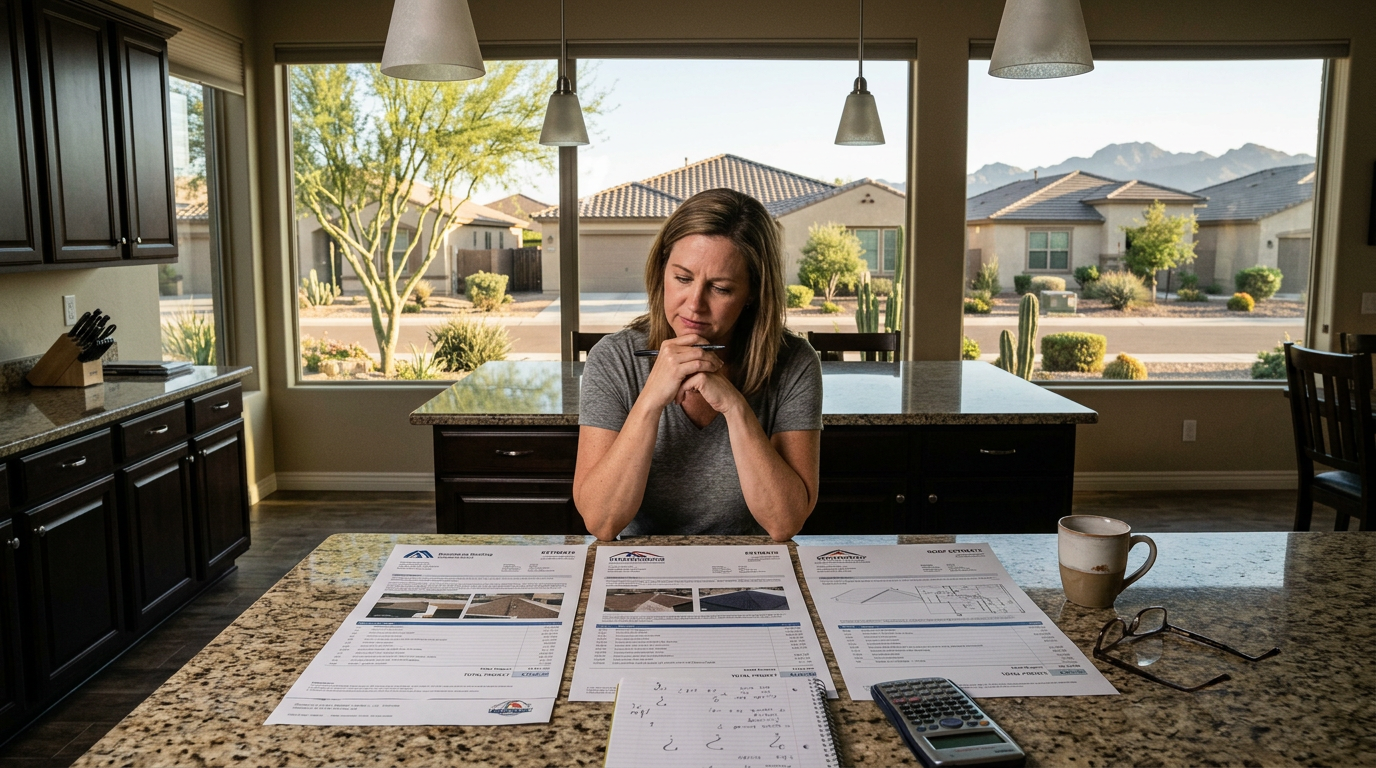
If you're in Gilbert, Chandler, or Mesa and you've started getting quotes for a new roof, you've probably noticed the numbers jump around a lot. One contractor says $10,000. Another says $22,000. And you're standing there wondering who's right and why there's a $12,000 gap.
Here's the short answer: for most East Valley homes, a full roof replacement runs somewhere between $8,000 and $22,000. Where you land in that range comes down to three things: what material is on your roof now, how big your roof is, and what a contractor finds when they get up there.
We run jobs across Gilbert, Chandler, Mesa, and Queen Creek every week. This is what we actually see on quotes and what we tell homeowners when they ask us to break it down.
What the Main Roof Types Cost in the East Valley
Concrete or clay tile roofs: $12,000 to $22,000 for a full replacement
Tile is the most common roof type in East Valley neighborhoods, and for good reason. The tiles themselves hold up well in Arizona heat. The problem most homeowners run into isn't broken tiles, it's the underlayment beneath them wearing out. Concrete tile roofs typically need underlayment replacement every 15 to 25 years in this climate, even when the tiles look fine from the street.
So there are actually two different jobs here. If your tiles are in decent shape, you might only need the underlayment replaced, which runs $8,000 to $14,000 as a job total on a typical East Valley home. Full replacement, underlayment plus new tile, runs $12,000 to $22,000 fully installed on a 2,000-square-foot home with a roof footprint around 2,400 to 2,600 square feet.
The tile itself, when properly maintained, can last 40 to 50 years. Some clay tile roofs push past 60. So the cost is front-loaded, but you're typically not doing this job again.
Asphalt shingle roofs: $9,000 to $15,000
Shingles are cheaper upfront. On a standard East Valley home, you're looking at $9,000 to $15,000 depending on the shingle grade and roof complexity.
The catch in Phoenix is lifespan. Architectural shingles that would last 25 to 30 years in a milder climate typically last 15 to 25 years here. Three-tab shingles, the thinner baseline option, often come in under 15 years in our heat. The UV exposure and the expansion-contraction cycle from 115-degree days just breaks them down faster. If someone's offering you a full shingle replacement for $4,500, ask hard questions about what grade of shingle they're installing and whether they're cutting corners on underlayment.
Foam (SPF) roofs on flat or low-slope sections: $5,000 to $14,000
A lot of East Valley homes have flat or low-slope sections, especially at entries, covered patios, and additions. Spray polyurethane foam is the standard material here, and it does a good job in Arizona. It seals well, insulates well, and doesn't mind the heat.
Cost runs $5,000 to $14,000 depending on square footage. The thing to plan for: foam needs to be recoated every 5 to 10 years to stay effective. That recoating is much cheaper than a full replacement, so as long as you stay on top of it, it's a reasonable long-term system.
Why Two Quotes for the Same Roof Can Be Miles Apart
This is the question we hear constantly. And the answer is usually one of a few things.
Underlayment quality. You can't see underlayment from the ground. Some contractors price jobs with felt paper, which is cheaper and degrades faster in Arizona heat. Others specify synthetic underlayment with a 25 to 35-year lifespan. Same tile, different underlayment, completely different long-term outcome. The cheaper quote may not be the better deal.
Decking condition. When a crew tears off old material and finds rotted plywood underneath, that's extra work. Good contractors include language about how they handle unexpected decking repairs and what they charge. Lowball quotes often don't mention decking at all, then hit you with add-ons mid-job.
Tile sourcing. If you're doing a tile replacement and your existing tile style is discontinued, matching or replacing it costs more. Some contractors plan for this, some don't.
Labor overhead. Labor typically makes up half or more of your total cost. An experienced crew that knows how to work in East Valley heat, knows the common failure points on 1990s and 2000s-era neighborhood homes, and carries proper licensing and insurance will charge more than a newly licensed crew trying to build a customer base. That gap is real and it's usually worth it.
What's Specific to East Valley Homes
The East Valley has a lot of neighborhoods built between the mid-1990s and early 2010s. Chandler and Gilbert especially saw huge tract development during that era. Many of those homes are hitting 20 to 30 years old now, which means they're right at the point where underlayment is failing even if the tile looks okay.
We pull permits in Gilbert and Chandler regularly and see this pattern constantly. Homeowners call us because of a small leak after a monsoon storm. We get up there and the underlayment is cracked and brittle across the whole roof, not just where it's leaking. That's a common story on 1998 to 2008 homes in the East Valley.
The other thing that's specific to this area: HOA restrictions. A lot of communities in Gilbert and Chandler have specific tile color and profile requirements. Before you commit to a tile replacement, confirm with your HOA what's approved. A contractor who's worked the East Valley regularly knows this, but it's worth asking up front.
The Monsoon Factor
Arizona's official monsoon season runs June 15 through September 30 according to the National Weather Service. The real action, the heavy storms, haboobs, and wind-driven rain, happens mostly in July and August.
For roofing, this matters in two ways. First, a worn roof that's managing okay in dry weather will often show its weakness in the first big monsoon storm. Wind-driven rain finds every gap, every cracked piece of felt, every loose flashing. If you've got water stains on your ceiling after a monsoon, that's the roof telling you the underlayment is gone.
Second, if you're planning a replacement, pre-monsoon timing (May and early June) gives you the best window. Crews can work efficiently before temperatures peak, and you're covered before the heavy storms hit. Post-monsoon (October through November) is the other good window, once the heat breaks and before the holiday rush on contractor schedules.
Trying to get a replacement done in August is expensive and hard to schedule. Most East Valley crews are already slammed with storm-response calls.
The Mistake Most Homeowners Make
The most common thing we see: homeowners wait until there's visible damage before calling anyone.
By the time you've got a water stain on the ceiling, you've had water getting in for a while. That usually means some decking has gotten wet. Wet decking warps, develops mold, and sometimes rots. What could have been an underlayment job turns into an underlayment plus decking job, which adds cost.
The smarter move: get a professional on your roof around the 18 to 20-year mark if you haven't had a recent inspection, especially on a tile roof. You're not necessarily looking at a full replacement, but you need to know where the underlayment stands before a storm makes the decision for you.
We do free inspections across the East Valley. We're not going to tell you your roof needs work if it doesn't.
The Simple Version
If you want a quick reference to work from:
Concrete or clay tile, full replacement: $12,000 to $22,000
Tile underlayment only (tiles reused): $8,000 to $14,000
Asphalt architectural shingle: $9,000 to $15,000
Foam/SPF on flat sections: $5,000 to $14,000
These are East Valley numbers from 2025 to 2026 jobs. Your specific home will vary based on size, pitch, decking condition, and material choice. Any quote you accept should specify what underlayment grade is included and how decking issues are handled if discovered mid-job.
When Should You Actually Replace vs. Repair?
This one's genuinely situational. A few real-world calls we make on our jobs:
If your tile roof is under 20 years old and the leak is isolated to one area, it's probably a repair job. Maybe a few cracked tiles, maybe flashing around a vent pipe that's pulled loose. Those are $300 to $800 fixes.
If your tile roof is 22 to 28 years old and you're seeing multiple leaks in different spots after rain, the underlayment is probably failing system-wide. Patching doesn't fix that. Replacement is the right call.
If your shingle roof is 15-plus years old and you're losing granules visibly (check the gutters after rain), you're in the replacement window. Granule loss exposes the asphalt layer directly to UV, and once that starts, the clock is moving fast.
If you've had the same area repaired more than twice, that spot is telling you something. It's usually not isolated.
One More Thing on Getting Quotes
Get three quotes on any job over $8,000. In the Phoenix metro, prices for the same scope can vary by $3,000 to $5,000. That gap isn't always about quality, but it sometimes is. Ask every contractor specifically: what underlayment product are you installing, and what's your process if you find rotted decking?
A contractor who can't answer those two questions clearly isn't the right contractor for an East Valley roof.
Make sure they're licensed with the Arizona ROC. You can verify that at the ROC's website. Licensing matters on permits, and permits matter on your homeowner's insurance.
If you're in the East Valley and want a second opinion on your roof before you commit to a big project, we do free inspections. No pressure, no hard sell. We'll tell you what we actually see up there.
Our team is based in Gilbert. We work across Gilbert, Chandler, Mesa, and Queen Creek. AZ ROC #345156. Tamko Diamond Certified, and the only Tamko Diamond Certified roofing contractor in Arizona.
About the author
Tuuta Pulotu is the CEO and co-founder of All Storm Roofing + Construction. He was born and raised in Arizona. His mom is from Hawaii, his dad from Tonga, and Tuuta grew up in the trades working alongside his father, who's been running a landscaping and masonry crew in the Valley for over thirty years.
Before founding All Storm in 2021, Tuuta spent years in solar sales. Long enough to watch too many East Valley homeowners get pushed into roof decisions they didn't fully understand. He started All Storm to flip that conversation: be the contractor who tells homeowners what's actually going on with their roof, even when the truth costs him the job.
He runs All Storm out of Gilbert, where he lives with his wife and four kids.
AZ ROC #345156. Tamko Diamond Certified. The only Tamko Diamond Certified roofing contractor in Arizona.
WRITTEN BY
Tuuta Pulotu is the CEO and co-founder of All Storm Roofing + Construction. He was born and raised in Arizona. His mom is from Hawaii, his dad from Tonga, and Tuuta grew up in the trades working alongside his father, who's been running a landscaping and masonry crew in the Valley for over thirty years. Before founding All Storm in 2021, Tuuta spent years in solar sales. Long enough to watch too many East Valley homeowners get pushed into roof decisions they didn't fully understand. He started All Storm to flip that conversation: be the contractor who tells homeowners what's actually going on with their roof, even when the truth costs him the job. He runs All Storm out of Gilbert, where he lives with his wife and four kids. AZ ROC #345156. Tamko Diamond Certified. The only Tamko Diamond Certified roofing contractor in Arizona.
Worried about your roof?
Get a free, no-pressure inspection from a Gilbert team that gives honest answers — not pressure to replace.
Schedule Free Inspection