Roofing Companies Near You in Queen Creek: Why Local Matters After a Monsoon Storm
→ QUICK ANSWER
Most roofing contractors knocking on Queen Creek doors after a monsoon aren't local. Here's how to vet them, protect your tile roof, and handle insurance claims the right way.

Short answer: Roofing companies near you in Queen Creek matter because local contractors know the storm corridor that drives concentrated wind and rain through neighborhoods like Pecos Ranch and Whitewing. Check any contractor at roc.az.gov, get an East Valley address, and never accept a deductible waiver—that is fraud. All Storm Roofing is licensed Arizona ROC #345156 and Tamko Diamond Certified.
Why Local Roofing Companies Matter in Queen Creek (And What to Watch Out For After a Storm)
Here's what happens in Queen Creek after a significant monsoon event. Trucks start rolling through neighborhoods within a day or two. Some are legit crews backed up with jobs, trying to keep pace with demand. Others are storm chasers who followed the weather system up from somewhere else and will be gone before your next water bill arrives. Knowing the difference before you hire someone isn't hard, but it does require asking the right questions.
This covers what to look for in a Queen Creek roofing contractor, what your actual roof risk looks like heading into monsoon season, and what the insurance claim process looks like when a local contractor does it right versus when one doesn't.
What Most Queen Creek Roofs Are Dealing With Right Now
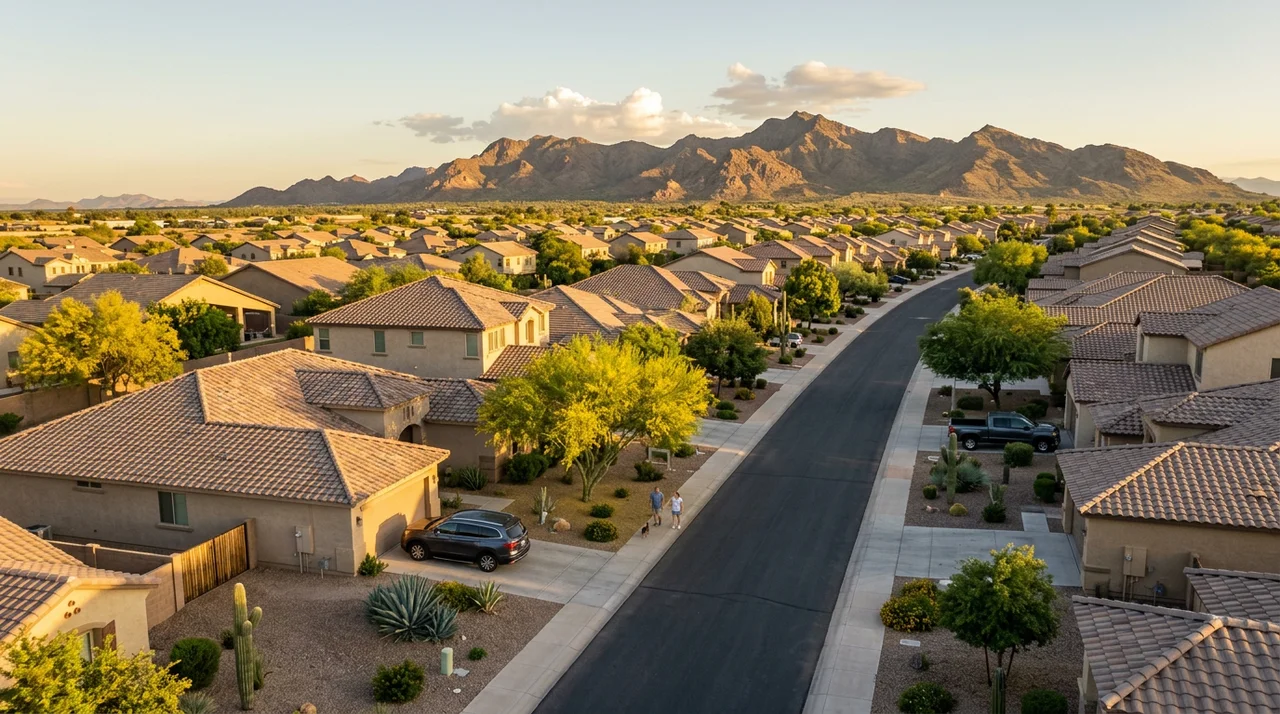
Most of the housing stock in Queen Creek was built in the mid-2000s through the early 2010s. That means a lot of concrete tile roofs built somewhere between 15 and 20 years ago, now entering the range where the underlayment below the tiles starts to show real wear.
Concrete tile itself holds up well in Arizona. It handles UV, it handles heat, it handles monsoon wind reasonably well. Clay tile lasts even longer. But the underlayment is a different story. That's the actual waterproof barrier. Standard felt underlayment installed in 2005 or 2008 is getting cooked by summer roof temperatures that can run over 160 degrees Fahrenheit, and it's been doing that every year for two decades now. It gets brittle. It cracks. And when a monsoon drives rain sideways under the tile, that cracked underlayment is where the water finds its way into your decking and framing.
The tiles don't leak. The failed underlayment does. That's the thing most Queen Creek homeowners don't know.
If your home was built before 2010 and hasn't had a proper inspection recently, the tiles might look completely intact from the driveway and there could still be sections of underlayment that crumble when you touch them. We see it across Queen Creek, in Pecos Ranch, Whitewing, Estates at Hastings Farms. It's common. Not catastrophic yet, usually. But it will be, after the wrong storm.
Queen Creek Gets a Specific Type of Storm Exposure
It's not the same as the rest of the Valley. Queen Creek sits at the edge of a natural storm corridor that runs northwest out of the open desert near Apache Junction and San Tan Valley. Haboobs hit here hard. The dust-driven wind loads coming from the southeast tend to be more concentrated than what Scottsdale or Tempe sees during the same weather event.
That matters for roofing because wind direction and intensity affect where damage shows up. On a typical Queen Creek home, the south- and west-facing pitches take the worst of it. Tile can lift or slip, especially on older mortar ridges that have dried out. Flashing around vents and skylights is another spot. And any area where the underlayment is already compromised becomes a real problem once that wind-driven rain finds the weak point.
A contractor who works regularly in Queen Creek knows this. One who drove up from Tucson or down from Flagstaff for the week probably doesn't.
How to Actually Vet a Roofing Company Here
Three things, in order.
Look up their AZ ROC license at roc.az.gov. Arizona law requires any contractor doing work valued at $1,000 or more to hold a valid state license. The ROC lookup takes about 90 seconds. You can see whether the license is active, what classification it is, and whether there are any disciplinary actions or complaints on file. This is not optional research. This is the minimum bar.
Get a physical address. Not a P.O. box. Not a Google Voice number that routes to a cell phone. An actual office or yard in the East Valley where you could show up if something goes wrong six months after the job is done. Local companies have a reputation to protect. Out-of-town contractors do not.
Ask for references from Queen Creek or Chandler jobs in the last two years. Two or three names is fine. If the contractor hesitates or can't produce any, that tells you something.
A company that's been running jobs in Queen Creek for years will clear all three of those without blinking.
What the Insurance Process Actually Looks Like
Your insurance company isn't your enemy, but they're not working for you, either. They're working to close claims accurately and efficiently. After a significant monsoon, adjusters get backlogged quickly across the East Valley. Queen Creek, San Tan Valley, and Gilbert often get hit by the same storm systems, which means the adjusters are spread thin across a lot of ZIP codes at once.
What most homeowners don't know: you can have your own inspection done before the adjuster arrives. And having a local contractor document the damage thoroughly before that adjuster visit, with photos, written call-outs, measurements, material-specific notes, puts you in a much better position during the claims conversation. It's not about inflating anything. It's about making sure nothing legitimate gets missed.
What a bad contractor does is different. They want you to sign your insurance check over to them directly. They push you to file a claim before you've had anyone else look at the roof. Some offer to "handle everything with your insurance company," which sounds helpful until you realize only a licensed public adjuster or attorney can legally negotiate a claim on your behalf. The contractor doing that is positioning themselves, not you.
And the deductible waiver offer. If a contractor tells you they'll waive your deductible, that's insurance fraud. Not a gray area. Not a special arrangement. Fraud. You could face legal consequences alongside them.
The Storm Chaser Problem Is Real After Every East Valley Storm
After major monsoon events, out-of-town roofing reps show up fast. Some are legitimate companies stretched thin trying to meet demand. The ones to watch out for share a recognizable pattern.
They knock on your door uninvited. They want to get on your roof immediately, and they'll hand you paperwork to sign before they do it. That paperwork is often a contract or an assignment of rights, not just an inspection authorization. Once you sign, you may have committed to using their company.
They pressure you to act fast. Urgency is their tool. The damage will get worse. The insurance window is closing. Your neighbors are already getting it fixed. None of that is a reason to sign anything before you've had a local contractor you trust take a look first.
They can't produce an AZ ROC number that checks out. They have out-of-state plates. No local office. No references from Queen Creek homeowners you could call.
Waiving the deductible offer is the clearest signal. Walk away from that one immediately.
If you feel rushed, slow down. The damage on your roof isn't going anywhere in 48 hours. Your insurance claim window typically runs well past the immediate post-storm period. Take the time to find someone local.
The Myth That Tile Means Fine
Concrete tile looks tough because it is tough. The tile itself handles a lot. And that creates a genuinely dangerous assumption for homeowners, which is that because no tiles are cracked or missing, the roof is okay.
Most of the damage we find on Queen Creek tile roofs after a monsoon isn't visible from the street. It's not cracked tiles. It's not missing ridge caps. It's the underlayment. It's the flashing around a vent pipe or skylight. It's a mortar ridge that took repeated wind hits and now has gaps. None of that shows from the driveway. Some of it doesn't show until the next hard rain, when you've got a water stain spreading across the drywall in your bedroom ceiling.
The assumption that "tile means fine" costs Queen Creek homeowners real money. Not because the tile is a bad product. It's a great product for this climate. But the tile is not the whole system. And the parts of the system you can't see are the parts that fail first.
What Actually Matters When You're Choosing a Contractor
We've been on roofs across Queen Creek, Gilbert, Chandler, and San Tan Valley for years. We see the same patterns. A homeowner who chose the lowest estimate from a company with an unfamiliar name, and now has a patch job that failed six months later. A homeowner who let a door-to-door rep sign paperwork on their behalf and is now in a dispute with their insurance company.
Tile holds up better than 3-tab asphalt in Phoenix UV. That's not an opinion, it's what we see on every job we run in this area. And a local contractor with a real AZ ROC license and an East Valley address is going to be there when you call with a problem two years from now. The one who drove in from out of state for the week is not.
That's the real reason local matters. Not a marketing angle. Accountability.
Get Eyes on Your Roof Before Monsoon Season
We work across Queen Creek, Gilbert, Chandler, and San Tan Valley. If you want a roofer who'll tell you what's actually going on up there, give us a call. Free inspection, no sales pitch. If the roof is fine, we'll tell you it's fine.
AZ ROC #345156.
Tuuta Pulotu is the CEO and co-founder of All Storm Roofing + Construction. He was born and raised in Arizona. His mom is from Hawaii, his dad from Tonga, and Tuuta grew up in the trades working alongside his father, who's been running a landscaping and masonry crew in the Valley for over thirty years.
Before founding All Storm in 2021, Tuuta spent years in solar sales. Long enough to watch too many East Valley homeowners get pushed into roof decisions they didn't fully understand. He started All Storm to flip that conversation: be the contractor who tells homeowners what's actually going on with their roof, even when the truth costs him the job.
He runs All Storm out of Gilbert, where he lives with his wife and four kids.
AZ ROC #345156. Tamko Diamond Certified. The only Tamko Diamond Certified roofing contractor in Arizona.
WRITTEN BY
Tuuta Pulotu is the CEO and co-founder of All Storm Roofing + Construction. He was born and raised in Arizona. His mom is from Hawaii, his dad from Tonga, and Tuuta grew up in the trades working alongside his father, who's been running a landscaping and masonry crew in the Valley for over thirty years. Before founding All Storm in 2021, Tuuta spent years in solar sales. Long enough to watch too many East Valley homeowners get pushed into roof decisions they didn't fully understand. He started All Storm to flip that conversation: be the contractor who tells homeowners what's actually going on with their roof, even when the truth costs him the job. He runs All Storm out of Gilbert, where he lives with his wife and four kids. AZ ROC #345156. Tamko Diamond Certified. The only Tamko Diamond Certified roofing contractor in Arizona.
Worried about your roof?
Get a free, no-pressure inspection from a Gilbert team that gives honest answers — not pressure to replace.
Schedule Free Inspection