Your Tile Roof Is Leaking But Every Tile Looks Perfect. Here's Why.
→ QUICK ANSWER
Your tiles look perfect, but you've got a water stain on the ceiling. Here's what's actually happening — the most common monsoon call we get in Gilbert and Queen Creek.

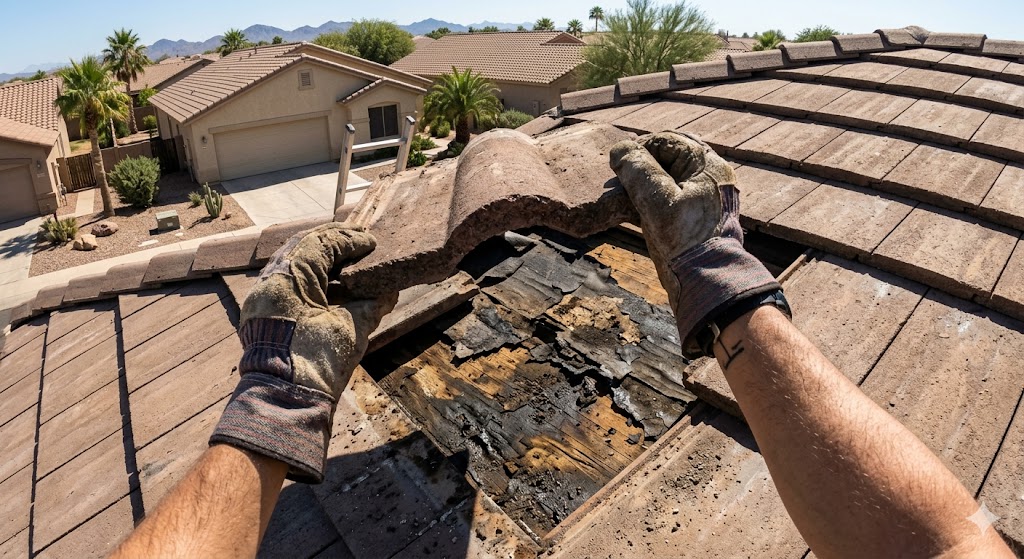
You've got a water stain on the ceiling. You go outside, look up at the roof, and every tile is sitting right where it should be. No cracks. No missing pieces. Nothing looks wrong.
So what is going on?
We get this call constantly. Gilbert, Chandler, Queen Creek. Homeowners with tile roofs built in the late 1990s or early 2000s, no visible damage, and water coming in during monsoon season. The answer almost every time is the same: the tiles are fine. The underlayment isn't.
This is the thing most people don't know about tile roofs in Arizona.
Tiles don't waterproof your roof. The underlayment does.
Here's what a tile roof actually is. The tiles on top are there to shed water and take the punishment from the sun, wind, and hail. But they're not sealed to each other. They're not waterproof on their own. Rain driven sideways by monsoon winds can push water underneath the tile and down the pitch of the roof.
The thing that stops that water from getting into your house is the underlayment. That's the layer of material installed directly over your roof deck, under the tiles. It's the actual waterproofing barrier.
If the underlayment is solid, the water that sneaks under your tiles hits it and runs off. If the underlayment has dried out, cracked, or torn, which happens constantly in Arizona, that water goes straight through to your attic, your ceiling, your drywall.
The tiles above can look brand new. The underlayment below can be completely shot. And from the street, you'd never know.
How long does tile underlayment actually last in Arizona?
This is where people get surprised. The tiles on most East Valley homes can last 50 years or more. The underlayment underneath them? Much shorter.
Standard felt paper underlayment, which is what the vast majority of homes built in the 1990s got, typically lasts somewhere between 10 and 20 years in Arizona conditions. Some sources put the felt lifespan at 10 to 15 years in our climate. The heat accelerates it. Arizona roof surfaces regularly hit over 160 degrees Fahrenheit on summer afternoons. That kind of sustained thermal punishment dries the felt out from below. It gets brittle. It cracks. And then the monsoon hits and water finds every crack it can.
Synthetic underlayment, which became more common through the 2000s and is standard now, holds up considerably better. Typically 20 to 30 years or more depending on material and attic ventilation. Rubberized asphalt options can push that further.
But if your home was built in 1998 or 2003 and got standard felt, you're well past the expected service life. The tiles still look great. The underlayment is the problem.
Signs your underlayment is failing (most aren't visible from the ground)
This is the frustrating part. Underlayment failure is usually invisible until water gets in.
That said, here's what to look for.
Interior water stains on ceilings or near walls after a storm are the most obvious sign. They often show up away from where you'd expect based on the location of the tiles, because water travels along roof decking before it drips.
Musty smell in the attic or in rooms below the roof line. Moisture gets in, sits, and starts growing mold before it ever makes it to your ceiling.
Staining or streaks on the underside of the roof deck when you look up in the attic. If you can safely get into your attic with a flashlight after a hard rain, this is worth checking.
Leaks that appear during monsoon season specifically but not during lighter rain. This is a classic underlayment tell. Light rain doesn't generate enough pressure to push water under a tile. The sideways driving rain in a real monsoon storm does.
One thing we see all the time on East Valley roofs: the leak shows up in a room that isn't directly under a pitch, or in a spot where there's no broken tile at all. The water entered 15 feet away and traveled. That's underlayment failure, not a tile problem.
Tile underlayment replacement vs. full reroof: what's the difference?
This is the question that comes up right after we explain what's going on. Does the whole roof need to come off?
Not necessarily. If your tiles are in good shape, no widespread cracking, no significant breakage, they can often be removed, the old underlayment stripped, new underlayment installed, and the tiles reset back on top. This is called an underlayment replacement, and it's meaningfully less expensive than a full tear off and new tile installation.
The honest answer is it depends on the tile condition. Concrete tile holds up well in this process. Our crew can lift, reuse, and reset concrete tiles without a lot of breakage. Clay tile is more fragile and sometimes takes more losses during removal, which affects the cost calculation. If a significant percentage of tiles are broken or cracked on top of the underlayment issues, a full replacement starts to make more sense.
We walk homeowners through this on every inspection. The goal is not to talk you into a full reroof if the tiles don't need it.
What homes in Gilbert and Chandler built in the late 1990s should know right now
This is the situation on the ground in the East Valley right now. Large subdivisions in Gilbert, Chandler, and Queen Creek went up in the late 1990s and early 2000s. Tile roofs on all of them, because that's what the market wanted and what builders used. The tile on most of those homes still looks good. But the underlayment is anywhere from 20 to 25 years old.
That puts a huge portion of East Valley homes either at or past the point where underlayment failure starts showing up. Not all of them are leaking yet. Some homeowners won't know until the next hard monsoon. The leak that shows up in July on a home that's been fine for 20 years isn't a surprise to us. It's exactly what the expected service life of that original felt paper looks like.
If you live in one of those neighborhoods and your roof hasn't been inspected in the last few years, pre monsoon is the right time to do it. We're talking about June specifically. The window between the end of spring and the start of the July storms is the best time to find underlayment issues and get them addressed before the season begins.
How much does underlayment replacement cost compared to a full tear off?
We don't publish pricing in blog posts because it genuinely varies by roof size, pitch, tile condition, and access. But the general shape is that underlayment replacement on a home where the tiles are reusable is significantly less than a full tear off and new tile installation.
What we can say: getting this handled before a monsoon is almost always cheaper than getting it handled after water has been sitting in your attic for a season. Water damage, mold remediation, and structural repairs add up fast once moisture gets into the framing.
The inspection is free. We'll tell you what we find, give you an honest read on whether it's underlayment only or something more, and not pressure you into a decision that day.
The monsoon test: why underlayment failure shows up every July
Monsoon season in Arizona runs officially from June 15 through September 30. The real action happens in July and August when the storms come in fast, drop a lot of water in a short window, and drive rain sideways with serious wind.
That storm profile is uniquely brutal on aging underlayment. A light steady rain doesn't penetrate under a tile the way a monsoon does. So a roof that's been fine through a dry spring will fail its first hard monsoon test when the underlayment has gotten thin enough.
We've been on homes in Queen Creek and Gilbert the day after a July storm where the homeowner genuinely had no idea anything was wrong until water showed up on a bedroom ceiling. Every tile was in place. The underlayment under that section had reached the end of its life.
This is not a dramatic catastrophic failure. It's a slow predictable process that Arizona heat accelerates. The tile does its job for decades. The underlayment underneath has a shorter clock, and in our climate, that clock runs faster than it would anywhere else in the country.
A quick note on getting up on the roof yourself
Don't. This isn't us being overly cautious. Tile roofs are slippery, especially with the dust accumulation you get in the East Valley. Broken tiles during a DIY inspection create new entry points for water. And walking in the wrong spot on a tile roof can crack tiles on the pitch below your feet.
If you suspect underlayment issues, get a roofer up there. That's what we do.
If you're in the East Valley and this sounds familiar
If your home was built before 2005 and you haven't had a roof inspection in a few years, this is worth getting eyes on before monsoon season. The inspection is free. We work across Gilbert, Chandler, Mesa, and Queen Creek.
We'll tell you what's actually going on up there, good news or bad. No pressure, no hard sell.
Give us a call or reach out through the site. (602) 806-6806
Tuuta Pulotu is the CEO and cofounder of All Storm Roofing + Construction. He was born and raised in Arizona. His mom is from Hawaii, his dad from Tonga, and Tuuta grew up in the trades working alongside his father, who's been running a landscaping and masonry crew in the Valley for over thirty years.
Before founding All Storm in 2021, Tuuta spent years in solar sales. Long enough to watch too many East Valley homeowners get pushed into roof decisions they didn't fully understand. He started All Storm to flip that conversation: be the contractor who tells homeowners what's actually going on with their roof, even when the truth costs him the job.
He runs All Storm out of Gilbert, where he lives with his wife and four kids.
AZ ROC #345156. Tamko Diamond Certified. The only Tamko Diamond Certified roofing contractor in Arizona.
WRITTEN BY
Tuuta Pulotu is the CEO and co-founder of All Storm Roofing + Construction. He was born and raised in Arizona. His mom is from Hawaii, his dad from Tonga, and Tuuta grew up in the trades working alongside his father, who's been running a landscaping and masonry crew in the Valley for over thirty years. Before founding All Storm in 2021, Tuuta spent years in solar sales. Long enough to watch too many East Valley homeowners get pushed into roof decisions they didn't fully understand. He started All Storm to flip that conversation: be the contractor who tells homeowners what's actually going on with their roof, even when the truth costs him the job. He runs All Storm out of Gilbert, where he lives with his wife and four kids. AZ ROC #345156. Tamko Diamond Certified. The only Tamko Diamond Certified roofing contractor in Arizona.
Worried about your roof?
Get a free, no-pressure inspection from a Gilbert team that gives honest answers — not pressure to replace.
Schedule Free Inspection