ACV vs. RCV: The Insurance Policy Detail That Determines What You Actually Get Paid After a Monsoon Roof Claim in Arizona
→ QUICK ANSWER
ACV or RCV? That one line in your Arizona homeowners policy determines whether a monsoon roof claim covers your whole roof or maybe a third of it. Here's the plain-language breakdown.

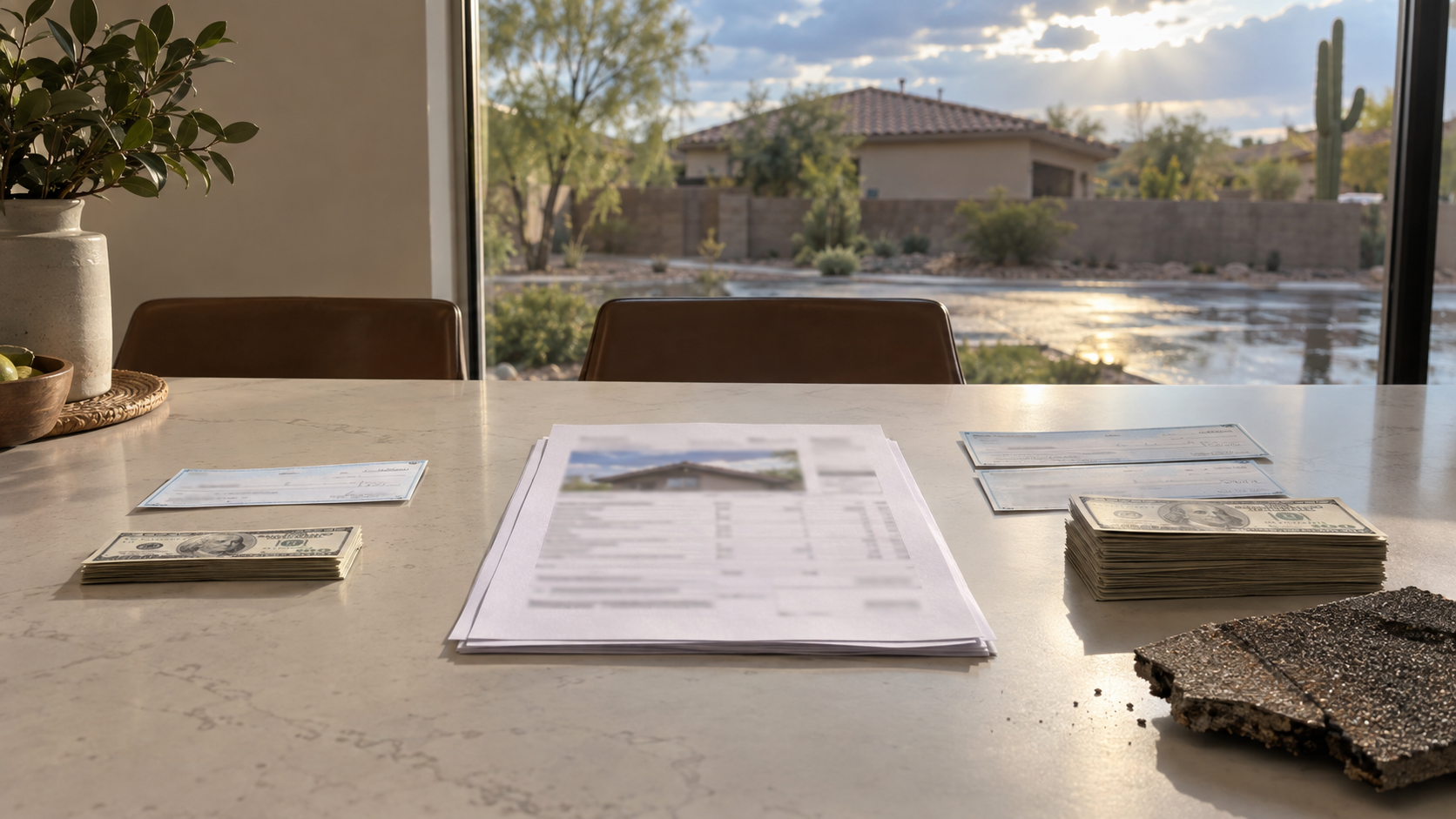
The 2026 Monsoon Hit a Lot of East Valley Roofs. Here Is What Your Insurance Will Actually Pay.
The 2026 monsoon has been active. Gilbert. Mesa. Chandler. The July 13 storm tore through the East Valley with gusts above 50 mph. The July 21 event hit Mesa hard enough to rip sections of roofing off homes near the Loop 101. If your roof took damage in either of those, or in any of the storms since, there is one question that decides how much money you actually collect: does your policy pay ACV or RCV?
Not your deductible. Not whether you have "good coverage." This one line in your policy can mean the difference between getting a check that covers your roof and getting a check that covers maybe a third of it.
Most homeowners in Gilbert and Chandler don't know which one they have until the settlement letter arrives.
What ACV Means (And Why It Matters More Than Your Deductible)
ACV is Actual Cash Value. Your carrier takes the cost to replace the damaged roof today, subtracts depreciation based on age and condition, and cuts you a check for what's left. Minus your deductible. That's the only check you get.
Here's the math on a real East Valley scenario. Fifteen-year-old architectural shingle roof in Queen Creek. A monsoon microburst lifts a section. Replacement today: around $18,000. The carrier figures the roof has used up roughly 60% of its useful life. They depreciate $10,800. Your ACV payment, before the deductible, is $7,200. Subtract a $2,000 deductible and you get $5,200 to replace an $18,000 roof.
The gap is yours. No second check comes.
What catches people off guard is that ACV coverage isn't always something you chose. Arizona insurers have been shifting higher-risk ZIP codes, and East Valley ZIP codes with elevated monsoon exposure are in that group, from RCV roof coverage to ACV endorsements quietly at renewal. You might have bought RCV five years ago. Your renewal paperwork last spring may have flipped your roof to ACV. The declarations page tells you. Most people don't read it until they need it.
That's not a criticism. Nobody reads insurance declarations pages until a storm hits. But it's worth pulling yours out right now.
What RCV Means (And How to Know If You Have It)
RCV is Replacement Cost Value. The insurer pays what it actually costs to replace the damaged roofing with comparable new materials, regardless of how old the roof is.
There's a catch: RCV pays in two checks.
The first check is the ACV amount, same math as above. Depreciation withheld. But with RCV, that held depreciation isn't gone. It gets released as a second check once you complete the repair and send documentation to the carrier.
Same Queen Creek roof, same storm, RCV policy: first check is $5,200. Roof gets replaced. Invoice goes to the carrier. Second check comes for the $10,800 that was withheld. The homeowner ends up paying only their deductible out of pocket instead of $13,000 more.
That's the difference. One line in the policy.
To confirm yours: pull the declarations page. Look for "Replacement Cost Value," "RCV," or "Actual Cash Value," "ACV" next to the dwelling or roof coverage. Read both lines, because some policies apply RCV to the dwelling broadly but run a separate ACV endorsement specifically for the roof. If you see "roof payment schedule" or "roof surcharge," that's usually code for ACV treatment kicking in as the roof ages.
If the language isn't clear, call your agent and ask directly: "Is my roof covered at replacement cost or actual cash value?" Those exact words. Make them answer with one of those two phrases.
The 30-60 Day Prompt Notice Clause: Why Waiting Is Expensive
Almost every homeowners policy in Arizona includes a prompt notice requirement. You have to report damage to your carrier within a reasonable time of discovering it. Most carriers set this at 30 to 60 days, though some just say "as soon as practicable" without giving you a number.
In the East Valley, this clause is particularly dangerous because monsoon season stacks storms. July 13. July 19. July 21. Another outflow event in August. If you wait six weeks to report damage from the first storm, the carrier has a legitimate argument that the damage came from a later storm, or from pre-existing wear, or from deferred maintenance. You've lost the ability to tie the damage to a specific event.
That's exactly the argument adjusters use to reduce or deny claims on older East Valley roofs.
Missing a tile after the July 13 storm and waiting until September to report it doesn't just risk a deadline problem. It hands the adjuster an opening: "We can't confirm when this damage occurred or what caused it."
File as soon as you know damage happened. You don't need a contractor's report to call your carrier. A timestamped photo from the day after the storm is more useful than a roofer's estimate filed six weeks late. See our post on the 72-hour guide after monsoon damage for the full sequence.
What Insurers Use Against AZ Homeowners: Age, Maintenance, and Pre-Existing Wear
Here's where claims in Gilbert and Chandler get messy. Arizona UV and heat degrade roofing materials faster than almost anywhere in the country. Sealants and flashing caulk typically break down within 5-7 years in this climate. Architectural shingles that hold up 30 years in milder markets age out in 20-25 years in Phoenix heat. Adjusters know this. It's part of their training.
When a monsoon hits an older East Valley roof, the carrier's first move is often to classify as much of the damage as possible as pre-existing wear rather than storm damage. The argument: "The storm didn't cause this. The roof was already failing." Even when the storm damage is clearly visible and clearly real.
The documentation that fights this argument is pre-loss condition evidence. A dated inspection report from before the storm showing the roof was in reasonable condition. Timestamped photos from the week before the storm. Anything that establishes a baseline before the damage event.
Without it, adjusters work with what they have: a damaged roof of unknown prior condition, in a climate where wear is aggressive and fast. They lean toward wear-and-tear classification because it's defensible and it reduces the payout.
This is exactly why a pre-monsoon inspection, even a simple one, does more than catch problems before they become leaks. It creates a documented baseline. If you had your roof inspected this spring, hold onto that report. It's evidence. See our pre-monsoon inspection checklist if you want to know what that baseline inspection should cover.
Cosmetic vs. Functional Damage: How Adjusters Draw the Line on Tile Roofs
Most roofs in Gilbert and Chandler are concrete tile. After a monsoon, a common adjuster move on tile roofs is to classify storm damage as cosmetic and deny or reduce the claim.
Cosmetic damage means surface-level marks that don't compromise waterproofing or structural attachment. A surface scuff. Discoloration. Functional damage is anything that affects roof performance: broken tile that exposes underlayment, displaced tile that changes how water sheds, cracked tile along the waterline that allows infiltration.
Adjusters have discretion on this line and they often use it to reduce payouts. A tile with a hairline crack that isn't visibly open gets called cosmetic. The same tile after two weeks of Arizona thermal cycling in August can become a functional failure as the crack opens and closes with heat expansion.
The problem with that: the adjuster isn't coming back in two weeks to reassess. They wrote "cosmetic" in the report and moved on. That classification follows the claim.
Getting a roofer on the roof before the adjuster, or at minimum right after, gives you the ability to document and flag these connections before the carrier draws its own conclusions. A photo showing a tile crack with adjacent displaced flashing tells a different story than an adjuster's surface-level walk.
We wrote more on what hidden monsoon damage actually looks like on East Valley roofs if you want to know what to look for beyond the obvious breaks.
What We Do at Inspection to Protect Your Claim Value
When we get on a roof after a monsoon, we're not just counting broken tiles. We're building a damage picture with enough detail to hold up when an adjuster pushes back.
That means timestamped photos of every affected area. The storm date on record. Documentation of what condition the rest of the roof is in, because that context matters when the carrier tries to lump everything into "deferred maintenance." We also note any pre-existing wear that's clearly separate from the storm damage and say so clearly, because being honest about what was there before the storm actually makes the storm damage more credible, not less.
We also walk homeowners through their declarations page before they call the carrier. Knowing your coverage type going into that first call changes the conversation. If you have RCV, you need to ask specifically about the depreciation hold and the documentation required to release the second check. If you have ACV, you need to push on the scope before signing anything, because there's no second payment to correct an underestimated repair.
If your adjuster's number looks off, we're also happy to be a second set of eyes after the fact. That's not an unusual request. We see it regularly in Gilbert and Chandler.
When to Call Us
If something in this post lines up with what you're dealing with, reach out. We do free inspections across the East Valley. No pressure, no upsell, no out-of-state storm chasers.
We're based in Gilbert. We know how these roofs get damaged and we know how carriers handle these claims. If you want someone who'll tell you what's actually going on, give us a call.
WRITTEN BY
Tuuta Pulotu is the CEO and co-founder of All Storm Roofing + Construction. He was born and raised in Arizona. His mom is from Hawaii, his dad from Tonga, and Tuuta grew up in the trades working alongside his father, who's been running a landscaping and masonry crew in the Valley for over thirty years. Before founding All Storm in 2021, Tuuta spent years in solar sales. Long enough to watch too many East Valley homeowners get pushed into roof decisions they didn't fully understand. He started All Storm to flip that conversation: be the contractor who tells homeowners what's actually going on with their roof, even when the truth costs him the job. He runs All Storm out of Gilbert, where he lives with his wife and four kids. AZ ROC #345156. Tamko Diamond Certified. The only Tamko Diamond Certified roofing contractor in Arizona.
Worried about your roof?
Get a free, no-pressure inspection from a Gilbert team that gives honest answers — not pressure to replace.
Schedule Free Inspection