Do You Need a New Roof in Arizona? Here's How to Actually Know
→ QUICK ANSWER
Arizona heat compresses the aging timeline. Here's the honest breakdown by material, the warning signs from gutters to attic, and the East Valley specifics every homeowner needs.

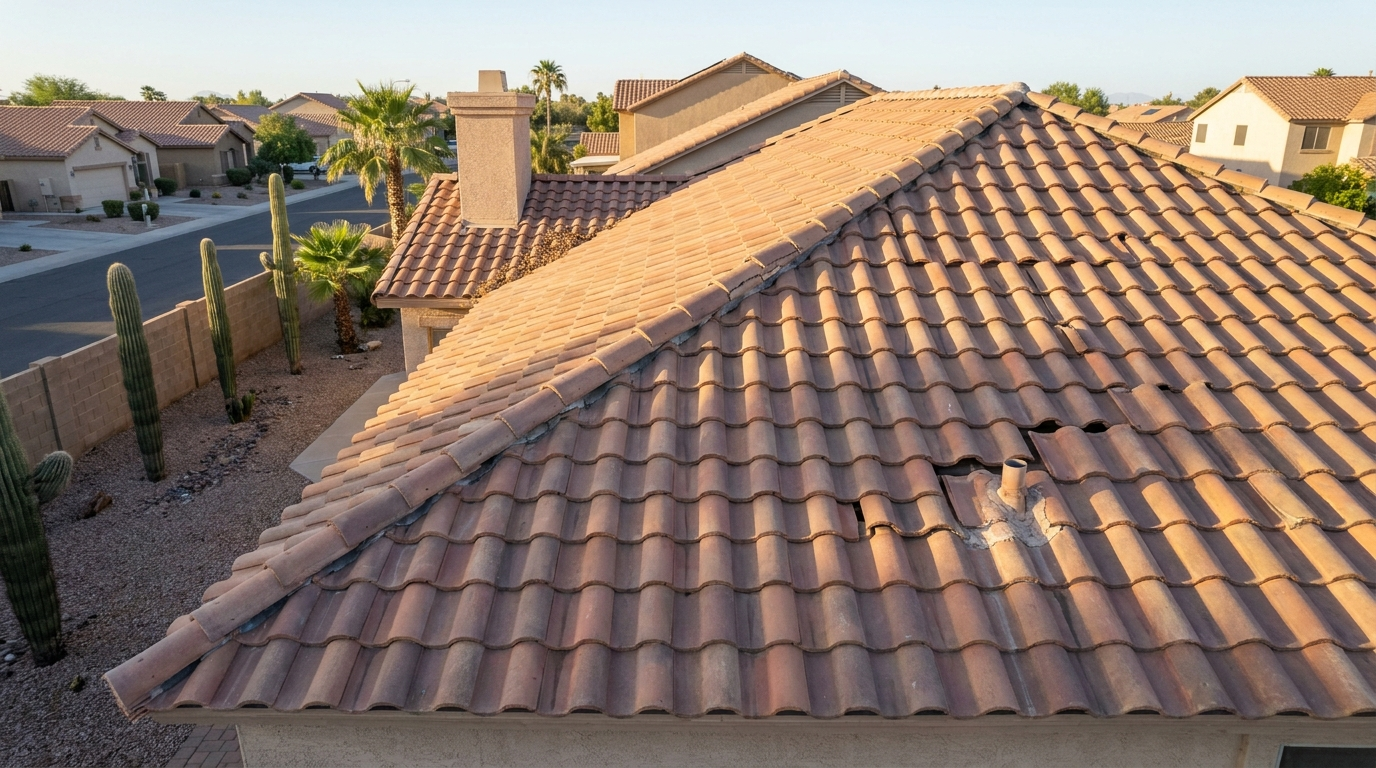
Short answer: You need a new roof in Arizona when your shingle roof is 18-plus years old with multiple warning signs, or when tile underlayment has exceeded its 15-20 year felt lifespan—even if the tiles look perfect from the street. East Valley heat pushes aging faster than most climates. All Storm Roofing is licensed Arizona ROC #345156 and Tamko Diamond Certified.
Three things tell you whether an Arizona roof needs replacing: what it's made of, how old it is relative to what East Valley heat actually allows, and what's happening underneath what you can see from the driveway. That's the whole framework. Everything else flows from those three.
Arizona heat compresses the aging timeline faster than most homeowners realize. A shingle that would last 25 years in a moderate climate might be done at 18 in Gilbert. A tile roof that looks perfect from the street can be failing through underlayment that's been baking and cracking under those concrete tiles for two decades. We walk into that second scenario constantly. The first one, homeowners usually know about. The second, they almost never see coming.
The Short Answer by Material
3-tab asphalt shingles: Real East Valley lifespan is 12-18 years. Past 15 with no professional inspection, you're guessing about something you shouldn't guess about.
Architectural (dimensional) shingles: Thicker and better than 3-tab. Still heat-limited. East Valley lifespan: 20-25 years. Past that, you're on borrowed time.
Concrete tile: The tile itself lasts 40-50 years. The underlayment beneath it does not. Felt underlayment in Arizona heat lasts 15-20 years. Synthetic runs 25-35. This is the number Gilbert and Chandler homeowners consistently miss. The tiles look fine. The underlayment underneath may have been failing quietly for years.
Foam/SPF roofs: These need recoating every 5-7 years in East Valley conditions. Let that window pass without a recoat and you lose waterproofing integrity, even if the surface looks solid.
Age alone doesn't force replacement. But age plus two or three of the signs below almost always does.
What the Warning Signs Actually Look Like
Homeowners tend to expect the signal to be obvious. It usually isn't.
Check your gutters after rain. Dark, gritty granules in there are your shingles losing their UV protection layer. Some granule loss over time is expected. Heavy accumulation means the shingles are running out of what protects them.
From the street, look at the shingle edges and surface. Curling or cupping at the edges means heat has been extracting the oils from the asphalt for a while. Curled shingles catch monsoon wind and snap off cleanly. Missing shingles after a storm are a worse sign. That means the adhesive seal strip had already failed before the wind even arrived.
On a tile roof, look for slipped tiles. A tile that's shifted even slightly exposes the underlayment beneath it to direct Arizona sun. That's a serious problem when the underlayment is already near the end of its life.
Now go inside. Attic, daytime, lights off. If daylight comes through the roof deck, water can follow the same path. Look at the rafters for staining or dark spots. Check the insulation for dampness. A musty smell that wasn't there before means something. These signs show up months before a ceiling stain appears. The ceiling stain is the last signal, not the first. By the time you see a brown ring on your drywall, the problem has usually been building in the structure for a while.
One more that people miss: cooling bills climbing without another explanation. A failing asphalt or foam roof transfers heat into the attic in ways that push your AC harder than it needs to work.
What Arizona Heat Does That Other States Don't Have to Think About
On a 115-degree Phoenix day, the surface of an asphalt shingle roof reaches 170-195 degrees Fahrenheit. That's not exaggeration. The oils in asphalt that keep shingles pliable and wind-resistant evaporate under that kind of sustained heat. The shingle dries out. It cracks. Granules start shedding into the gutters. A 10-year-old shingle roof in Gilbert can look the way a 20-year-old shingle looks in the Midwest.
Concrete tile handles the surface heat better. We're fans of tile in the East Valley for this reason. But the underlayment under those tiles is still an asphalt-based or felt product, and it's cooking in the same conditions. Eighteen to twenty-two-year-old tile roofs in Gilbert and Chandler consistently have tiles that look perfectly intact with underlayment that's dried and cracked underneath them.
On top of that, thermal cycling. The roof expands in 115-degree afternoon heat and contracts overnight. That cycle repeats hundreds of times across a Phoenix summer. It stresses the sealants around flashing, vents, and skylights. In Arizona's UV environment, flashing sealant degrades in 5-7 years. Most homeowners never think to check it, because it's not something that fails dramatically.
The Tile Roof Problem That Catches Homeowners Off Guard
This needs its own section. It's the most common misread we see.
Concrete tile roofs look fine for a long time. The tiles don't lose granules. They don't crack from UV. No visible surface wear. So homeowners assume the roof is fine. Tiles look great, no leaks yet, nothing to worry about. That assumption is wrong when the underlayment has a completely different clock running beneath those tiles.
Felt underlayment in Arizona heat: 15-20 years. Synthetic: 25-35 years. Homes built in Gilbert from the mid-1990s through mid-2000s are in or past that window right now.
The warning usually isn't a dramatic, obvious leak. Tile sheds most rain fine. But when a July monsoon drives rain sideways at 60 mph, or when water finds even a small gap at the ridge or a flashing seam, it hits underlayment that's already brittle. The result is a ceiling stain on a roof that looks completely fine from outside. We've explained this pattern in detail before: why your tile roof leaks even though the tiles look fine.
If your tile roof is 18 or more years old and no one has physically lifted tiles to inspect the underlayment, you don't actually know the state of your roof. You know the state of the tile. Those are two different things.
Repair or Replace?
Not every problem is a new roof.
Repair is the right call when damage is isolated: a few shingles missing after a microburst, one slipped tile, a cracked vent boot. The rest of the system is in solid shape for its age and you're still inside the expected lifespan by a few years.
Replacement is the right call when the shingle roof is 18+ years and showing multiple signals. When there have been three or more patch jobs in the past two years, because water is finding new paths as the whole system weakens. When tile underlayment is at or past its felt lifespan on an original product.
A rule that consistently holds up: when repair costs are heading toward 30% of a full replacement estimate, replacement is almost always better math. Patches fix spots. They don't fix a system that has run its course.
East Valley Specifics
Gilbert, Chandler, and Queen Creek are in one of the highest UV-intensity zones in the country. Triple digits from late May through September. And homes built in the 1995-2010 development boom are squarely in the replacement window right now. Shingle roofs at or past their lifespan. Tile underlayment at or past the felt threshold.
Monsoon layers mechanical stress on top of that UV damage. A microburst in the East Valley typically runs 60-70 mph, with stronger gusts pushing past that. A shingle that was holding through July heat is a different product once monsoon winds have worked the adhesive strips. The combination of relentless UV degradation and monsoon wind stress is what makes Arizona roofing a genuinely different calculation than anywhere else in the country.
Know your home's build date. If you're in a Gilbert or Chandler neighborhood from 1995 to 2010, find the roof history. Permit records are the most reliable way to do it. We put together a guide on exactly that: how to find out how old your roof is in Arizona.
And in HOA neighborhoods where every tile roof looks the same from the street: don't let that uniformity fool you. If your subdivision went up in 2001, every tile roof on your street entered the same risk window at the same time. "The neighbors' roof looks fine" tells you almost nothing.
Free Inspection, No Sales Pitch
We're based in Gilbert and do free roof inspections across the East Valley. If you're in Gilbert, Chandler, Mesa, or Queen Creek and want a real answer on where your roof stands, give us a call at (602) 806-6806. No pressure, no upsell.
If you'd rather start with a ground-level walkthrough, our pre-monsoon roof inspection checklist covers what you can check from the ground before calling anyone.
Tuuta Pulotu is the CEO and co-founder of All Storm Roofing + Construction. He was born and raised in Arizona. His mom is from Hawaii, his dad from Tonga, and Tuuta grew up in the trades working alongside his father, who's been running a landscaping and masonry crew in the Valley for over thirty years.
Before founding All Storm in 2021, Tuuta spent years in solar sales. Long enough to watch too many East Valley homeowners get pushed into roof decisions they didn't fully understand. He started All Storm to flip that conversation: be the contractor who tells homeowners what's actually going on with their roof, even when the truth costs him the job.
He runs All Storm out of Gilbert, where he lives with his wife and four kids.
AZ ROC #345156. Tamko Diamond Certified. The only Tamko Diamond Certified roofing contractor in Arizona.
WRITTEN BY
Tuuta Pulotu is the CEO and co-founder of All Storm Roofing + Construction. He was born and raised in Arizona. His mom is from Hawaii, his dad from Tonga, and Tuuta grew up in the trades working alongside his father, who's been running a landscaping and masonry crew in the Valley for over thirty years. Before founding All Storm in 2021, Tuuta spent years in solar sales. Long enough to watch too many East Valley homeowners get pushed into roof decisions they didn't fully understand. He started All Storm to flip that conversation: be the contractor who tells homeowners what's actually going on with their roof, even when the truth costs him the job. He runs All Storm out of Gilbert, where he lives with his wife and four kids. AZ ROC #345156. Tamko Diamond Certified. The only Tamko Diamond Certified roofing contractor in Arizona.
Worried about your roof?
Get a free, no-pressure inspection from a Gilbert team that gives honest answers — not pressure to replace.
Schedule Free Inspection