Monsoon Damage or Just Age? How to Tell on a Mesa Roof
→ QUICK ANSWER
Hail punctures, wind creases and broken tile point to a storm. Granule loss and old unsealed shingles point to age. Here's how to tell the difference on a Mesa roof.

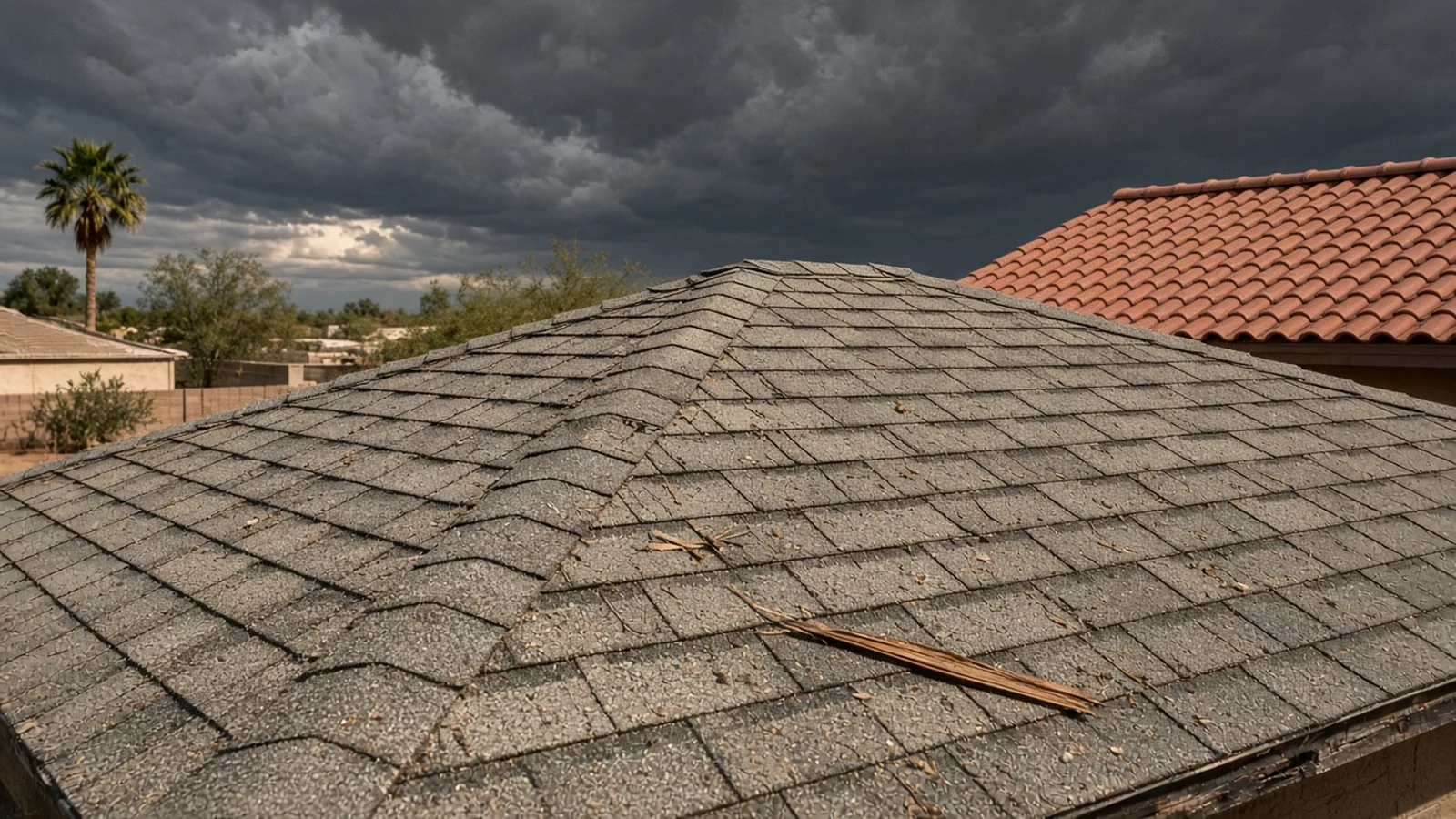
Roofing engineers draw a pretty clear line. On shingles, hail damage means a puncture or a fracture, and granule loss by itself is normal weathering. Wind leaves creases, folds or tears, most often at the eaves, hips and ridges. On tile, breaks usually come from hail or wind-blown debris, rarely from wind alone.
So if something looks off after a storm, it isn't automatically storm damage, and it isn't automatically age. An inspection with photos is the clearest way to tell. Mesa has seen both kinds of trouble.
Is it monsoon damage or just age?
Everything in this table comes from engineering and industry sources: Haag Engineering writing in NRCA's Professional Roofing (2009), IIBEC (2017), and the TRI Alliance tile group.
| What you're looking at | Points to a storm | Points to age |
|---|---|---|
| Shingle surface | A puncture or fracture, or a soft "bruise" you can feel with your fingertips | Granule loss, or worn spots showing the dark coating with no fractures |
| Shingle shape | Creases, folds, tears, or missing pieces, often at eaves, hips and ridges | A shingle that's unsealed but not creased, folded or torn |
| Tile breaks | Several cracks spreading out from one impact point, or tiles broken by flying debris | Cracks in a straight line, which usually come from foot traffic |
| Surface marks | Fresh hail "spatter" marks, clean spots where hail knocked grime off. These usually last about a year | No fresh spatter marks. Haag says those usually last only about a year |
One honest caveat: a roof can have both. An older roof can take a storm hit, and a storm can finish off something that was already worn out. That's where a trained eye and good photos earn their keep.
A real example from nearby Gilbert, September 2026, shows both on one tile roof. Recent wind blew tiles off one area, and a roof vent was damaged. The rest of the tile was in good condition, but the underlayment was curling and deteriorating in multiple areas, a sign of age, not storm. We gave two written options: replace the underlayment and reuse the tile, or repair just the wind-damaged area. Our write-up said the repair "would take care of the immediate storm damage, but it would not address the aging underlayment throughout the rest of the roof." The homeowner chose the repair.
Our opinion, if you're a Mesa neighbor who spots granule loss after a storm: don't assume it's just age. Get it looked at before you decide either way.
What does wind damage look like on a Mesa tile roof?
Mesa has tile damage on the official record. On September 12, 2023, at about 9:10 PM, NOAA logged estimated gusts of about 80 mph that uprooted large trees and damaged "ceramic tiles on rooftops" in the Mountain Bridge neighborhood near East McKellips Road.
More recently, on the evening of July 20, 2026, the National Weather Service recorded a 53 mph gust 4 miles northwest of East Mesa at 8:15 PM. NOAA's summary of that storm describes gusts of 35 to 55 mph across the Phoenix area, with some downed trees and power lines. Here's our rundown of the July 20 monsoon wind.
TRI Alliance says broken tiles rarely come from wind by itself. In a high wind storm, tiles usually break when something hits them, like tree limbs or yard decor. TRI also says broken tiles don't, on their own, prove the wind lifted the tiles.
On shingle roofs, IIBEC's engineers say a wind event leaves lasting evidence: creases, folds, tears, or missing shingles or pieces. That shows up most on the parts of the roof that catch the most wind, like eaves, hips and ridges.
What does hail damage look like?
According to Haag's engineers, a shingle has to be punctured or fractured by hail before it counts as functionally damaged. Sometimes the fracture is hard to see but feels like a soft spot, which roofers call a "bruise." On tile, hail fractures usually spread out from a single impact point, and the corners and edges are the most likely to break.
Size matters. Haag's table lists the smallest hail that can damage each roof type:
- About 1 inch for three-tab shingles
- About 1¼ inches for laminated shingles
- About 1½ inches for clay tile
- About 1¾ inches for concrete tile
TRI Alliance says tile may break in hail larger than 2 inches. So for tile, think "about 1½ inches and up."
Mesa has had hail in that range. On October 16, 2022, NOAA logged hailstones up to 1.5 inches near Brown Road and Gilbert Road in Mesa, with no damage reported. That's right around where Haag says clay tile damage can start.
What does normal aging look like?
Age is slower and more even. Haag's engineers call granule loss "normal weathering" that starts the day a shingle is made. Shingles worn down to the coating, with no fractures, are usually near the end of their life. That's age, not hail.
Unsealed shingles are another age sign people mistake for wind. IIBEC cites research finding that shingles tend to stay sealed for about their first 4 to 5 years, and that unsealing becomes more common after that as the roof ages.
Mesa's heat speeds all of this along. East Mesa averages about 112 days a year at 100°F or hotter, based on NOAA's 1991 to 2020 normals. Tile ages differently: on most East Valley tile roofs, the underlayment wears out long before the tile does. Our post on tile roof underlayment lifespan covers that.
Mesa's housing is older than its neighbors to the south and east. In the Census Bureau's 2024 five year estimates, the median Mesa home was built in 1989, compared with 1997 in Chandler, 2003 in Gilbert and 2012 in Queen Creek. About 52.8% of Mesa homes were built in the 1980s or earlier, and about 43% went up in the 1970s and 1980s alone. House age isn't roof age, since many of those homes have been re-roofed. But it explains why so many Mesa roofs show both age and storm wear. If an inspection points to repair or replacement, our roofing services page covers what we do.
Why does the difference matter for insurance?
Because storm damage and wear lead to different conversations with your insurer, and your insurer, not your roofer, decides what your policy covers.
What helps is clear evidence. TRI Alliance says a trained professional can usually tell a fresh tile break from an old one. Photos taken soon after a storm show what the roof looked like at the time.
If you file a claim, here's how we help. With your permission, we meet the adjuster at your home for the inspection. At your request, we send photos and inspection reports to your insurance company, and we prepare supplements when they're needed. We don't interpret your coverage.
If my Mesa home is historic, what changes?
Mesa's residential construction FAQ says: "You can replace your roof with the same roof material type or better, if you follow the manufacturer's instructions. If your home is historic, Planning approval is required."
If your home is in a historic district or is locally designated, check with Mesa's Historic Preservation Office before any roof work. We can pull a permit for your re-roof when one is required. For permit questions, Mesa Permit Services is at (480) 644-4273.
FAQ
How soon after a storm should I get my roof checked?
Once it's safe to have someone look. Fresh damage is easier to document, and hail spatter marks usually fade within about a year. Your insurance company or agent can tell you about any deadlines in your policy.
Can I check for storm damage from the ground?
You can spot a lot from the ground. TRI Alliance says broken tile is usually visible to the naked eye. Stay off the roof, though. NRCA doesn't recommend homeowners walk on roofs without experience and safety equipment, and walking on tile can break it. For a full assessment, TRI recommends a trained roofing professional.
Do roofing companies in Mesa help with insurance claims?
We do, within clear limits. With your permission, we meet the adjuster at your home for the inspection, send photos and inspection reports to your insurer at your request, and prepare supplements. You file the claim, and your insurer decides coverage.
Book an inspection in Mesa
Book an inspection with us. All Storm Roofing was founded in 2022. Our office is in Gilbert, just south of Mesa, and we serve the whole Valley down to Tucson. Our Mesa roofing page has more on our work here. We answer 24/7 at (602) 806-6806, or you can book an inspection online.
WRITTEN BY
Tuuta Pulotu is the CEO and co-founder of All Storm Roofing. He was born and raised in Arizona. His mom is from Hawaii, his dad from Tonga, and Tuuta grew up in the trades working alongside his father, who's been running a landscaping and masonry crew in the Valley. Before founding All Storm in 2022, Tuuta spent years in solar sales. Long enough to watch too many East Valley homeowners get pushed into roof decisions they didn't fully understand. He started All Storm to flip that conversation: be the contractor who tells homeowners what's actually going on with their roof, even when the truth costs him the job. He runs All Storm out of Gilbert, where he lives with his wife and four kids. AZ ROC #345156. TAMKO Pro Diamond Certified. The only TAMKO Pro Diamond Certified contractor in Arizona.