How Long Does Tile Roof Underlayment Last in Gilbert AZ? A Real Answer for East Valley Homeowners
→ QUICK ANSWER
Gilbert homes built before 2008 are entering the underlayment replacement window right now. The tiles look fine. That doesn't mean the roof is fine. Here's why underlayment fails first.

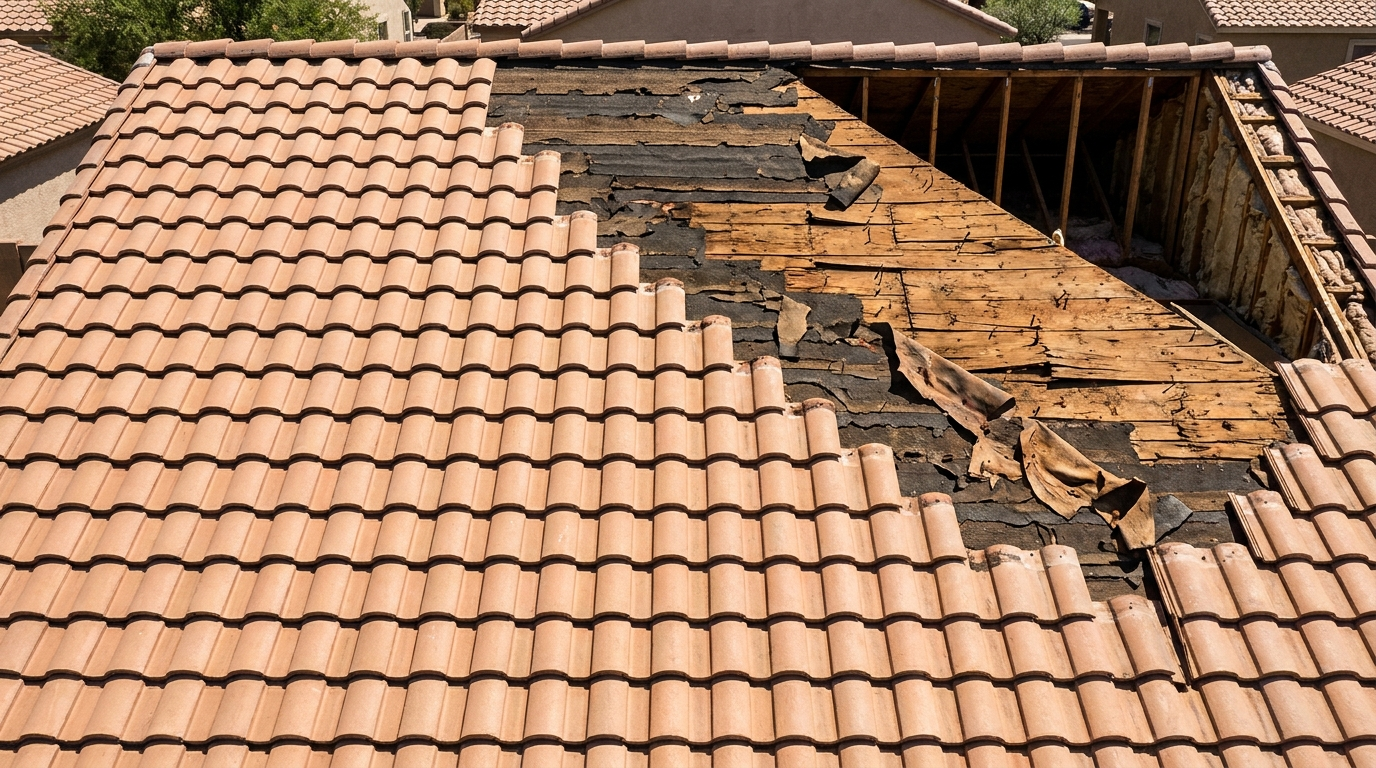
Walk through any neighborhood in Gilbert that went up between 1995 and 2008. The roofs look fine. Intact tiles, no missing pieces, nothing from the street that says "problem." But a lot of those houses are sitting on felt underlayment that's 20 to 25 years old right now. Felt in the East Valley does not have 25 years in it.
The tiles last. The layer under them does not. That's the gap most Gilbert homeowners don't find out about until there's a water stain on the bedroom ceiling after a July storm.
Your Tile Looks Fine. That Doesn't Mean Your Roof Is Fine.
Concrete tile roofs in Arizona typically last 40 to 50 years. That's the number everyone knows. What almost nobody explains clearly is that the tiles are not your waterproofing. The underlayment beneath them is. And those two layers are running on completely different clocks.
Felt underlayment, which was standard on most East Valley tile installs from the mid-1990s through the early 2000s, lasts about 15 to 20 years in Arizona's climate. Synthetic underlayment, which started becoming more common around the mid-2000s, runs 25 to 35 years. Either way, you're replacing the underlayment well before the tiles above it wear out.
So if you're standing in front of a Gilbert home that was built in 2001, you're looking at underlayment that's 24 or 25 years old. If it's felt, it's past expected life. If it's synthetic, it's at the edge of its window or past it depending on the product and how the roof was ventilated.
The tiles won't tell you any of this. They look exactly the same as they did ten years ago. That's kind of the whole problem.
What Underlayment Actually Does (And Why It Fails Before Your Tiles Do)
Tile roofs are a weather-shedding system, not a sealed waterproof barrier. The tiles overlap and channel rain down the slope. That works great when rain falls straight down. But monsoon storms in Gilbert don't always do that. Wind pushes water sideways and upward. A loose tile creates an entry point. That's when the underlayment has to catch what the tiles miss.
In extreme heat, underlayment dries out. Felt becomes brittle. It cracks at the overlaps, particularly on south- and west-facing pitches where UV exposure is heaviest. It tears when tiles shift from thermal expansion, which happens every single day out here when the temperature runs from the high 70s at dawn to 110 by mid-afternoon. Each crack is a path for water to reach the decking.
Sub-tile surface temperatures in an Arizona summer can exceed 150°F. Felt underlayment is not built to absorb that for 20 straight years. Synthetic handles the heat stress better, but even the good synthetic products degrade faster here than they would in a milder climate.
The tiles above stay intact because concrete and clay are designed specifically to handle intense sun and heat. The felt beneath them was not designed for the same mission. That's the mismatch that catches homeowners off guard.
The East Valley Housing Timeline: Why 2026 Is the Crossover Year for a Lot of Gilbert Homes
Gilbert exploded during a very specific window. According to Census data, the median construction year for homes in Gilbert is 2003. More than a third of the town's housing stock was built between 2000 and 2009. Add the homes built in the late 1990s and you're looking at a big slice of Gilbert neighborhoods that are now 16 to 30 years old.
That puts a lot of those roofs right in the window where felt underlayment has run its clock.
Neighborhoods like Power Ranch, Finley Farms, Val Vista Lakes, and the developments that went up along Higley and Greenfield during that run are all in this zone right now. Not every house. But enough that if you live in one of those neighborhoods and haven't had a roofing contractor look underneath your tiles in the last few years, you're operating on incomplete information.
The pattern we see on inspections out here: homeowner has lived there 8 or 10 years. Roof looks solid. They get their first real monsoon leak. They expect us to replace one tile. We get on the roof, pull a few tiles near the entry point, and the underlayment is dried out and cracked across a wide area. The tile wasn't the failure. The tile was the last thing to move before water found the path.
That story is not unusual in Gilbert in 2026. It's becoming the most common thing we deal with.
How to Tell If Your Underlayment Is Failing Without Getting on the Roof
You can't fully diagnose underlayment from the street. But you can spot signals that justify getting a professional up there.
From outside, stand back and use binoculars. Look for tiles that have shifted or cracked. One tile sitting noticeably higher or lower than the surrounding field means the underlayment beneath it has been exposed, and wind-driven rain has had a direct path to the decking. Look along the eave line too. If you can see gray or black material showing through gaps between tiles, that's deteriorated underlayment visible from the ground and it needs attention now.
From the attic, go up on a bright day and turn off your flashlight. If you see daylight coming through the roof deck boards, that's a problem. Look for brown staining on the underside of the decking, moisture in the insulation, or a musty smell. Any of those means water has been finding its way through for a while.
From inside the house, a ceiling stain that shows up during or after a monsoon is almost always a roof issue. Important thing to know: the stain on your ceiling is rarely directly under the entry point. Water travels along rafter framing before it drips through drywall. The entry point can be two or three feet away from where you see the stain.
The age test is the simplest one. If your Gilbert home was built before 2005 and has never had an underlayment replacement, you're in the window where an inspection is warranted regardless of how the roof looks. The roof looking fine does not mean the underlayment is fine.
The Difference Between Reusing Tiles and Buying New Ones (And When Each Makes Sense)
This is something a lot of homeowners don't realize when they first hear "underlayment replacement." The tiles don't have to go in the trash. Underlayment replacement means removing the tiles, stripping off the old underlayment, installing new material, and resetting the tiles. If those tiles are structurally intact, most of them come back down on the new underlayment.
That's a very different cost picture than a full tear-off and replacement. Reusing existing tiles costs significantly less.
But there are situations where replacement makes more sense. If the existing tiles are cracked or brittle across a large area, if the profile is discontinued and you can't match the tiles that break during removal, or if there's already deck damage that requires full access, buying new tile is the right call.
When we do an underlayment-only job, we plan for some breakage during tile removal. That's normal. We order additional matching tile to cover it. The homeowner ends up with a new underlayment, re-set original tiles, and a handful of new matching tiles where breakage happened. If everything was installed with a current common profile, this approach works well.
One thing worth checking before any job: whether your tile profile is still in production. Some of the profiles common in Gilbert in the late 1990s and early 2000s have been discontinued. If that's the case for your roof, it's worth knowing before you need to replace underlayment, not after.
What a Tile Roof Lifespan Actually Looks Like in Gilbert's Climate
Here's how the clock actually runs on a tile roof in the East Valley.
Concrete tiles: 40 to 50 years. That number holds in Arizona. The heat fades the color over time and surface absorption increases on concrete tile as it ages, but the structural integrity holds up well under UV and the daily thermal cycling we get out here.
Underlayment: felt lasts 15 to 20 years in the East Valley. Synthetic lasts 25 to 35 years. Not ranges invented to justify roof jobs. Those numbers reflect how these materials respond to heat stress and UV under a tile system in Arizona.
Flashing and caulk: a different clock entirely. Sealants and flashing caulk typically degrade in 5 to 7 years under Arizona UV. Flashing failure is often the first leak source on a tile roof, even before the underlayment fully gives out. If your roof is leaking and the tiles look fine, check the flashing around pipe boots, vents, and where the roof meets any walls.
The deck: when underlayment fails and water reaches the plywood or OSB decking, delamination starts. That's when the repair scope gets expensive. Getting to it at the underlayment stage is always cheaper than waiting until the deck is soft.
A Gilbert home built in 2001 with felt underlayment has underlayment that's past expected life right now in 2026. A home built in 2001 with synthetic has maybe 5 to 10 years left depending on product quality. The tiles on both roofs look the same from the street.
That's the situation. Worth knowing about before the monsoon hits.
If you want to understand the full picture of what's happening beneath your tile on a pre-monsoon checklist, take a look at our pre-monsoon roof inspection checklist for East Valley homeowners. And if your tiles look perfect but you're already getting leaks, read why a tile roof leaks when every tile looks fine before you call anyone.
Get a Real Answer: Free Inspection for Gilbert and Chandler Homeowners
If your Gilbert home was built before 2008 and you haven't had a professional look under your tiles in the last few years, honest answer is: you don't know what's under there. The roof looking fine from the street tells you about the tiles. It doesn't tell you about the felt that's been baking underneath them for 20 years.
We're based in Gilbert. We do free roof inspections across the East Valley including Gilbert, Chandler, Mesa, and Queen Creek. No pressure, no sales pitch. If the underlayment is holding, we'll tell you that. If it isn't, we'll tell you what your options are and what the job actually involves.
Call us at (602) 806-6806. We can usually get out within the week.
What an underlayment replacement involves, with your existing tile reset rather than replaced, is laid out step by step on our tile roof repair and underlayment replacement in Gilbert page.
Tuuta Pulotu is the CEO and co-founder of All Storm Roofing + Construction. He was born and raised in Arizona. His mom is from Hawaii, his dad from Tonga, and Tuuta grew up in the trades working alongside his father, who's been running a landscaping and masonry crew in the Valley for over thirty years.
Before founding All Storm in 2021, Tuuta spent years in solar sales. Long enough to watch too many East Valley homeowners get pushed into roof decisions they didn't fully understand. He started All Storm to flip that conversation: be the contractor who tells homeowners what's actually going on with their roof, even when the truth costs him the job.
He runs All Storm out of Gilbert, where he lives with his wife and four kids.
AZ ROC #345156. Tamko Diamond Certified. The only Tamko Diamond Certified roofing contractor in Arizona.
WRITTEN BY
Tuuta Pulotu is the CEO and co-founder of All Storm Roofing + Construction. He was born and raised in Arizona. His mom is from Hawaii, his dad from Tonga, and Tuuta grew up in the trades working alongside his father, who's been running a landscaping and masonry crew in the Valley for over thirty years. Before founding All Storm in 2021, Tuuta spent years in solar sales. Long enough to watch too many East Valley homeowners get pushed into roof decisions they didn't fully understand. He started All Storm to flip that conversation: be the contractor who tells homeowners what's actually going on with their roof, even when the truth costs him the job. He runs All Storm out of Gilbert, where he lives with his wife and four kids. AZ ROC #345156. Tamko Diamond Certified. The only Tamko Diamond Certified roofing contractor in Arizona.
Worried about your roof?
Get a free, no-pressure inspection from a Gilbert team that gives honest answers — not pressure to replace.
Schedule Free Inspection