How to Read a Roof Replacement Financing Offer in Arizona Before You Sign It
→ QUICK ANSWER
A roofing contractor just handed you a no-money-down financing offer. Here is what same-as-cash really means, what red flags to look for, and how to compare your options.

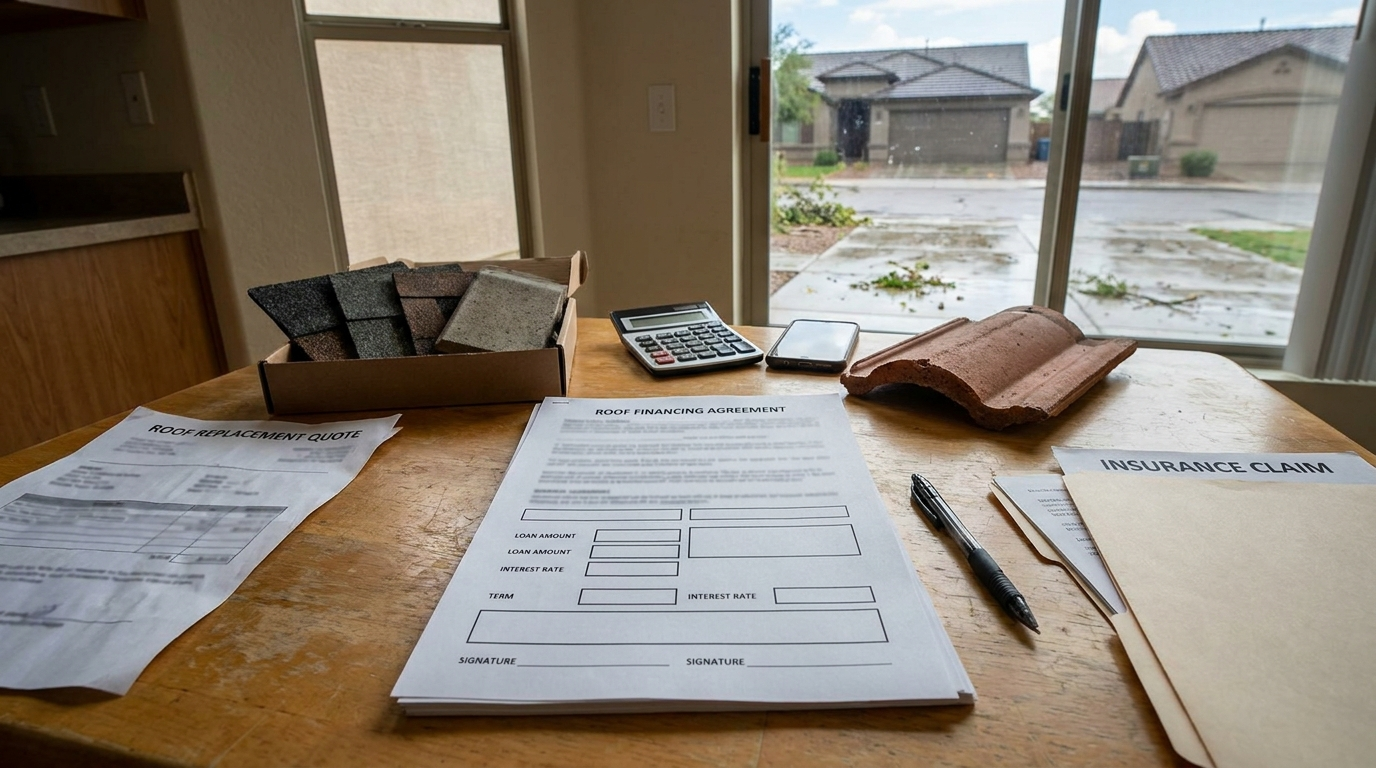
Short answer: Yes, Arizona homeowners can get no-money-down roof replacement financing through legitimate contractors and third-party lenders, but terms vary widely. Always confirm whether an offer is true 0% or deferred interest before signing. On a $14,000 East Valley job, retroactive deferred interest can reach $2,500 to $3,000. All Storm Roofing is licensed Arizona ROC #345156 and Tamko Diamond Certified.
A roofer just handed you a financing offer. No money down. Zero interest for 18 months. Looks pretty reasonable.
Here is what you actually have in your hand.
We are a roofing contractor, not a bank. But we have watched enough East Valley homeowners sign financing documents they did not fully understand that it felt dishonest not to write this post.
The Contractor Financing Offer Sitting on Your Kitchen Table
Say the quote is $14,000 for a tile re-roof in Gilbert. Contractor slides a one-page sheet across the table. Zero down. No interest for 12 months. Some monthly payment after that.
That can be a perfectly fine deal. Or it can be a setup for a very unpleasant surprise in month 13.
Four things that paper almost never tells you clearly: who the lender actually is, what the full APR becomes when the promotional period ends, whether interest is already accumulating on your entire balance right now without showing up on any statement, and what happens if you come up a dollar short on the payoff deadline.
Those four questions are the real deal. Get answers to them before you sign.
What "Same-as-Cash" Actually Means (and What Happens at Month 13)
Same-as-cash is not the same as 0% APR. Most people think it is. That assumption is where the expensive surprises come from.
A true 0% APR offer: no interest charges during the promotional window. At the end, the remaining balance starts accruing at the stated rate going forward.
Deferred interest is built differently. Interest runs on your full original balance from day one. You just do not see it. Pay the whole thing off before the deadline and the lender waives all of it. Miss that deadline by a dollar, and they add every bit of that accrued interest back to your balance. Retroactively. On the full original amount, not on what you still owe.
On a $14,000 job with a post-promo rate around 26%, that retroactive hit can easily land around $2,500 to $3,000. A homeowner who thought they were close to paid off discovers they owe more than they expected.
The sentence to look for: "interest will be charged to your account from the purchase date." Find that phrase and you know it is deferred interest, not a true 0%. Most contractor financing through platforms like GreenSky or Synchrony works this way.
Here is the plan if you want to use same-as-cash correctly: divide the full balance by the number of promotional months. Set up auto-pay for exactly that amount. Do not use the account for anything else. Do all of that and it costs you nothing extra. But if there is honest doubt about hitting the deadline, a fixed-rate personal loan will almost always cost you less over the full term.
Long-Term Financing: When a Fixed APR Actually Makes Sense
Not everyone can clear $14,000 in 12-18 months. If you cannot, a personal loan with a fixed APR is a better option than trying to race a deferred interest deadline you are not certain you will hit.
Home improvement personal loans run about 7% to 36% right now. Good credit, stable income: most borrowers land around 8-12%. On $14,000 over five years at 10%, the monthly payment is around $297. Fixed. Predictable. No clock.
Something contractors do not always mention: some third-party lenders pay the contractor a referral fee of around 5-15% of the loan amount. It is embedded in your project cost, not listed on your quote. That referral arrangement gives the contractor a financial reason to recommend their preferred lender. Worth knowing when that recommendation comes with a lot of enthusiasm.
If you have real home equity and want the cheapest available rate, Arizona HELOCs are averaging around 7-8.25% APR as of summer 2026. Lower than most personal loans. The real cost is that your house is collateral and setup takes several weeks. For a planned replacement, that timeline works. For an urgent post-storm repair, it might not.
Personal Loans vs. HELOC vs. Contractor Financing: The Real Tradeoff
Same-as-cash: zero extra cost if you hit the deadline. Expensive if you do not. That is the whole story.
Personal loan: costs something from day one. But you always know exactly what. Rates around 8-15% for decent credit, no deadline trap, no retroactive surprise.
HELOC: lowest rates available right now. Variable rate risk, your house as collateral, and a few weeks of setup time. Right tool for homeowners with substantial equity and no rush.
Credit card: realistic only for smaller repairs under $5,000 with a genuine plan to clear the balance during an introductory period.
The actual honest answer: if your credit is solid and you can guarantee hitting the payoff deadline, contractor financing costs you nothing extra. Real doubt about that? Get your own bank quote first. Then compare total cost over the full repayment term, not the monthly payment number.
Red Flags in Roofing Financing Offers (What Storm-Chasers Do With Payment Plans)
Monsoon comes through Gilbert or Queen Creek. Within 48 hours, certain contractors are already knocking on doors. Quick quote. Financing ready to go.
That speed is intentional. It is part of the model.
The urgency push comes first. "We can start Monday if you sign today." A homeowner dealing with roof damage wants the problem solved. Stress and time pressure push people to skim things they should read. Storm chasers count on this.
Watch for blank spaces on any financing documents. We have personally seen addendums come through with the APR field empty, the repayment term empty, the penalty structure empty. A legitimate lender fills in every line. A contractor filling in numbers after the signature is a different arrangement than you think you agreed to.
Large upfront deposit plus financing is a structural problem. Normal deposits in roofing run 10-20% for materials. A contractor wanting a substantial deposit on top of asking you to sign financing means they collect quickly and you carry all the risk going forward. That arrangement benefits exactly one party.
The deductible pitch. Some contractors suggest they can finance your deductible, or quietly offer to absorb it. Absorbing a deductible is insurance fraud in Arizona. Financing it through a contractor-linked product is your call, but make that call with the full terms in front of you, not at the door with someone waiting for an answer.
ROC license check. Before signing anything financial: roc.az.gov. It takes two minutes. Do it every time.
What a Legitimate Financing Offer from a Gilbert Contractor Looks Like
A real financing offer answers these from the document itself, without you having to ask the contractor: who is the lender, what is the promotional rate and how long it runs, what is the full APR after the promotional period, is this deferred interest or a true 0% product, what triggers a penalty, what happens if a payment is missed.
If the contractor cannot answer those from the paper they handed you, they have not actually read the paper. That is a problem regardless of how much you like the contractor.
We offer financing options at All Storm. What we do before anyone signs is sit down and walk through what the offer actually costs under different payoff scenarios. Not because we are required to. Because homeowners who understand what they are agreeing to make better decisions. That is the whole point of the conversation.
For context: All Storm is based in Gilbert and we hold AZ ROC #345156. We are Tamko Diamond Certified, the only Tamko Diamond Certified roofing contractor in Arizona.
The Insurance-Plus-Financing Scenario: When You Have a Partial Claim
Most of the East Valley homeowners who end up needing financing post-monsoon are here for one of two reasons.
ACV policy. The insurer pays the depreciated value of the roof. Not what it costs to replace today. On a 15-year-old shingle roof in Chandler, that check might land at $5,000 to $7,000 on a $14,000 replacement. The gap is yours.
RCV policy, waiting on the second check. Replacement cost policies often work in two stages. First check covers the ACV portion. Second check, the depreciation holdback, arrives after the completed work is documented with the insurer. That gap while you wait is real and needs to come from somewhere.
Financing the gap short-term while waiting for the depreciation release often makes sense. But call your insurer before signing any financing offer. Ask what policy type you have and when the second payment would land if applicable. If it shows up in 30-60 days, you might not need outside financing at all.
See also: Does homeowners insurance cover monsoon roof damage in Arizona? and what roof replacement actually costs in the East Valley.
Quick Reference: Financing Questions Answered
Can Arizona homeowners get no money down roof replacement financing? Yes. Legitimate contractors and third-party lenders offer it. The terms vary widely, and that variation matters.
What is the real difference between same-as-cash and 0% APR? With a true 0% offer, no interest accrues during the promotional period. With deferred interest (same-as-cash), interest builds from day one and gets added retroactively if you miss the payoff deadline.
What do Arizona HELOC rates look like right now? As of summer 2026, Arizona HELOCs are averaging around 7-8.25% APR. Typically lower than personal loans and contractor financing products.
What is the biggest single red flag in a financing offer? Blank fields anywhere on the document. Every term should be specified before you sign.
Should you finance if you have an insurance claim pending? Check your policy type first. RCV policyholders may have a second payment arriving in 30-60 days that covers the gap. ACV policyholders often need to finance the shortfall.
If You Are in the East Valley and Have Questions
If something in this post lined up with what you are looking at right now, we are happy to take a look at your roof and have an honest conversation about what it needs and how to pay for it without getting burned.
We work across Gilbert, Chandler, Mesa, and Queen Creek. Free inspection, no pressure, no financing pitch.
(602) 806-6806
AZ ROC #345156.
WRITTEN BY
Tuuta Pulotu is the CEO and co-founder of All Storm Roofing + Construction. He was born and raised in Arizona. His mom is from Hawaii, his dad from Tonga, and Tuuta grew up in the trades working alongside his father, who's been running a landscaping and masonry crew in the Valley for over thirty years. Before founding All Storm in 2021, Tuuta spent years in solar sales. Long enough to watch too many East Valley homeowners get pushed into roof decisions they didn't fully understand. He started All Storm to flip that conversation: be the contractor who tells homeowners what's actually going on with their roof, even when the truth costs him the job. He runs All Storm out of Gilbert, where he lives with his wife and four kids. AZ ROC #345156. Tamko Diamond Certified. The only Tamko Diamond Certified roofing contractor in Arizona.
Worried about your roof?
Get a free, no-pressure inspection from a Gilbert team that gives honest answers — not pressure to replace.
Schedule Free Inspection