What Makes a Good Tile Roofer Different From a Shingle Roofer in Gilbert, AZ
→ QUICK ANSWER
Most Gilbert roofers say they do tile. Many don't really know it. Here's what tile-specific competency looks like, five questions to ask before you hire, and what to watch for from the driveway.

Not Every Roofer Who Advertises Tile Actually Knows Tile
If you're in Gilbert and need work done on your concrete tile roof, nearly every roofer in the East Valley will say yes to the job. Most of them do shingles. That's not an accusation. It's just how the market shakes out, and it matters more than most homeowners expect.
Tile roofing is its own trade. The techniques, the tools, the sequencing, even the way you walk across the roof are completely different from shingle work. A contractor running 90% shingle installs who picks up tile jobs on the side can technically put tile on a house. Whether they do it right is a different question.
Here's what tile-specific competency actually looks like, what to ask before you hire, and what to watch for during the job.
What Tile Roofing Requires That Shingle Work Doesn't
Weight is the starting point. Concrete tile runs 9 to 12 pounds per square foot. Asphalt shingles run 2 to 4. That's not a detail to round past. It's a structural question. A roofer who lives in the shingle world may not be thinking about deck load when he prices your job.
Batten installation is next, and it's something shingle roofers don't deal with at all. Arizona building code requires horizontal battens on slopes over 7:12. Minimum 1x2 nominal, with drainage gaps to keep water and debris moving. Get the spacing wrong and you've created pockets that hold moisture. Get the fastener count wrong and tiles shift in high winds. These aren't details that cross over from shingle work because shingles don't use battens.
Valley flashing on tile is different too. The pitch of most Gilbert and Chandler homes, combined with the sheer volume of water a monsoon throws at a roof in twenty minutes, means those valleys carry a lot. Experienced tile crews run wider metal valleys with proper lap. Inexperienced crews pattern their valleys after shingle installs. You find out who did which one in July.
Then there's ridge attachment. This is the clearest split between a roofer who knows tile and one who learned it on the job. Mortar alone is the old method, and it's still common. Mortar provides rigidity but cracks over time, especially in the East Valley where daily thermal cycling in triple-digit heat expands and contracts materials constantly. Mechanical fastening holds up better. The right answer on a Gilbert concrete tile roof is mechanical attachment with proper sealing, not a thick coat of mortar and a handshake.
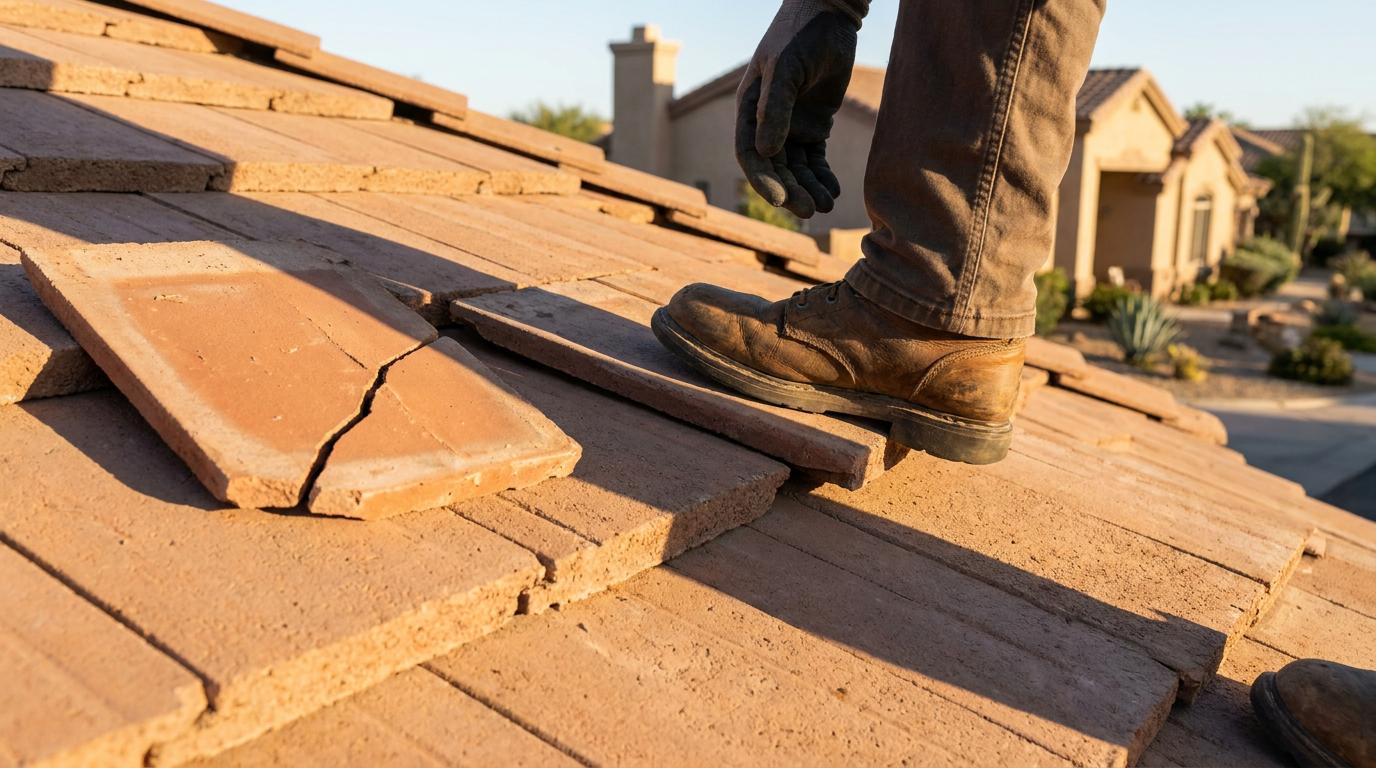
Foot traffic is the other one. Sounds obvious, but most homeowners never see it because they're not on the roof. Concrete tile cracks when stepped on wrong. The correct technique is to step on the lower third of each tile, where it's supported by the tile beneath it and by the deck below. Step in the center of a tile and you're loading the unsupported section. Experienced tile crews have this in their muscle memory. Shingle guys who walk a tile roof the way they walk a shingle roof leave hairline cracks you won't find until water shows up six months later.
Five Questions to Ask a Tile Roofer Before You Sign Anything
What percentage of your annual jobs are tile?
This is the fastest filter. A contractor who runs tile on 15% of jobs is a shingle roofer who takes tile calls when they come in. You want someone where tile is at minimum half their volume. If they can't give you a rough answer, that's an answer.
How do you handle ridge attachment on this roof profile?
A knowledgeable contractor gives you a specific answer about mechanical fastening or foam adhesive. "We do it right" is not an answer. Mortar-only without any mechanical backup means you're looking at cracked ridgelines in a few years. The East Valley's temperature swings make mortar-only a gamble.
What underlayment are you using, and why?
Felt runs 15 to 20 years in Arizona heat. Synthetic runs 25 to 35. On a concrete tile roof that might last 40 to 50 years, that's the difference between replacing the underlayment once or twice over the roof's life. A contractor who defaults to felt without explaining why isn't thinking past the install.
How do your crews walk the roof during installation?
They should tell you crews step on the lower portion of each tile where the overlap supports the load. If they look at you like this is a strange question, that's information too.
Can you show me a completed tile install in the East Valley I can drive by?
Shingle references don't count here. Every contractor has happy shingle customers. You want to see tile specifically, finished recently enough that any installation problems would have shown up.
What to Watch for During the Job (From the Ground)
You won't be on the roof. But you can learn a lot standing in your driveway.
Watch for tile breaking at the staging area. Some breakage in handling is expected on any tile job. A crew cracking multiple tiles just moving product off the truck is telling you something about how carefully they work.
Watch the ridge toward the end of the job. If you're seeing mortar applied without any mechanical fastening, ask about it. You're allowed to ask questions mid-job. Any contractor worth hiring won't mind.
After completion, look at the valley lines from across the street. Clean, straight, symmetrical. Sloppy valleys usually mean sloppy flashing underneath. And check the ridge caps. Run your hand along one if you can reach it. Nothing should rock with hand pressure.
The Mistakes We See From Roofers Who Learned Tile on the Job
The most common one is treating the tile as the waterproofing. It isn't. The tile sheds water. The underlayment is what keeps the house dry. Roofers who don't fully understand tile architecture put all their care into the surface and rush the underlayment. We've pulled tile on homes in Queen Creek and found single-layer underlayment where the pitch and valley layout demanded two layers, with seams placed in the worst possible spots.
Second is mortar-heavy ridges with no mechanical fastening. We see this on 15 to 20-year-old roofs in Power Ranch and Agritopia regularly. The mortar cracked by year three. By year eight the ridge caps were loose. Nobody noticed until a microburst in July sent a few of them into the yard.
Third is mixing shingle-trained and tile-trained crews without proper oversight. Some contractors in the Valley move people between job types based on schedule. The result is tile work performed by people whose hands know shingles. Quality drops fast when nobody on site has tile specifically in their background.
Why the Gilbert and Chandler Market Has More Tile Work Than Most Places in the Country
Most of Gilbert's housing stock was built in the last 25 years. The builders defaulted to concrete tile. It handles UV exposure, thermal cycling, and monsoon loads better than asphalt at these temperatures, so tile became the neighborhood standard across the East Valley in a way you don't see in most of the country.
Concrete tile lasts 40 to 50 years in our climate. Asphalt architectural shingles run 20 to 25 years in Phoenix heat. That lifespan gap is part of why tile dominated here. But it also means there's a massive wave of underlayment replacements happening right now across Gilbert, Chandler, and Queen Creek. The tiles on a lot of these homes look fine. The original felt underlayment installed during the late 1990s and early 2000s build-out is at or past the end of its useful life.
That's why contractor selection matters on tile. Not because the visible surface work is the hard part. Because a contractor who understands tile as a system knows how to lift and reset tiles without cracking the field, how to inspect the deck underneath for rot and damage, and which underlayment is the right call for the next 25 to 30 years.
It's also why the East Valley gets a flood of out-of-area contractors after every major monsoon season. Most of them can handle surface work. The underlayment and flashing quality is where they cut corners. We've seen the results on homes in Seville, Neely Farm, and Finley Farms after back-to-back storm seasons.
For the full framework on vetting any Gilbert roofer, see our 6-question contractor selection guide. And if you've got a tile roof that looks intact but is leaking after monsoon rain, the problem is almost always the underlayment. We covered that exact situation at why your tile roof leaks even when every tile looks fine.
Free Inspection, Tile Roof Expertise
We're a roofing company based in Gilbert. Tile work is a significant part of what we do. If you're seeing lifted ridge caps, old mortar ridgelines, or want to know where your underlayment actually stands before monsoon season hits, we do free inspections across Gilbert, Chandler, Mesa, and Queen Creek.
All Storm is the only Tamko Diamond Certified roofing contractor in Arizona. AZ ROC #345156.
If you want a roofer who'll tell you what's actually happening up there, call us at (602) 806-6806. No upsell, no scare tactics.
See exactly what we do on tile in Gilbert, which of the four tile jobs a roof needs, and what each costs, on our tile roof repair, underlayment and replacement in Gilbert page.
Tuuta Pulotu is the CEO and co-founder of All Storm Roofing + Construction. He was born and raised in Arizona. His mom is from Hawaii, his dad from Tonga, and Tuuta grew up in the trades working alongside his father, who's been running a landscaping and masonry crew in the Valley for over thirty years.
Before founding All Storm in 2021, Tuuta spent years in solar sales. Long enough to watch too many East Valley homeowners get pushed into roof decisions they didn't fully understand. He started All Storm to flip that conversation: be the contractor who tells homeowners what's actually going on with their roof, even when the truth costs him the job.
He runs All Storm out of Gilbert, where he lives with his wife and four kids.
AZ ROC #345156. Tamko Diamond Certified. The only Tamko Diamond Certified roofing contractor in Arizona.
WRITTEN BY
Tuuta Pulotu is the CEO and co-founder of All Storm Roofing + Construction. He was born and raised in Arizona. His mom is from Hawaii, his dad from Tonga, and Tuuta grew up in the trades working alongside his father, who's been running a landscaping and masonry crew in the Valley for over thirty years. Before founding All Storm in 2021, Tuuta spent years in solar sales. Long enough to watch too many East Valley homeowners get pushed into roof decisions they didn't fully understand. He started All Storm to flip that conversation: be the contractor who tells homeowners what's actually going on with their roof, even when the truth costs him the job. He runs All Storm out of Gilbert, where he lives with his wife and four kids. AZ ROC #345156. Tamko Diamond Certified. The only Tamko Diamond Certified roofing contractor in Arizona.
Worried about your roof?
Get a free, no-pressure inspection from a Gilbert team that gives honest answers — not pressure to replace.
Schedule Free Inspection