Haboob Roof Damage in the East Valley: What Dust Storms Actually Do to Your Roof
→ QUICK ANSWER
A haboob strips granules, infiltrates tile gaps, and erodes sealant in ways rain doesn't. Gilbert, Mesa, and Queen Creek roofs take the hardest hit.

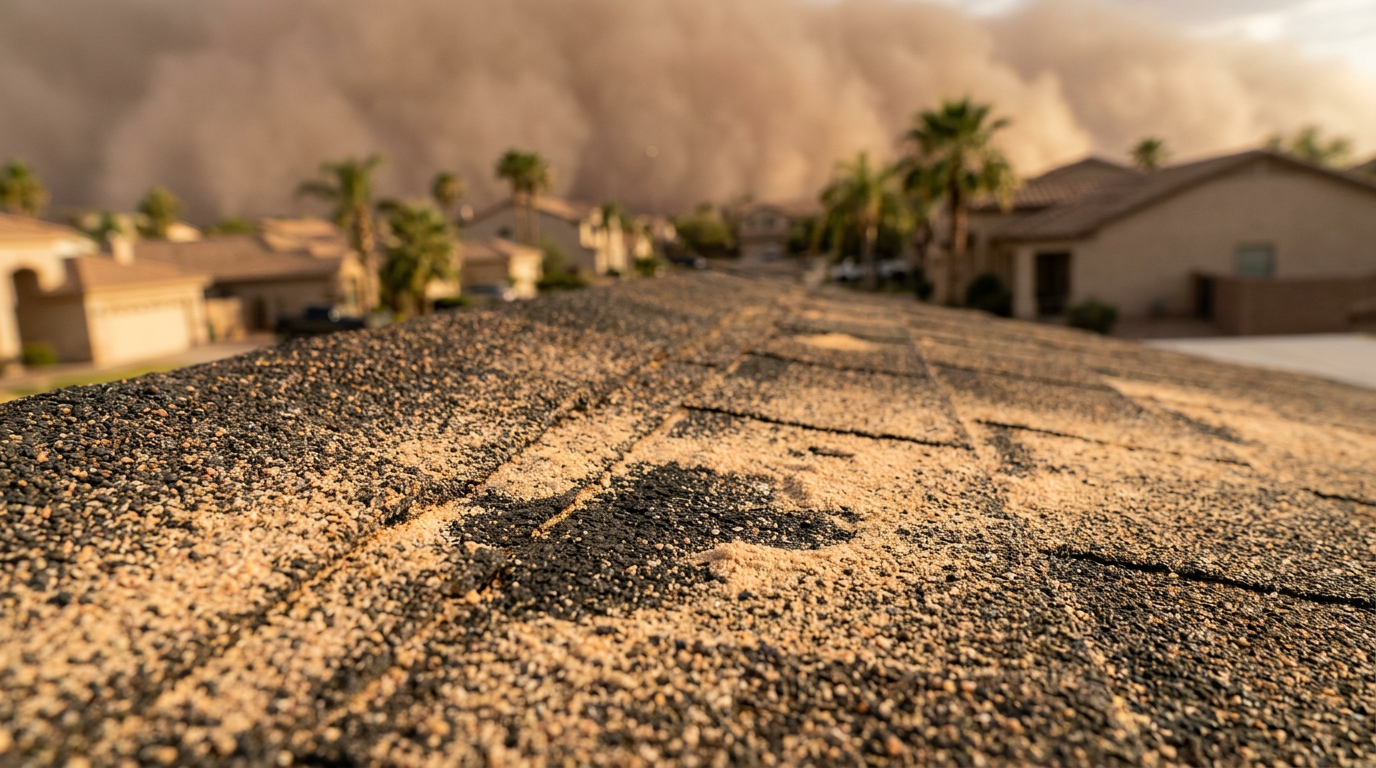
Haboobs Are Not Just Wind. Here's What They Actually Do to Your Roof.
Most people watch a haboob roll across the East Valley and think about their cars, their pool water, their windows. The roof? That thing's solid. It'll be fine.
It usually isn't. And what a haboob does to a roof is almost nothing like what a monsoon rain does. Different mechanisms, different materials at risk, different inspection checklist. We've been on roofs in Gilbert, Mesa, and Queen Creek for years now, and haboob damage is the one homeowners consistently miss. This post is the specific breakdown most roofers don't bother writing.
How Dust Abrasion Strips Shingle Granules Faster Than Rain or UV
Asphalt shingles have a surface layer of mineral granules. Small, rough, embedded into the asphalt. Their job is to sit between the shingle's asphalt base and the sun's UV radiation. No granules, the asphalt bakes directly. It dries out, loses flexibility, and cracks.
A haboob carries fine silica and mineral particulate at 40 to 60 miles per hour. That particulate hits every south- and west-facing slope on your roof simultaneously, for the duration of the storm. Think sandpaper, not rain. Rain is blunt. Haboob particulate is abrasive. It doesn't blast shingles off. It scours the granule surface, storm by storm, season by season.
Here's the real problem for East Valley shingle roofs: 3-tab shingles in Phoenix heat already only last 12 to 18 years. Architectural shingles run 20 to 25 years. Cumulative granule abrasion from haboobs compresses those timelines further. Once significant bare patches develop, the underlying asphalt can show visible cracking within months in Arizona's summer heat. At that point you're not talking about maintenance. You're talking about replacement timelines moving up by years.
The sign you'll catch from the ground: granules in the gutters. After a haboob, check the downspout discharge area and the gutters themselves. A handful after one storm is one thing. A heavy deposit after every event on a shingle that's already 10 to 12 years old means something is accelerating. Pay attention to that pattern.
Tile Roofs in a Haboob: The Problem Hiding in the Gaps
Concrete tile roofs dominate Gilbert and Queen Creek neighborhoods. They're durable. They'll last 40 to 50 years. But a haboob doesn't care how solid your tiles are. It finds the gaps.
Tile roofs have intentional air gaps underneath. That's normal and correct. The problem is that haboob particulate is fine enough to work through those gaps when 40 to 60 mph winds are driving it. Dust infiltrates the space above the underlayment, packs into lap joints, and accumulates on top of the membrane beneath the tiles. That's a moisture trap. When monsoon rain eventually follows, and in Arizona it almost always follows, water that gets under a tile now has a path through accumulated debris to underlayment that may already be aging.
The other tile issue: wind at haboob speeds can shift tiles that aren't bedded with enough mortar, or that have had mortar dry out in Arizona's UV. A tile that moves one inch doesn't look moved from the street. But that inch breaks the overlap seal. Water, dust, and debris then have a channel straight to the underlayment below.
We see this regularly on homes where the underlayment was installed 15 to 20 years ago using felt. That felt is at or past its service life in Arizona heat. A tile slip from a haboob on top of degraded underlayment is a fast track to a leak. If your home was built before 2008 and the underlayment hasn't been replaced, our post on underlayment lifespan in Gilbert covers what that timeline looks like and why it matters right now.
What Happens to Flashing Sealant When Airborne Silica Hits It
This is the one that really doesn't get covered.
Flashing sealant around chimneys, pipe boots, skylights, and HVAC penetrations degrades in 5 to 7 years under Arizona's UV exposure alone. Normal. Expected. But a haboob doesn't just bring UV. It brings abrasive particulate that physically erodes sealant edges, opening gaps that previously held a seal.
That combination makes East Valley roofs vulnerable faster than a standard maintenance schedule would suggest. A sealant joint that had two more years of life left before haboob season might be cracked open by October. The crack is small. Invisible from the street. But fine dust and later rain can work into that flashing joint, and by the time it shows up as a ceiling stain, the flashing has been letting in moisture for months.
Practical rule: after a haboob season, any sealant joint more than three years old should be on a watch list. Any joint more than five or six years old deserves a physical inspection up close, not an eyeball from the driveway. That's the kind of thing our crew catches during pre-monsoon checks that homeowners don't find until October.
Drainage Clog: The Haboob Aftermath Nobody Checks
A single haboob can deposit enough fine dust and debris on a roof surface to partially clog gutters, downspouts, and flat-roof scuppers. We pull this stuff off East Valley roofs every August.
The danger isn't the haboob. The danger is what comes next. Most East Valley haboobs are followed within hours or days by monsoon thunderstorm rain. Water that can't drain builds up. On sloped shingle roofs, backed-up water finds edges and works under. On tile roofs, standing water in the valley intersections accelerates underlayment damage. On foam roofs, standing water defeats the entire coating system.
Check your gutters the morning after a haboob. If you can see a visible dust or debris line inside, they need to be cleared before the next rain. Don't wait for the rain to prove there's a problem. If you have a scupper-drained flat roof or foam roof, this matters even more. Ponding water on foam for more than 24 to 48 hours accelerates coating wear in concentrated spots, and the recoat cycle for East Valley foam roofs runs every 5 to 7 years. You don't want to pull that forward because you didn't clear a drain.
East Valley Haboob Corridor: Why Gilbert, Mesa, and Queen Creek Get Hit Hardest
Not all of the Phoenix metro takes haboobs the same way. Central Phoenix has more urban friction. The worst haboob exposure consistently runs through the southeast valley.
Most major Arizona haboobs originate from thunderstorm outflow in southern Arizona, often near Pinal County, and track northwest toward the metro. That track hits Mesa, Gilbert, Queen Creek, and Chandler Heights before losing energy as it pushes into denser urban terrain. Open desert to the south and east of Gilbert means less natural windbreak. The haboob arrives at close to full speed.
The August 2025 haboob recorded wind gusts of 66 mph near East Mesa and triggered severe thunderstorm warnings across Mesa, Gilbert, Queen Creek, and Chandler Heights. That's not a rare event. That's a normal strong haboob season. East Valley homeowners should count on two to four significant dust events per monsoon season, roughly late June through September, and plan roof maintenance accordingly.
This is also why haboob damage compounds with heat damage for East Valley homes specifically. The 2026 spring was Phoenix's hottest on record, averaging 80.2°F from March through May, 6.4 degrees above normal. Sealants that spent all spring baking under record heat are not going to hold up the same way under a full summer of abrasive particulate events.
What to Check on Your Roof After a Haboob (Ground-Level Guide)
Don't get on your roof the morning after a haboob. You don't need to. Here's what you can check from the ground.
Gutters and downspouts. Walk the perimeter. Look for visible dust accumulation, debris, or granules. Material you can see from the ground is a clog in the making.
Gutter discharge area. At the bottom of every downspout, look at what's collected there. Normal desert dust is fine and minimal. A heavy granule deposit means track this. Tile debris or mortar fragments mean call someone to get up there.
South- and west-facing slopes. These take the most direct haboob hit. Look for tiles that appear shifted, shingles with visible dark patches (bare asphalt showing through), or any section that looks different in color or texture from the surrounding area.
Visible flashing. From the ground you can sometimes see pipe boots or skylight flashing. Anything that looks lifted or pulled away deserves a closer look.
Inside the home. After a haboob followed by rain, check the attic within 24 to 48 hours. Water stains on the decking, any smell of moisture, or daylight visible through roof boards is your signal. Our attic-first inspection guide covers exactly what to look for up there.
When Haboob Damage Is an Insurance Claim vs. Wear and Tear
Here's where it gets complicated, and where we see homeowners either give up too early or push a claim that's going to get denied.
Standard Arizona homeowners insurance covers haboob damage under wind coverage. Sudden, accidental damage from a specific weather event gets paid. What doesn't get paid: gradual wear, pre-existing granule loss, aging sealants, or drainage issues that built up over time.
The trap haboob damage sets is that it's almost never purely sudden. A haboob strips granules faster from shingles that were already losing granules. It opens sealant joints that were already UV-degraded. It clogs gutters that were already partially silted. Insurers know this. When they can classify the damage as aggravation of pre-existing wear, they will.
The practical answer: document your roof's condition before haboob season each year. Photographs from May or June showing an intact roof establish a baseline. Photographs taken within 24 hours of a specific haboob event show what changed. That documentation is what separates a paid claim from a denied one. Our post on homeowners insurance and monsoon roof damage covers the ACV vs. RCV distinction in detail. That distinction matters a lot on a 15-year-old shingle roof.
One more thing: haboob-specific granule abrasion typically doesn't rise to a single-event claim on its own. What it does is accelerate the deterioration that makes a later hail or microburst claim stronger, or that pushes a roof toward replacement faster than planned. That's reason enough for annual inspections, but it's usually not a one-haboob insurance story.
The Myth: "It's Just Dust. It Won't Really Do Anything."
In one storm, they're probably right. A single haboob is not going to destroy a roof.
But that's not how this works. It's cumulative. Each storm strips a few more granules. Opens the sealant edge a fraction more. Pushes more particulate under the tile laps. Over two or three monsoon seasons, that adds up to a roof that is measurably weaker than it should be for its age. The homeowner who has a leak in year 14 of a 20-year shingle roof and can't figure out why almost always had a roof that was absorbing cumulative haboob damage for years without anyone checking it.
The East Valley gets two to four significant haboob events in a typical monsoon season. Some years more. That's two to four rounds of granule abrasion, sealant erosion, and debris infiltration per year. Over ten years, that's real wear. It doesn't look like anything dramatic. It shows up as a wet ceiling stain in October.
We'll Tell You Exactly What We See Up There
If you're in Gilbert, Mesa, Queen Creek, or anywhere across the East Valley, we'll come out and give your roof a real look before the next haboob hits. Free inspection, no sales pitch. We'll tell you what's holding up fine and what to watch.
Call us at (602) 806-6806 or reach out through the website. If something in this post sounded like your house, that's the sign.
Tuuta Pulotu is the CEO and co-founder of All Storm Roofing + Construction. He was born and raised in Arizona. His mom is from Hawaii, his dad from Tonga, and Tuuta grew up in the trades working alongside his father, who's been running a landscaping and masonry crew in the Valley for over thirty years.
Before founding All Storm in 2021, Tuuta spent years in solar sales. Long enough to watch too many East Valley homeowners get pushed into roof decisions they didn't fully understand. He started All Storm to flip that conversation: be the contractor who tells homeowners what's actually going on with their roof, even when the truth costs him the job.
He runs All Storm out of Gilbert, where he lives with his wife and four kids.
AZ ROC #345156. Tamko Diamond Certified. The only Tamko Diamond Certified roofing contractor in Arizona.
WRITTEN BY
Tuuta Pulotu is the CEO and co-founder of All Storm Roofing + Construction. He was born and raised in Arizona. His mom is from Hawaii, his dad from Tonga, and Tuuta grew up in the trades working alongside his father, who's been running a landscaping and masonry crew in the Valley for over thirty years. Before founding All Storm in 2021, Tuuta spent years in solar sales. Long enough to watch too many East Valley homeowners get pushed into roof decisions they didn't fully understand. He started All Storm to flip that conversation: be the contractor who tells homeowners what's actually going on with their roof, even when the truth costs him the job. He runs All Storm out of Gilbert, where he lives with his wife and four kids. AZ ROC #345156. Tamko Diamond Certified. The only Tamko Diamond Certified roofing contractor in Arizona.
Worried about your roof?
Get a free, no-pressure inspection from a Gilbert team that gives honest answers — not pressure to replace.
Schedule Free Inspection