What to Check Inside Your Home After a Phoenix Monsoon: The Attic-First Guide to Hidden Roof Damage
→ QUICK ANSWER
After a Phoenix monsoon, your attic tells you more than your roofline does. Here's the interior-first inspection guide East Valley homeowners need before calling a roofer.

Why Your Attic Tells You More Than Your Roof Does After a Monsoon
Most homeowners walk outside after a monsoon, look up, see nothing obviously wrong, and go back inside satisfied. That's a reasonable instinct. It's also how hidden roof damage goes undetected for weeks while wet insulation compresses in your attic and mold spores start colonizing wood framing you can't see from any angle outside.
The truth is that after a Phoenix monsoon, the interior of your home tells you more than the roofline does. Especially if you have a concrete tile roof. Tile is great at surviving storms. It's also great at hiding what happened underneath it.
Here's what to look for inside before you call a roofer.
The 5-Minute Attic Walk: What to Look For Immediately After a Storm
You don't need a full ladder setup. You need five minutes and a flashlight.
Head up to the attic the same day the storm clears, while any moisture that got in is still fresh. Attics in the East Valley sit at 140 to 150 degrees Fahrenheit in summer, so go early morning. Do not wait until afternoon.
Here's what you're looking for:
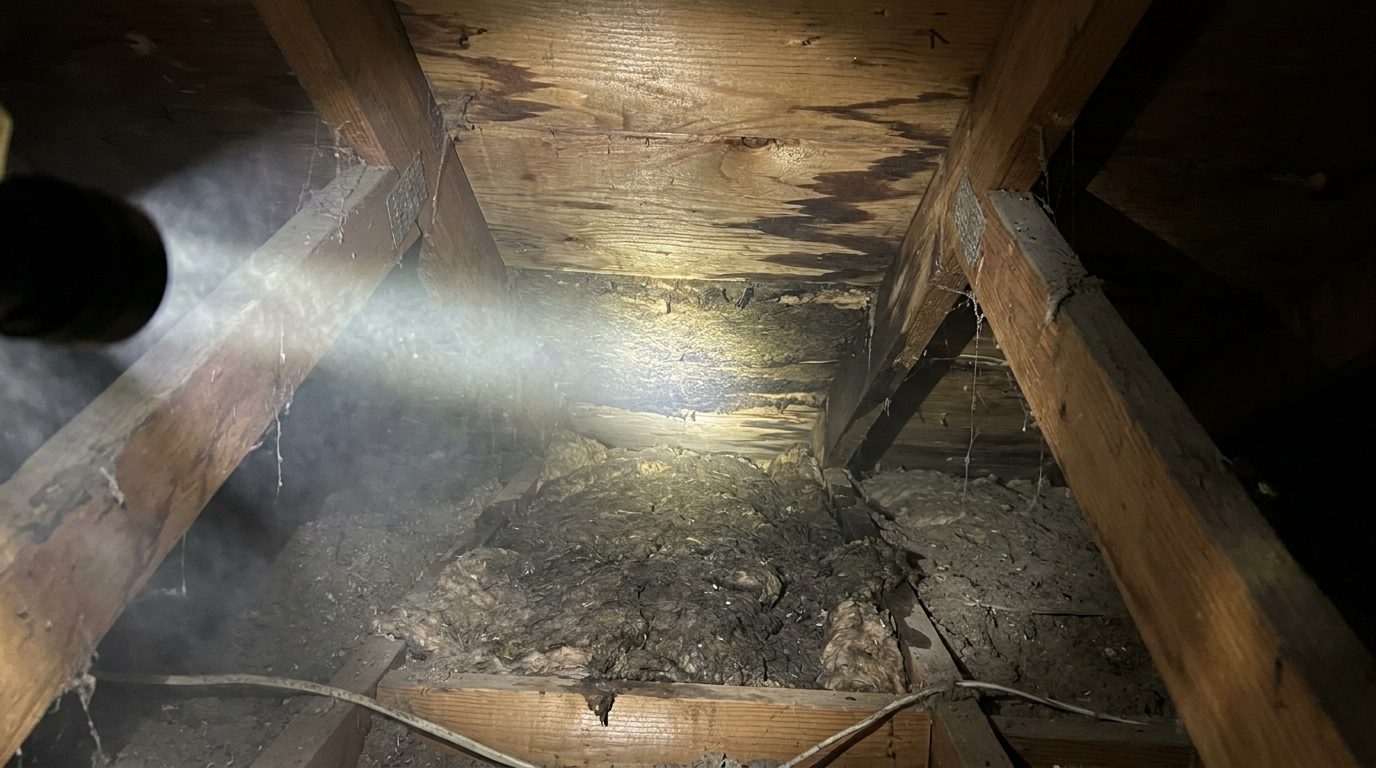
Wet or compressed insulation batts. Insulation in a healthy attic should feel dry and springy. If you press a batt and it's dense, cold, or wet in patches, water has been in there. Even if it feels dry on the surface, look at the color. Insulation that has taken water and partially dried often shows a visible waterline, a tide mark where wet met dry.
Dark staining on the roof deck or rafters. Shine your flashlight along the underside of the plywood decking. Fresh water stains look dark brown, almost black. Old staining is gray or light brown. If you see staining that looks distinctly darker than the surrounding wood, that happened recently.
Light coming through the deck. Close the attic hatch behind you. Wait thirty seconds for your eyes to adjust. If you see pinpoints of daylight coming through the roof deck, that's a gap. Light in means water in. It doesn't mean the roof is failing catastrophically, but it does mean something shifted.
Musty smell. If your attic smells like a wet towel, that's not heat. That's moisture. Mold spores in a hot Arizona attic can begin germinating within 24 to 48 hours of water exposure. That wet-towel smell is early-stage mold establishing in the wood and insulation.
Water on or around HVAC equipment. A lot of East Valley homes have air handlers or ductwork in the attic. If there's water around the air handler pan or pooling near duct connections, it didn't come from the HVAC. It came from above.
Ceiling Stains vs. Active Leaks: How to Read the Difference
Ceiling stains and active dripping are both bad. They're not the same problem.
A ceiling stain that's tan or light brown, dry to the touch, and not growing after the storm has likely been there a while. It may be from a previous monsoon season that got repaired. Or it may be from a slow, ongoing leak that's been cycling through wet-and-dry for months. Either way it needs investigation, but it's not a today emergency.
A stain that's dark brown and feels damp is different. That's new water, still moving through the drywall. If you push gently on the drywall near the stain and it gives slightly, or feels softer than the surrounding area, water has saturated it. That's urgent.
Active dripping is straightforward. Put a bucket under it. Take a video with your phone, timestamped, before you do anything else. That video is evidence for your insurance adjuster.
One thing most homeowners miss: the drip point is rarely directly below the entry point on the roof. Water enters through a gap or a breach, hits a rafter or a piece of decking, and travels laterally, sometimes six to ten feet, before it finds somewhere to drip down. So the ceiling stain in your master bedroom hallway might point to a flashing problem over your primary bathroom skylight, not a breach above the hallway itself. Roofers know this. Insurance adjusters know this. Most homeowners don't, and it leads to a lot of misdiagnosis.
Insulation Compression: The Hidden Sign Most East Valley Homeowners Miss
This one matters more than it gets credit for.
Blown-in insulation, the loose gray or white material that looks like fluffy fiberglass or cellulose, is particularly vulnerable. When water hits it, it compresses. Compressed insulation doesn't spring back. It stays matted. And matted insulation loses most of its thermal rating, which in the East Valley in July means your AC starts working significantly harder to keep your house at the same temperature.
So if your electric bills spiked after a monsoon, that's a data point, not a coincidence. It doesn't prove roof damage by itself. But a compressed insulation patch in the attic combined with a post-monsoon energy spike is worth taking seriously.
Batt insulation, the pink or yellow rolls between joists, behaves a little differently. It holds water in a way that's less immediately visible. You have to press it. If a section feels cold, heavy, or won't spring back, it's wet. Wet batt insulation in a Phoenix attic in July is sitting in essentially a greenhouse environment. That's mold-growth territory.
This is the sign that most East Valley homeowners, and honestly a lot of roofers, walk right past. They're looking for obvious drips and stains. A section of compressed insulation in a corner of the attic isn't dramatic. It just quietly tells you where the water went.
Attic Humidity After Monsoons: What's Normal, What's a Red Flag
Arizona attics are dry by default. That's the baseline.
During and immediately after a monsoon, humidity in the attic will spike. That's expected. The storm raises humidity everywhere, including air that leaks into your attic through soffit vents. A humidity spike that drops back down within 24 hours is normal. It's the attic ventilating itself.
What's not normal is humidity that stays elevated two or three days after the storm. If you have a hygrometer, a basic one costs about fifteen dollars at a hardware store, take a reading the morning after a monsoon. Take another reading 48 hours later. If the reading is still above 60 percent two days post-storm, something is holding moisture in the attic that shouldn't be. That's either a breach that let water in, or compressed wet insulation that's releasing moisture into the attic air, or both.
Without a hygrometer, go by smell and feel. If the attic still smells damp two days after the storm, not hot, not dusty, but genuinely damp, that's the same signal.
When Interior Signs Point to Flashing Failure vs. Underlayment Breach
This is where it helps to know what you're looking at, because the fix is different.
Flashing failure tends to produce localized staining near specific features. Water stains near a chimney, skylight, plumbing vent stack, or roof valley. Particularly staining that appears as a streak running away from that feature. That pattern almost always points to flashing. The metal flashing around those features lifts, gaps open, and monsoon-driven rain pushes in horizontally. Roofing caulk and sealants around AZ flashing degrade in 5 to 7 years of Phoenix UV. If your home is more than five years past its last roof work, that's a realistic failure point.
Underlayment breach shows up differently. You tend to see broader staining patterns. Water marks on the decking that span several feet rather than clustering near a specific penetration. Compressed insulation in a wide patch rather than a tight spot. And often no obvious explanation when you look at the roof from the outside, because the tiles can still be sitting perfectly in place while the felt or synthetic membrane underneath has cracked and let water through.
Concrete tile roofs are the prime candidate for this. In Gilbert and Chandler, we run into homes built in the late 1990s and early 2000s all the time. The tiles look solid, sometimes freshly cleaned, but the felt underlayment is 25 years old and done. One monsoon pushes wind-driven rain under the tile course, it hits cracked underlayment, and makes it to the attic with no exterior evidence at all.
Our post on when tile roof underlayment fails in Gilbert AZ covers the lifespan math in more detail. Short version: felt underlayment in Arizona heat runs 15 to 20 years. Synthetic runs 25 to 35. If your home is in that window, an interior wet spot after a monsoon is strong evidence the underlayment is done.
How to Document Interior Damage for an Insurance Claim Before the Roofer Arrives
Do this before you clean anything up. Before you put buckets away. Before you start wiping down the ceiling.
Photograph everything in context. Wide shots first, then close-ups. You need the adjuster to understand where in the house the damage is, not just what it looks like up close. Shoot the stained ceiling with enough of the room visible that it's clear this is the master bedroom, not a closet. Then get close.
Video with narration. A thirty-second video where you describe what you're seeing, for example "this is the attic above the primary bedroom, you can see wet insulation here on the north-facing side near the ridge," is more useful than twenty photos. Adjusters play video. It tells a story.
Note the timestamp. Most phone cameras embed timestamp metadata automatically. If yours doesn't, take one photo of a clock or the date on your phone screen in frame. Insurers sometimes question whether interior damage predates a claimed storm event. A documented timestamp eliminates that argument.
Don't repair before documentation is complete. Temporary tarps are fine. But don't repaint over that ceiling stain and don't pull out wet insulation batts before your adjuster has seen them. That insulation is evidence. Once it's gone, you're telling the adjuster what was there rather than showing them.
Call the roofer before you call the insurance company. Have a roofer inspect and produce a written damage assessment tied to the storm event. That report, combined with your documentation, gives the adjuster something concrete rather than just a homeowner's account. Our post on what to do in the first 24 hours after a monsoon storm walks through the sequencing in detail.
The Myth Most East Valley Homeowners Believe After a Monsoon
If the tiles look fine, the roof is fine. We hear this constantly.
Here's what that conclusion missed: the underlayment. The tile is not your waterproofing layer. Never was. The tile sheds most of the water, but the underlayment below it is what actually keeps water out of the attic. Tile can sit perfectly in place while the underlayment underneath it is cracked, brittle, and letting water through every seam.
On a concrete tile roof in Gilbert or Chandler that's 20-plus years old, this isn't a fringe scenario. It's common. We see hidden exterior monsoon damage on East Valley roofs all the time, but the exterior damage is just the entry point. The more telling story is what the attic shows after the storm.
The tile test is not the roof test. The attic test is the roof test.
East Valley Specifics: Why This Matters More Here Than Elsewhere
Phoenix-area monsoons are not like summer rain elsewhere. The East Valley gets microbursts that routinely hit 60 to 70 miles per hour. That wind drives rain horizontally under tile courses and into flashing gaps that would never see water in a normal rain event.
Most East Valley homes also have relatively shallow-pitch tile roofs. That means water moving under a tile in a horizontal wind event doesn't drain quickly. It sits on the underlayment. Old felt underlayment sitting under 48 hours of intermittent moisture contact in 110-degree heat degrades faster than most people realize.
And the older the home, the higher the stakes. A large portion of the housing stock in Gilbert, Chandler, and Queen Creek was built between 1995 and 2005. Those roofs are right at or past the edge of their felt underlayment lifespan. One hard monsoon season won't destroy a roof overnight. But every storm that drives water through compromised underlayment is adding saturation and stress to the wood deck beneath.
The attic walk matters more here than almost anywhere else in the country. Act on what it tells you.
If You Found Something, Here's What to Do Next
If your attic showed you wet insulation, dark staining on the decking, a musty smell that's still there two days out, or a ceiling stain that's new, don't sit on that.
Get a roofer up there. Not to sell you a replacement. To tell you whether what you found is a flashing repair, an underlayment issue, or something that can wait until fall. Those are three very different conversations with very different price tags.
Our team is a roofing company based in Gilbert. We do free roof inspections across the East Valley, including Gilbert, Chandler, Mesa, and Queen Creek. No sales pitch, no pressure. If your attic is showing you something after the last storm and you want a second opinion, give us a call at (602) 806-6806.
Tuuta Pulotu is the CEO and co-founder of All Storm Roofing + Construction. He was born and raised in Arizona. His mom is from Hawaii, his dad from Tonga, and Tuuta grew up in the trades working alongside his father, who's been running a landscaping and masonry crew in the Valley for over thirty years.
Before founding All Storm in 2021, Tuuta spent years in solar sales. Long enough to watch too many East Valley homeowners get pushed into roof decisions they didn't fully understand. He started All Storm to flip that conversation: be the contractor who tells homeowners what's actually going on with their roof, even when the truth costs him the job.
He runs All Storm out of Gilbert, where he lives with his wife and four kids.
AZ ROC #345156. Tamko Diamond Certified. The only Tamko Diamond Certified roofing contractor in Arizona.
WRITTEN BY
Tuuta Pulotu is the CEO and co-founder of All Storm Roofing + Construction. He was born and raised in Arizona. His mom is from Hawaii, his dad from Tonga, and Tuuta grew up in the trades working alongside his father, who's been running a landscaping and masonry crew in the Valley for over thirty years. Before founding All Storm in 2021, Tuuta spent years in solar sales. Long enough to watch too many East Valley homeowners get pushed into roof decisions they didn't fully understand. He started All Storm to flip that conversation: be the contractor who tells homeowners what's actually going on with their roof, even when the truth costs him the job. He runs All Storm out of Gilbert, where he lives with his wife and four kids. AZ ROC #345156. Tamko Diamond Certified. The only Tamko Diamond Certified roofing contractor in Arizona.
Worried about your roof?
Get a free, no-pressure inspection from a Gilbert team that gives honest answers — not pressure to replace.
Schedule Free Inspection