After the July 13 Storm: What East Valley Homeowners Should Check on Their Roof Right Now
→ QUICK ANSWER
The July 13 storm hit the East Valley with 50+ mph gusts, flash flooding, and hail near the Superstition foothills. Here's your 48-hour ground-level inspection guide.

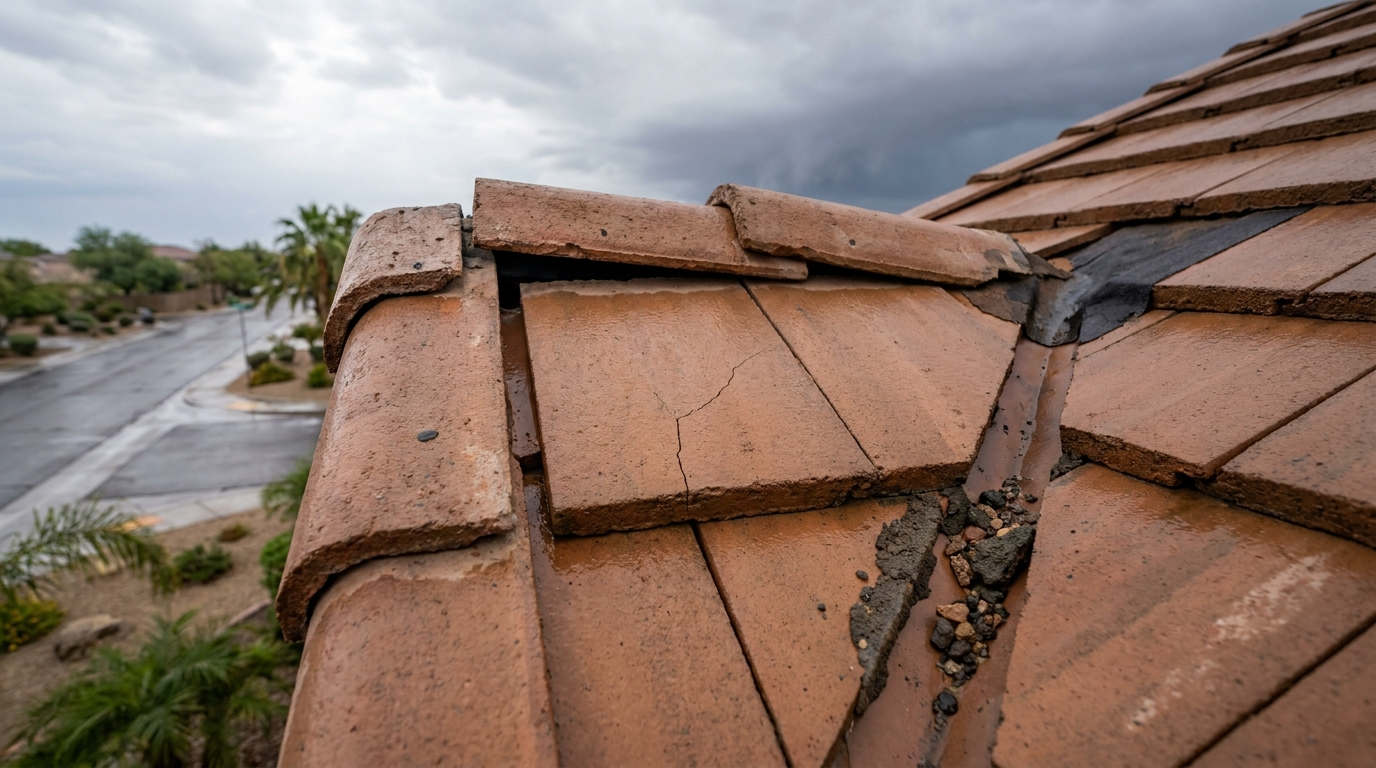
Monday night, the storm was real. Wind above 50 mph. Flash flood warnings covering Phoenix and Scottsdale. At peak, more than 20,000 utility customers lost power between APS and SRP. If you live in the East Valley, your roof caught something. Here's what needs to happen in the next 48 hours.
What last night's storm actually did to East Valley roofs
The July 13 cell tracked northwest from San Tan Valley and the Florence Junction area, moving through the East Valley before rolling into central Phoenix. It brought three things that damage roofs: sustained wind gusts above 50 mph, concentrated rain (a gauge in central Phoenix logged 1.26 inches in one hour), and quarter-size hail reported near the Superstition foothills, around Roosevelt Lake, Canyon Lake, and Apache Lake.
Fifty mph lifts tile. On the concrete tile roofs that most Gilbert and Chandler homes have, those gusts break mortar seals on ridge caps and hip tiles, shift field tiles out of position, or lift them just enough to crack the underlayment when they settle back down. The tile looks untouched from the street. The problem is underneath, where no one looks until water shows up inside.
Shingle roofs tell a different story. Wind at that speed lifts tab edges and cracks adhesive strips. Sometimes a shingle pulls free entirely. You may not notice from the driveway. What you might catch is one corner tab slightly raised. That corner is a water entry point right now.
Foam roofs are the outlier. Wind alone rarely damages SPF. But if your neighborhood was in the path of that hail activity near the foothills, impact craters in foam sit there quietly. Phoenix heat does the rest, and it does it quickly.
Your 48-hour ground-level inspection checklist
Stay off the roof. Fall risk is real after a storm, especially on tile, and you can cover what actually matters from the ground and your attic.
Walk the full perimeter. You're looking for: displaced or cracked ridge cap tiles along the peak and hip lines. Anything tilted, broken, or sitting differently than it was, photograph it. Lifted or missing shingles, and check your gutters. Significant granule piles at the downspouts are the shingle version of an early warning. Dented metal anywhere on the exterior: gutters, vent caps, AC condenser fins, any exposed flashing. This matters because hail that dents a gutter was hard enough to reach your roof. Note anything resting on the roofline that wasn't there yesterday.
Then go in the attic. Flashlight across the decking, corners first, then along the valleys and any roof penetrations. Wet wood, water staining, any daylight showing through: all of those belong on your list.
Flat or foam roof? Come back and check for standing water 24 hours after the storm. Some ponding right after rain is normal. Water still sitting the next afternoon is a drainage problem that needs attention.
What roof damage looks like on tile vs. shingle vs. foam
Concrete tile is the most common roof in Gilbert, Chandler, and Queen Creek. It's also the most commonly misread after a storm. The tile is heavy and it usually survives. What fails is the underlayment beneath it. A tile that lifted and resettled, or one with a hairline crack from impact, may have fractured the felt or synthetic layer below without looking different from the street. You find out when water reaches the decking. That's not a fun way to find out.
After a wind event like Monday's, start with the hip and ridge tiles on a tile roof. Those mortar-set pieces at the peaks and along the edges absorb the most stress in a wind event. Then check field tiles on the south- and west-facing pitches, which take the direct force. Flashing around chimneys, skylights, and A/C curbs is a regular failure point in these events.
On a shingle roof, look for lifted tab edges first. Check the gutters for granule volume too. Hail bruising is the hard one: roughly circular, soft, darker where granules got knocked loose. You will not see it from the ground. A roofer presses the spot. If it gives, the mat below is compromised.
Foam looks fine after hail until it isn't. Impact divots expose the foam to UV. In Phoenix heat, that degradation happens fast. A quarter-size hail strike needs to be cleaned, dried, and recoated before the next rain. If your neighborhood was in the path of that hail activity east of the Valley, get eyes on your foam roof before Thursday.
When to call your insurance company (and how to document it right)
Get documentation together before you make the call. The sequence matters more than the speed.
Photos first. Walk the home, document the roofline from every angle. Then photograph everything else that shows damage: dented gutters, bent window screens, AC condenser dings, vehicle hail marks. Every dent on the outside of your property is evidence that a storm of real force came through your address on a specific date. Adjusters want a story they can follow. Give them one.
Get a roofer up there before you file. A licensed Arizona contractor who's physically been on the roof will find what you cannot see from the ground. Hail bruising, cracked tile, failed underlayment, lifted flashing: none of that shows in phone photos taken from the driveway. It shows in a written inspection report. That report with your photo set is a cleaner claim than either alone.
Then call your carrier. Have the storm date (July 13), your damage list, your photos, and the roofer's report. Know this: Arizona law prohibits insurers from applying hurricane deductibles to monsoon storm damage. Your standard deductible applies, not a higher storm percentage.
File without waiting. Arizona's property damage statute of limitations runs one year from the date of loss. Many carriers require notification much sooner than that. Don't let this drift.
For more on how the claims process actually works in Arizona, our full monsoon insurance claim guide walks through the filing sequence in detail.
More storms coming this week: what that means if you have damage
This week isn't done. AZFamily has Thursday and Friday designated as First Alert Weather Days. Storm chances climb to 50 to 60 percent by end of week. The National Weather Service has a Flood Watch covering parts of Maricopa County through Friday morning.
Any compromised section of roof you have right now becomes a leak point in the next round of rain. A lifted ridge cap. A cracked field tile. A shingle section with tabs that aren't sealed down. Those become interior damage when the next storm arrives, and another storm is arriving.
A licensed roofer can install temporary protection on a known problem area before Thursday. Insurers expect you to mitigate further damage. Temporary protective measures are reimbursable in most cases. Keep your receipts.
Waiting a week is the mistake we see most often. Once two storms have moved through, distinguishing damage from July 13 versus a follow-on event gets hard. Your insurance carrier will want to know which storm caused which damage. The sooner you get a roofer up there, the cleaner that answer is.
What most East Valley homeowners get wrong after a storm
Every monsoon season, we hear it from homeowners in Gilbert and Chandler: "Looks fine from the street." Almost always from someone standing under a concrete tile roof that's been sitting under Arizona UV for fifteen or twenty years.
The tile looks indestructible. And the tile usually is intact. That's not where the problem lives. The failure mode on tile roofs is invisible from the street: it's the underlayment that goes first. Felt underlayment, which is what you'll find under most East Valley tile roofs built before about 2005, has a lifespan of 15 to 20 years in Arizona UV exposure. Synthetic underlayment lasts longer, typically 25 to 35 years. Both can be compromised by impact or sustained wind load. Neither shows any sign of failure until water hits the decking.
The other thing that costs people money: cleaning up before photographing everything. Granules in the gutters. Displaced tiles in the yard. Dented vent caps. All of it is evidence of what July 13 did to your property. Clear it before you document, and you've just made your claim harder.
For more on what hides under a tile roof that looks completely fine, this post on hidden monsoon roof damage covers exactly that.
We'll come look for free. No pitch, no pressure.
We're based in Gilbert. Our crew was in these same neighborhoods Monday night. We know what East Valley roofs take in a storm like this, because we've been on thousands of them.
If you're in Gilbert, Chandler, Mesa, or Queen Creek and want a straight read on your roof, we'll send someone out at no charge. We write up what we find. If there's damage worth claiming, we document it in a format built for the claims process. If the roof came through clean, you'll hear that too.
Call us at (602) 806-6806. No pressure, no sales pitch.
WRITTEN BY
Tuuta Pulotu is the CEO and co-founder of All Storm Roofing + Construction. He was born and raised in Arizona. His mom is from Hawaii, his dad from Tonga, and Tuuta grew up in the trades working alongside his father, who's been running a landscaping and masonry crew in the Valley for over thirty years. Before founding All Storm in 2021, Tuuta spent years in solar sales. Long enough to watch too many East Valley homeowners get pushed into roof decisions they didn't fully understand. He started All Storm to flip that conversation: be the contractor who tells homeowners what's actually going on with their roof, even when the truth costs him the job. He runs All Storm out of Gilbert, where he lives with his wife and four kids. AZ ROC #345156. Tamko Diamond Certified. The only Tamko Diamond Certified roofing contractor in Arizona.
Worried about your roof?
Get a free, no-pressure inspection from a Gilbert team that gives honest answers — not pressure to replace.
Schedule Free Inspection