Monsoon Roof Damage Claims in Phoenix: Why Timing and Sequence Determine What You Get Paid
→ QUICK ANSWER
Does the timing of your monsoon roof insurance claim change what you get paid? Yes. Here's the inspection, documentation, and filing sequence that actually protects your payout in Phoenix.

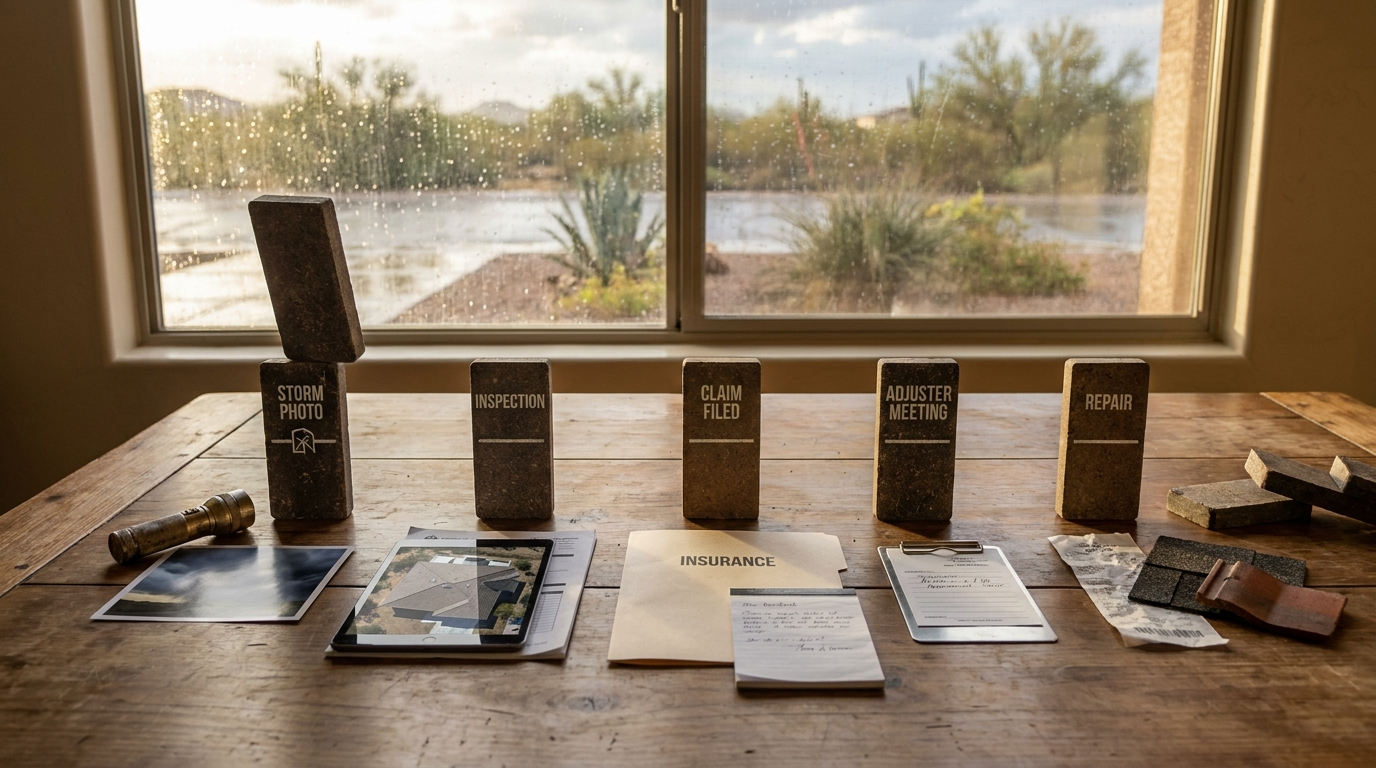
Does Timing Actually Change What Your Monsoon Claim Pays?
Yes. More than most Phoenix homeowners realize.
The sequence of inspection, documentation, and filing doesn't just affect how fast the process moves. It affects the dollar amount at the end. File before a thorough inspection and you may lock in a payout that misses half the actual damage. Wait too long and the carrier argues the damage came from a different storm, or from wear and tear that was already there before July hit.
This isn't really a coverage question. Most Phoenix homeowners already know monsoon wind and hail are covered perils. The question nobody answers is the sequencing one. And that's the one that determines what you actually collect.
Arizona Homeowners Insurance Claim Deadlines You Need to Know
There are two clocks running after a storm, and homeowners mix them up constantly.
The first is the policy notification deadline. Most homeowner policies require you to report a loss "promptly" or within a specific window. Many carriers interpret that as 30 to 60 days. Miss it and you've handed the insurer a reason to question whether your claim is tied to the storm you're describing. That's an easy denial peg.
The second is the suit filing deadline. Under Arizona law, homeowner insurance policies typically contain a contractual clause that shortens the available time to file a lawsuit to one year from the date of loss. That's your legal backstop if they deny you. It is not your notification window. These are different clocks.
Arizona insurance regulations (Ariz. Admin. Code § R20-6-801) require your insurer to acknowledge a claim within 10 working days of receipt and to pay all first-party claims within 30 days of receiving acceptable proof of loss. The carrier has deadlines too.
Pull out your declarations page. Find your specific notification window. Don't guess. Some policies say 30 days, some say "as soon as practicable," some have stricter language. You need to know which one you signed.
Why Filing Too Fast Can Hurt Your Payout
This trips people up. Filing the morning after a storm sounds responsible. In reality, filing before a professional inspection often locks in an undercount.
Here's what happens. You call your carrier and open a claim. They assign an adjuster. The adjuster schedules a visit, climbs your roof, and produces a scope of loss. Whatever that adjuster documents becomes the claim. If your roofer hasn't done a full inspection first, you have no competing documentation going into that visit. The adjuster sets the scope uncontested.
And adjusters miss things. Not because they're bad at their jobs. Because monsoon damage in Phoenix hides. Wind doesn't always blow tiles off completely. It lifts them, lets water get underneath, and then reseats them. Three days later the tile looks fine from the ground. A roofer who knows Arizona roofing systems finds that. An adjuster doing 12 inspections that week may not.
Getting missed damage added later through a supplement is a real process, but it's a fight. A complete scope established before filing is far easier than supplementing a low initial estimate.
The better sequence: licensed roofing inspection first. Written report. Then file with documentation in hand, and ask that your roofer be present when the adjuster comes out. That's the version of this where you're in control.
Why Waiting Too Long Kills the Claim
Monsoon season in Phoenix runs roughly June through September. Storms stack up. One haboob, a microburst three days later, another wind event two weeks after that.
If you wait six weeks to file, the carrier doesn't take your word that the missing ridge cap came from storm one. They can reasonably argue it came from storm two, or storm three, or from age, or from deferred maintenance. You've lost the ability to tie damage to a specific event.
That matters particularly in Phoenix and the East Valley because Arizona's UV exposure and heat accelerate material breakdown faster than almost anywhere else in the country. The line between storm damage and pre-existing wear is exactly where carriers push back hardest on older roofs. A 15-year-old architectural shingle roof in Gilbert has seen a lot of UV. When the July storm hits, the storm damage is real and it's covered. But the carrier will probe the pre-existing condition hard. Clear documentation of the specific storm event, tied to specific damage, is what separates a full payout from a partial one.
There's also the duty-to-mitigate issue. Your policy almost certainly requires you to prevent further damage after a loss. Wait three weeks, and if water intrusion has expanded from a small leak to a larger mold problem, the carrier can argue the expanded damage was your failure to act, not the storm's.
File promptly. Just not before your inspection is done.
The Right Sequence: Inspection, Documentation, Then Filing
We see this pattern work across Gilbert, Chandler, Mesa, and Queen Creek after every named storm event. The homeowners who get complete settlements almost always do three things before the adjuster steps on their roof.
Document the storm first. Date, time, National Weather Service records if available. Your carrier has their own storm data, but having an independent record helps establish a weather event caused the damage, especially when filing a few weeks later.
Get a licensed Arizona roofer up there before you file. Not a general contractor. Not a handyman. A licensed roofing contractor who knows the difference between a shingle that aged normally and one that took a 70-mph microburst hit. They document with photos and a written scope, and they can explain the damage in terms that match how adjusters assess claims.
Have your roofer present at the adjuster visit. This is your right as a homeowner. It changes outcomes. A roofer walking the roof with an adjuster, pointing to documented storm damage with a written report in hand, gets a more complete scope than a homeowner watching from the driveway.
None of this is adversarial. It's just being prepared.
What Adjusters Are Looking For That You Can Document Yourself
Insurance adjusters are generalists. A thorough one is genuinely trying to do the job right. But they're not Arizona roofing specialists, and they assess storm damage across many types of properties and systems. They're specifically looking for evidence of a sudden storm-created opening or impact, distinct from gradual wear. That distinction is the coverage line.
Here's what you can document yourself in the first 24 hours after a storm, before anyone from the carrier arrives:
Take photos from ground level with visible damage, and get close on anything suspicious. Time-stamped photos from the night of the storm or the next morning carry real weight in establishing the storm cause.
Go into the attic. Water stains on the decking, wet insulation, or daylight visible through the deck are documenting evidence that needs to be captured before drying occurs. Our post on what to check inside your home after a Phoenix monsoon covers the attic inspection room by room.
Keep receipts for any emergency tarping or temporary repairs. Most policies cover reasonable mitigation costs, and those receipts belong in your claim file.
Write down the date and time you discovered the damage. It sounds simple. Homeowners skip it constantly.
How Storm Chasers Exploit the Timing Window
After every major Valley storm event, out-of-area contractors show up door to door in affected ZIP codes. Gilbert neighborhoods, Chandler subdivisions, Queen Creek cul-de-sacs. They follow storm tracks. Most of them are there before the sun comes up the next morning.
The play is to catch homeowners while damage adrenaline is still running, before the homeowner has done their own inspection, and lock in a contract. Some push an Assignment of Benefits clause, which transfers your insurance claim rights to the contractor. Once signed, the contractor negotiates with your carrier and you lose visibility into what's being claimed on your behalf.
Arizona law (ARS 32-1158.02) gives you a four-business-day cancellation right on storm repair contracts, and a 72-hour cancellation right after your insurer denies the claim. But by then the contractor may have already influenced how the damage was documented and filed.
The timing problem here isn't just financial. A contractor rushing the claim to close the job fast may document only what their crew plans to fix, not everything the storm damaged. You get a partial repair, you've handed away control, and you never knew what you were entitled to.
The fix is boring: don't sign anything at the door. Get your own inspection from a licensed local roofer first. Verify the contractor at roc.az.gov before you sign. A legitimate roofer gives you time. The ones who push for same-day signatures are telling you something.
The East Valley Pattern After Every Named Storm
Here's what actually plays out in Gilbert, Chandler, and Mesa after a serious monsoon.
In the 24 to 48 hours after a storm, the obvious damage calls come in fast. Ceiling leaks, missing tiles visible from the street, soffit blowouts. Those homeowners call right away. The ones with hidden damage, and in our experience that's more common than people think, don't realize anything happened for days or weeks.
By week three or four, two things have typically happened. Some homeowners signed with storm chasers who were first to the door. Others waited so long that tying damage to a specific storm date is now a genuine problem. Either way, the claim outcome gets compromised before a real roofer ever did a thorough inspection.
The East Valley complicates this further. Arizona's UV exposure and heat cycles mean a lot of roofs are already well into their working life by the time they face a serious monsoon. A 20-year-old architectural shingle roof in Gilbert has typically been through significant thermal cycling and UV degradation. When the storm hits, the storm damage is real and covered. But the carrier will probe the pre-existing condition hard. Documentation of the storm-specific damage, separate from the baseline aging, is what makes borderline claims. Without it, you're arguing instead of settling.
This is exactly why pre-monsoon documentation matters. If you had a professional inspection in May, it established a baseline. Whatever damage shows up after July's first storm didn't exist before the storm. That inspection report is a claim asset. Our pre-monsoon roof inspection checklist for East Valley homeowners covers what to capture.
When to Call a Public Adjuster vs. Your Roofer First
Most East Valley homeowners don't need a public adjuster for a straightforward monsoon roof claim. A licensed roofer present at the adjuster visit, with a complete written inspection report, handles most of what a public adjuster does for routine storm damage.
That said, public adjusters are a real tool for the right situations. They're licensed in Arizona under ARS §20-321.01 through the Department of Insurance and Financial Institutions. They work on contingency, typically 5 to 15% of the final settlement, with no upfront fee. Arizona has no statutory fee cap, but requires the fee to be in a written contract before work begins.
When does it make sense? Three situations: when the initial estimate is significantly lower than your contractor's documented scope; when the carrier has denied a claim your roofer assessed as legitimate storm damage; or when the damage is extensive enough that supplementing will take multiple rounds of negotiation.
Call your roofer first, always. Get the inspection, get the scope, go through the adjuster visit with your contractor present. If the settlement doesn't match the documented damage, that's when you assess whether a public adjuster makes financial sense for what's left on the table.
One thing to avoid: bringing in a public adjuster before a roofer has inspected the physical damage. You want an independent professional assessment of the roof before bringing in a claims negotiator. Sequence matters here too.
The Mistake That Costs More Than Filing Late
The biggest claims mistake we actually see in the East Valley isn't filing too late. It's authorizing permanent repairs before the adjuster visit.
Emergency tarping is expected and covered. If a storm blows off ridge cap and your roof is exposed, cover it. Document the tarping with photos and keep the receipt. But replacing shingles, patching tile, or pouring foam over a storm-damaged section before the adjuster inspects it eliminates your documentation.
Adjusters assess what they see. If your contractor repaired the damaged area before the visit, there's no storm damage visible on inspection day. There's a patched section. The carrier can argue there was no qualifying damage, that the work was maintenance, not storm response.
Tarp it. Document it. File it. Let the adjuster see the actual damage. Then authorize the permanent repair.
If you're dealing with hail alongside wind damage from the same storm, our hail damage roof claims guide for the East Valley covers the additional documentation steps hail claims require. Keep the wind and hail damage separated in your documentation even though they're both covered under the same HO-3 policy. A cleaner scope makes for a faster, more complete settlement.
We Do Free Inspections Across the East Valley
If something in this post matched what you're looking at on your roof, we're happy to come take a look. Free inspection, no sales pitch. We work across Gilbert, Chandler, Mesa, and Queen Creek. If you want someone up there who'll tell you what's actually going on, give us a call at (602) 806-6806.
You can also check out our full guide on what Arizona homeowners insurance actually covers for monsoon damage, and our first 24 hours emergency guide if you're dealing with an active situation right now.
Tuuta Pulotu is the CEO and co-founder of All Storm Roofing + Construction. He was born and raised in Arizona. His mom is from Hawaii, his dad from Tonga, and Tuuta grew up in the trades working alongside his father, who's been running a landscaping and masonry crew in the Valley for over thirty years.
Before founding All Storm in 2021, Tuuta spent years in solar sales. Long enough to watch too many East Valley homeowners get pushed into roof decisions they didn't fully understand. He started All Storm to flip that conversation: be the contractor who tells homeowners what's actually going on with their roof, even when the truth costs him the job.
He runs All Storm out of Gilbert, where he lives with his wife and four kids.
AZ ROC #345156. Tamko Diamond Certified. The only Tamko Diamond Certified roofing contractor in Arizona.
WRITTEN BY
Tuuta Pulotu is the CEO and co-founder of All Storm Roofing + Construction. He was born and raised in Arizona. His mom is from Hawaii, his dad from Tonga, and Tuuta grew up in the trades working alongside his father, who's been running a landscaping and masonry crew in the Valley for over thirty years. Before founding All Storm in 2021, Tuuta spent years in solar sales. Long enough to watch too many East Valley homeowners get pushed into roof decisions they didn't fully understand. He started All Storm to flip that conversation: be the contractor who tells homeowners what's actually going on with their roof, even when the truth costs him the job. He runs All Storm out of Gilbert, where he lives with his wife and four kids. AZ ROC #345156. Tamko Diamond Certified. The only Tamko Diamond Certified roofing contractor in Arizona.
Worried about your roof?
Get a free, no-pressure inspection from a Gilbert team that gives honest answers — not pressure to replace.
Schedule Free Inspection