What a Real Post-Monsoon Roof Inspection Looks Like in Gilbert and the East Valley
→ QUICK ANSWER
A storm came through and your roof looks fine. That's exactly how it looks before a ceiling stain shows up. Here's what a real post-monsoon inspection covers in Gilbert and the East Valley.

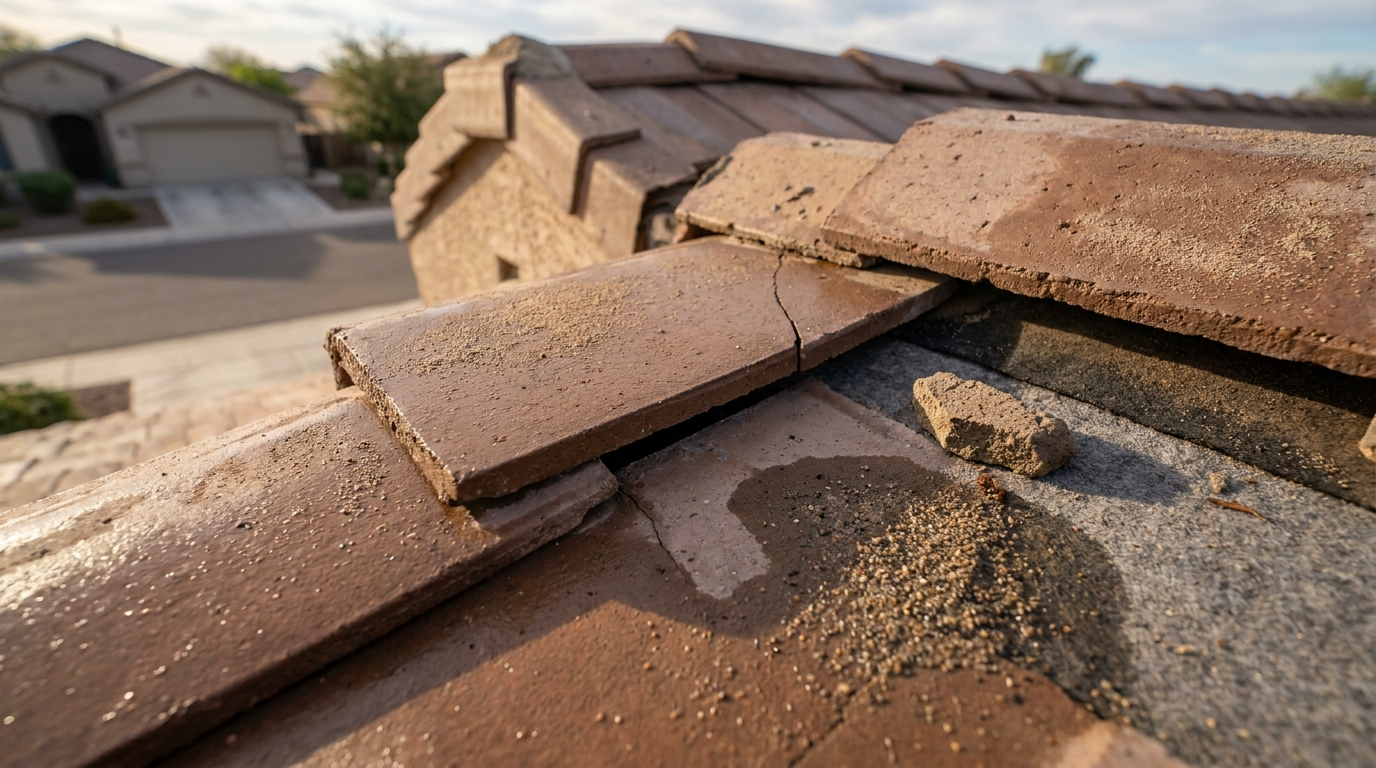
Short answer: After a monsoon, East Valley homeowners need a professional on the roof within a few days to find shifted tiles, cracked mortar, and flashing failures invisible from the driveway. Waiting risks compounding damage before the next storm. All Storm Roofing is licensed Arizona ROC #345156 and Tamko Diamond Certified.
The storm came through last night. This morning your tiles are still on the roof. No water on the ceiling, quiet house. Your gut says you're good.
That's exactly how it looks the month before the ceiling stain shows up.
Post-monsoon inspection isn't about confirming what's obviously broken. It's about the tile that shifted a few millimeters during the storm, re-seated itself perfectly, and looks completely normal from the street while the waterproof seal underneath it is already gone. The flashing at the boot around your HVAC stack that got loosened by the wind. The hairline fracture in a concrete tile that won't register as a leak until the first sideways rain in November. None of that announces itself. None of it is visible from your driveway.
You find it by getting someone on the roof.
Why "It Looks Fine From the Ground" Isn't Enough
Concrete and clay tile is what most East Valley homes are built on. It's genuinely good material. A 40-50 year lifespan is realistic in normal conditions, and we're not here to tell you tile is fragile.
But "the tiles look fine" is the most dangerous phrase in residential roofing. We hear it constantly, and it's usually the last thing a homeowner says before a $6,000 repair conversation.
Here's what the tile isn't doing: keeping your house dry. Under those tiles is a layer of underlayment, felt or synthetic depending on when your home was built, and that's the actual waterproof barrier. In older Gilbert and Chandler homes built before the early 2000s, that's typically felt paper, which starts getting brittle in Arizona heat after 15-20 years. Newer builds with synthetic run 25-35 years. Either way, it's the layer you can't see from the street, and it's the layer the monsoon is actually working against.
Wind lifts a tile slightly during a storm. Breaks the mortar at a ridge or hip cap. Lets driven rain find its way under. The tile comes back down when the storm passes. Nothing looks wrong from below. But water is moving under there right now, finding the low point, working toward your ceiling.
The only early warning system is someone walking the roof.
The 7 Things We Actually Check on a Post-Monsoon Inspection
When our crew gets on a Gilbert, Chandler, Mesa, or Queen Creek roof after a monsoon, we're working through the same points every time.
Ridge caps and hip caps. First thing we check. These are the most exposed pieces in a high-wind event. Mortar-set or nailed, depending on construction era, and monsoon uplift gets under them faster than anything else on the roof surface. A displaced cap looks like a minor thing. It's an open water entry point at the highest part of the roof.
Tile field. We walk the full surface looking for cracked, chipped, or displaced tiles. But we're also checking something less obvious: the angle each tile sits at. Wind can lift a tile and re-seat it millimeters off original position, break the overlap seal, and leave zero visible trace from below. You find this by looking at the tile position from the roof, not from the driveway.
Valley flashing. Valleys concentrate all the runoff from the roof surface. Lifted or bent flashing in a valley doesn't just let in some water, it funnels concentrated flow directly to your decking. We check every valley, including the roof-to-wall transitions where kickout flashing typically fails first. That failure hides behind stucco and shows up as a ceiling stain months later in a room that has nothing obvious to do with the wall it came from.
Pipe boots and HVAC penetrations. Rubber boots around plumbing stacks crack in 5-7 years of Arizona UV exposure. After a storm with wind-driven rain, any gap at a penetration is active water intrusion at the most direct path through the roof. We check every one.
Soffit, fascia, and drip edge. Wind-driven rain hits these from angles normal rain never approaches. Loose or water-stained soffits tell us moisture is wicking behind the stucco. That's structural over time, not cosmetic.
Attic moisture check. When we can access the attic, we do. Decking stains, wet or compressed insulation, musty odor. Honestly, almost every attic stain we find on a post-storm call is older than the storm that prompted the homeowner to call. That's exactly why this step matters.
Gutters and drainage. Monsoon and haboob debris hits gutters hard. Blocked drainage backs water up under the drip edge. On homes without gutters, common in Gilbert and Queen Creek, we verify the drainage path away from the fascia is clear.
Hidden Damage Patterns Specific to East Valley Tile Roofs
East Valley homes have specific vulnerabilities that come up on post-monsoon inspections more than anywhere else in the metro.
Hairline tile cracks from debris impact. Monsoon storms carry palm fronds, gravel, and branches at serious velocity. A palm frond hitting a concrete tile doesn't always shatter it visibly, but it leaves hairline fractures that open further with heat cycling. We find these most often on the northeast and east-facing roof sections after storms that came through the southeast corridor from Queen Creek and San Tan Valley.
Mortar failure at ridge and hip caps. Homes built in the 1990s and early 2000s are entering the window where original mortar gets brittle. One hard storm loosens caps that were already at the end of their service life. We see this regularly on homes in Gilbert south of the US 60 corridor and in older Chandler subdivisions south of Ocotillo Road.
Flashing failure at sidewalls. Where your roof meets a stucco wall, the flashing has to shed water away from the wall. Wind-driven rain hits that transition at an angle the roof wasn't designed to deflect. This is the single most common hidden failure we find on post-monsoon inspections. Nothing visible from below, water sitting in the flashing channel. It shows up inside the house eventually.
If you want more context on what monsoon storms are actually doing to East Valley roofs at a structural level, our post on hidden monsoon roof damage covers the patterns we see most consistently across Gilbert, Mesa, and Chandler.
How Soon After a Storm Should I Get My Roof Inspected?
Within a few days. Two reasons, and both matter.
First, documentation. Most Arizona homeowners policies operate on roughly a one-year window from the storm date for filing a claim, but the practical issue is that the connection between a specific storm event and specific damage gets harder to establish the longer you wait. An inspection report dated three days after a storm tells a clean story. The same damage documented six weeks later is a harder argument. If you think you might file a claim, get the inspection done first, before calling your insurer. The documentation sequence matters.
Second, the East Valley storm pattern during July and August means you're typically within a few days of the next event. A small gap in flashing or a single cracked tile won't destroy your home overnight. But it doesn't get smaller when the next storm comes through.
Our post on monsoon roof damage insurance claims walks through exactly how the documentation and filing sequence affects what you get paid.
Will a Free Inspection Pressure Me Into a Replacement?
If the roofer is honest, no. Here's how you tell the difference.
At the end of a legitimate inspection, you get a clear account of what was found, photos of anything notable, and a straight answer about what's urgent versus what's normal wear for a roof your age. A repair estimate if repairs are needed. No replacement pitch before the roofer has set foot on the roof.
We do these inspections the same way. We're going to tell you if your roof is fine, if it needs some repairs, or if it's getting close to the end of its service life. Some of those conversations turn into work for us. A lot of them don't. That's how it should work.
The thing to watch for is a roofer who opens with a replacement recommendation before they've looked at anything. That's not an inspection. That's a sales approach. The roofing contractor red flags post covers exactly how to vet someone before you let them on your roof.
What's the Difference Between a Post-Monsoon Inspection and a Regular Inspection?
A regular maintenance inspection is broader. Overall condition, estimated remaining service life, age-related wear. A full picture of where the roof stands.
A post-monsoon inspection is storm-specific. We're looking for acute damage patterns: impact cracking, wind uplift at ridge and penetration points, flashing displacement, drainage blockage from storm debris. The sequence of what we check and where we spend our time is different. On a post-storm call we prioritize the sections of the roof that faced the storm, which on East Valley homes is typically the south and west faces during the summer pattern, plus every penetration and valley on those elevations.
It's also worth understanding that hidden damage from a storm doesn't always show up at the most obvious location. Water travels. It enters at one point and appears at another. We've opened attic hatches in Gilbert homes and traced water staining to a valley flashing failure on the completely opposite side of the roof from where the homeowner thought the problem was.
The Mistake Most East Valley Homeowners Make
After a monsoon, most people walk outside, look up, count the tiles still on the roof, and go back inside. That feels like due diligence. It's really just confirming that the obvious damage is obvious.
The damage that converts a manageable repair into a $6,000 decking replacement is never visible from the driveway. A shifted valley flashing. A fractured tile on the northeast corner where the wind swung around. Cracked mortar at the hip cap closest to the HVAC unit. These don't announce themselves. They quietly let in water until you've got a stain on a bedroom ceiling or soft insulation in your attic.
The other piece is timing. Not because your roof is going to fail before the week is out, but because the East Valley stays active through July and August. Another storm typically rolls through within a week. What's a manageable repair before storm two can be a decking job after it.
East Valley Storm Patterns: Gilbert, Chandler, Queen Creek, Mesa
These four communities sit in different storm exposure zones, and it shows up on inspections.
Gilbert and Chandler, particularly west-facing slopes, take the main force of northwest-tracking thunderstorm cells. These are the classic summer afternoon storms that build over the mountains and push toward the metro. Queen Creek and San Tan Valley sit at the open desert edge. Less terrain friction means microburst outflow winds hit harder before they slow down, and we find more concentrated uplift damage on homes east of Power Road.
Mesa's older housing stock, particularly east of Gilbert Road, has more aged underlayment in the mix. Homes that show no tile damage can still have felt underlayment that's been compromised for years and is just waiting for one more storm to reveal itself through a ceiling.
We work across all four regularly. The inspection checklist is the same. The failure patterns we find most often shift based on location, roof age, and construction era. If your home was built before 2005 in any of these communities, the underlayment age is part of every post-storm conversation we have. The tile might go another 20 years. What's under it might not.
For more on what makes the East Valley's storm pattern different from the rest of the metro, our post on microburst roof damage in Gilbert and Queen Creek covers the terrain and exposure factors in detail.
When to Move Fast, and When You Don't Have To
Some things need immediate attention. If you've got an active leak, water on the ceiling, or a major section of damaged tiles or a missing ridge cap, that's not a "schedule an inspection this week" situation. That's a call-us-today situation. Temporary dry-in work matters when water is actively entering the home.
If your house is dry, no ceiling stains, nothing obviously missing from the roofline, you're not in an emergency. But "not an emergency today" doesn't mean "fine to ignore." The East Valley monsoon pattern means another storm is typically close. And the longer between the damage event and the inspection, the harder it is to build a clean documentation trail if insurance is in the picture.
Get the inspection done. Find out what you're dealing with. Then decide what to do about it with real information in hand.
If you want the full breakdown on what your roof assessment should cover before and after storm season, this post lays out the framework we use.
Schedule Your Free Post-Monsoon Inspection
Our team is based in Gilbert. We do free post-monsoon inspections across the East Valley. No pitch, no pressure. We get on the roof, show you what we found with photos, and give you a straight answer about what's actually going on up there.
If a storm moved through your neighborhood and you want a real look before the next one rolls through, give us a call at (602) 806-6806. AZ ROC #345156.
WRITTEN BY
Tuuta Pulotu is the CEO and co-founder of All Storm Roofing + Construction. He was born and raised in Arizona. His mom is from Hawaii, his dad from Tonga, and Tuuta grew up in the trades working alongside his father, who's been running a landscaping and masonry crew in the Valley for over thirty years. Before founding All Storm in 2021, Tuuta spent years in solar sales. Long enough to watch too many East Valley homeowners get pushed into roof decisions they didn't fully understand. He started All Storm to flip that conversation: be the contractor who tells homeowners what's actually going on with their roof, even when the truth costs him the job. He runs All Storm out of Gilbert, where he lives with his wife and four kids. AZ ROC #345156. Tamko Diamond Certified. The only Tamko Diamond Certified roofing contractor in Arizona.
Worried about your roof?
Get a free, no-pressure inspection from a Gilbert team that gives honest answers — not pressure to replace.
Schedule Free Inspection