Tile Re-Roofing Cost in Gilbert and Chandler: What the Number Actually Means in 2026
→ QUICK ANSWER
Tile re-roofing in Gilbert and Chandler runs $8,000 to $25,000 for most homes. The real question is whether you need a full tear-off or just underlayment. Here's how to read your quote.

Short answer: Tile re-roofing in Gilbert and Chandler runs $8,000–$14,000 for underlayment replacement with tiles reset, or $12,000–$22,000 for full tear-off and new concrete tile. Roof size, tile profile, underlayment grade, and permits around $250–$500 move the final number. All Storm Roofing is licensed Arizona ROC #345156 and Tamko Diamond Certified.
What Tile Re-Roofing Actually Costs in Gilbert and Chandler
You want a real number. Not a national average that has nothing to do with East Valley pricing. Not a range so wide it tells you nothing. A real number with the reasoning behind it.
Here it is: most tile re-roofing jobs in Gilbert and Chandler land between $8,000 and $22,000 for a standard single-family home, depending on which of two very different jobs you need. That range is real, and it hinges on one question that shapes everything else on your quote: are your tiles salvageable, or does everything come off?
That question splits into two completely different scopes of work.
The Two Jobs That Both Get Called "Tile Re-Roofing"
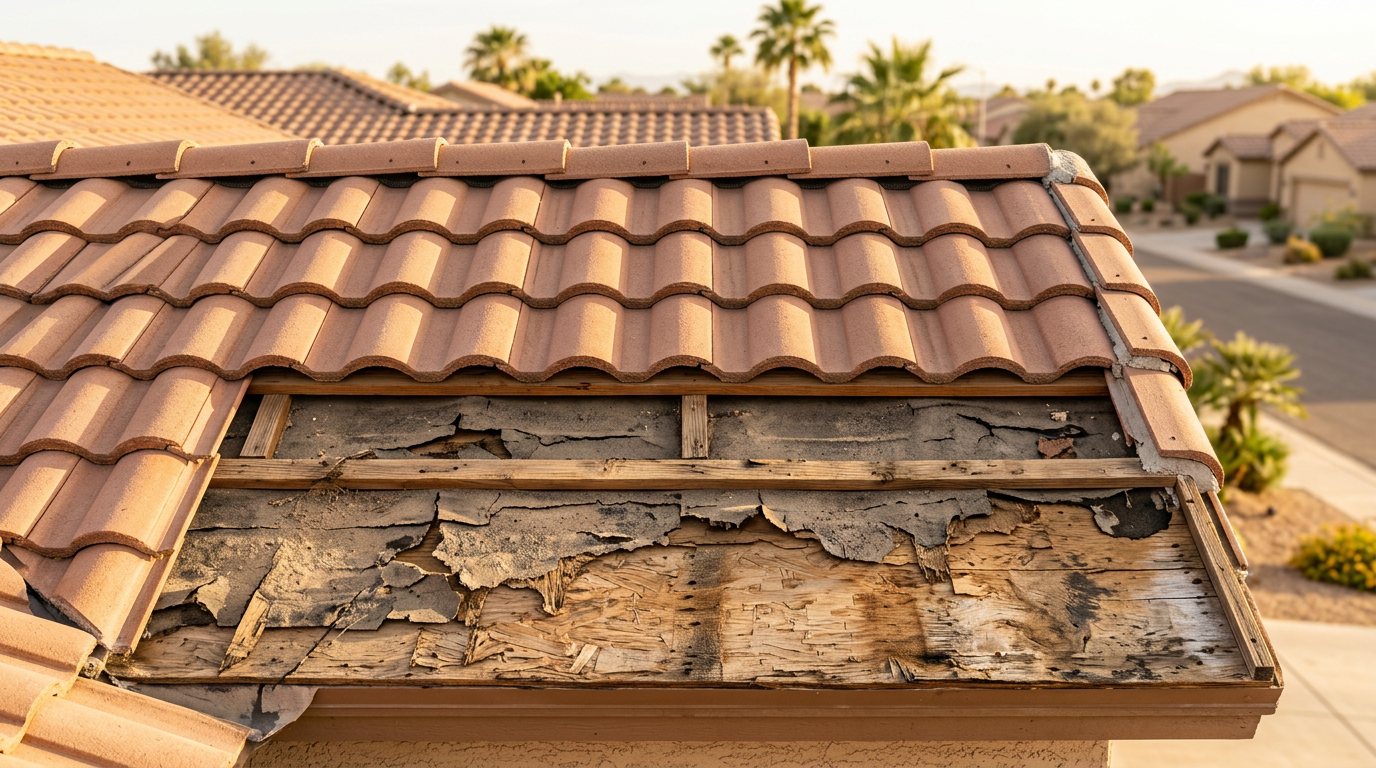
Lift-and-set (underlayment replacement). The crew removes your existing concrete tile carefully, replaces the deteriorated underlayment beneath, then reinstalls your original tile. This is the right call for most Gilbert and Chandler homes built between 1995 and 2010, where the tile is structurally fine and the layer beneath it is failing. Jobs like this typically run $8,000 to $14,000 for an average 2,000 to 2,500 square foot home. The tiles themselves have years left. What's worn out is what's underneath them.
Full tear-off and replacement. Everything comes off. New underlayment, new tile. This is the scope for homes with significant tile cracking, hail damage, discontinued profiles, or homeowners who want a different look. Concrete tile on a standard East Valley home runs $12,000 to $22,000 for a full replacement, depending on size, pitch and decking. Clay or custom profiles push higher.
These two scopes can look similar on a vague quote. They are not the same job. Confusing them is exactly how homeowners end up blindsided by costs or disappointed by scope.
Why the Tile Is Fine but the Roof Isn't
Concrete tile in Arizona lasts 40-50 years. Most homes in Gilbert's master-planned communities, built out through Seville, Power Ranch, and Val Vista Lakes in the late 1990s and early 2000s, are sitting on tile that still has structural life left.
What fails first is the underlayment. On homes from that era, original felt paper degrades in the 15-20 year range in Arizona heat. The tile above it looks fine from the street. Inside the roof system, the waterproofing layer is cracking and no longer doing its job. That is exactly why your tiles look fine but the roof is leaking. We hear that description constantly from Chandler and Gilbert homeowners. It is not mysterious. It is underlayment failure on schedule.
If your home is in that 15-25 year window and no one has checked the underlayment, that inspection should happen before monsoon season hits.
What Moves the Price Up or Down
Roof size. A 20-square roof and a 28-square roof are meaningfully different scopes. Chandler and Gilbert homes in the 1,800-3,000 square foot living area range often have roof surfaces running 20-30 squares once pitch and overhang are measured. Square footage alone understates the real surface area.
Tile profile. Standard Spanish-S concrete tile is the most common profile in the East Valley and prices accordingly. Barrel tile, clay tile, or any HOA-required color-matched profile costs more. If your development requires a specific tile no longer in production, matching it for a partial job can add meaningful cost or force a full tile replacement even when the scope is just underlayment.
Roof complexity. Valleys, hips, dormers, skylights, and pitch all add labor. A 4:12-pitch rectangular roof and a 7:12-pitch roof with four valleys and a chimney might both be 25 squares on paper. The second job costs more. That is not padding. It is the actual time the crew spends on the roof.
Underlayment grade. This is the most important decision in the quote, and the one most homeowners skip over. Felt paper is cheaper upfront. Synthetic underlayment costs more and lasts 25-35 years in Arizona conditions. That is a real difference in how long before your next service cycle. On a typical East Valley home, the cost difference between felt and quality synthetic is usually $1,500-$2,500. Get synthetic. The math over a 20-year horizon is not close.
What the crew finds when the tile comes off. No honest contractor can tell you what the decking looks like until it is exposed. Rotted or soft decking adds cost, typically $50-$100 per sheet of plywood. On most jobs, decking is fine. On jobs where water has been working through the underlayment for a while before the call, it is not. A trustworthy quote includes clear language about how decking repairs get billed if found.
Tile breakage during lift-and-set. Careful crews save most tiles during an underlayment replacement, but roughly 10% do not make it, whether already cracked or broken during removal. That tile gets replaced. If your profile is discontinued, sourcing matching tile is a real issue. Good contractors account for this in the estimate. Low-ball contractors do not mention it until the invoice.
Permits. Both Gilbert and Chandler require permits for tile roof replacements. A licensed contractor pulls the permit and coordinates the city inspection. The closed permit goes on your home's record and it matters when you sell. If a quote skips the permit step, that tells you everything you need to know about the rest of the proposal. Budget roughly $250-$500 for permit cost in the East Valley.
Solar panels. If you have solar, the panels come off before work and go back on after. Budget an additional $500-$1,500 depending on system size and your solar company's coordination fee.
How to Read a Quote You Can Actually Trust
A quote worth comparing breaks these items out separately. Bundled lump sums are not quotes. They are starting points for surprises.
Tear-off and disposal should be listed separately, including what gets hauled and how. This is not free and it is not folded into labor for no reason.
Underlayment type and square footage should be stated clearly. If the quote says "underlayment" without specifying felt or synthetic, ask. The answer tells you what you need to know.
Tile scope should specify whether you are getting new tile, reset tile, or a combination, and how breakage is handled. A lift-and-set scope without breakage language is incomplete.
Flashing should be addressed as its own line item. Valleys, pipe boots, chimney transitions, wall step flashing. These are where most long-term leaks start. A complete scope addresses all of them. A cut-rate scope leaves them alone until the next leak.
Permit fee should be listed explicitly, not buried or missing.
Decking contingency language should state clearly what happens and at what rate if soft decking is found. This protects you and it is a sign the contractor has done enough of these jobs to know they find it sometimes.
For a deeper look at what East Valley quotes tend to leave out, see our post on hidden costs that blow East Valley budgets.
The Most Common Mistake We See in Chandler and Gilbert
Homeowners comparing quotes that are not comparing the same scope.
Quote A is lift-and-set with synthetic underlayment, full flashing replacement, permit included. Quote B is a full tear-off with felt paper, no permit, and flashing addressed only where it is obviously failing. Quote A is $3,500 higher. It is also a fundamentally different job.
The low bid is low for a reason. Either the underlayment grade is inferior, the permit is missing, the flashing scope is incomplete, or the tile breakage contingency is absent. Getting to a real comparison takes line-item detail on every quote, not just the bottom number.
Three quotes is the right number. One from a large company with real overhead, one from a smaller crew, one from a mid-size local operation. Then compare line by line.
What Makes East Valley Tile Jobs Different
Tile re-roofing in Gilbert and Chandler is not the same job as tile re-roofing in a moderate climate, even at the same square footage.
Heat-rated materials are required, not optional. Underlayment, flashing sealants, and pipe boot materials all need to be spec'd for Arizona UV exposure. Products that hold up fine in Dallas or Denver break down in 5-7 years here. Contractors who drift into the East Valley after storms from other markets sometimes bring the wrong material spec. Worth asking: where do they normally work?
HOA approval adds a step on full tile replacements in most master-planned communities across Gilbert and Chandler. If you are changing tile profile or color, budget additional lead time for architectural review before work starts.
Post-monsoon backlogs are real. If you are reading this in September or October, reputable contractors in Gilbert are booking weeks out. Scheduling in the spring (April through June) or winter gives you better availability and sometimes better pricing.
Ask any contractor how they manage decking exposure time on jobs that take more than one day. In an East Valley summer afternoon, that window matters.
And before you hire anyone, read how to vet a roofer in Gilbert. Six questions. Takes ten minutes. It separates real local contractors from whoever knocked on your door after the last storm.
One More Thing Worth Saying
There is a version of this that is not urgent. Your roof is 18 years old, tiles look fine, no leaks you know of. Maybe the underlayment is holding. Maybe it is not. The only way to know is to get someone up there who knows what to look for.
We do free inspections across the East Valley. No sales pitch attached to it. We will tell you what we see, whether that is "you have got more time" or "here is what is actually happening under there." If something in this post matched what you are dealing with on your roof, give us a call at (602) 806-6806. We are based in Gilbert and we work all across Gilbert, Chandler, Mesa, and Queen Creek.
For the repair, underlayment-only and full re-roof options side by side, with Gilbert price ranges, see our tile roof repair, underlayment and replacement in Gilbert page.
WRITTEN BY
Tuuta Pulotu is the CEO and co-founder of All Storm Roofing + Construction. He was born and raised in Arizona. His mom is from Hawaii, his dad from Tonga, and Tuuta grew up in the trades working alongside his father, who's been running a landscaping and masonry crew in the Valley for over thirty years. Before founding All Storm in 2021, Tuuta spent years in solar sales. Long enough to watch too many East Valley homeowners get pushed into roof decisions they didn't fully understand. He started All Storm to flip that conversation: be the contractor who tells homeowners what's actually going on with their roof, even when the truth costs him the job. He runs All Storm out of Gilbert, where he lives with his wife and four kids. AZ ROC #345156. Tamko Diamond Certified. The only Tamko Diamond Certified roofing contractor in Arizona.
Worried about your roof?
Get a free, no-pressure inspection from a Gilbert team that gives honest answers — not pressure to replace.
Schedule Free Inspection