What to Do After Monsoon Roof Damage: The East Valley 72-Hour Guide
→ QUICK ANSWER
A monsoon just hit your East Valley neighborhood. The next 72 hours determine your insurance outcome, how much secondary damage you prevent, and whether you end up with a local roofer or a storm…

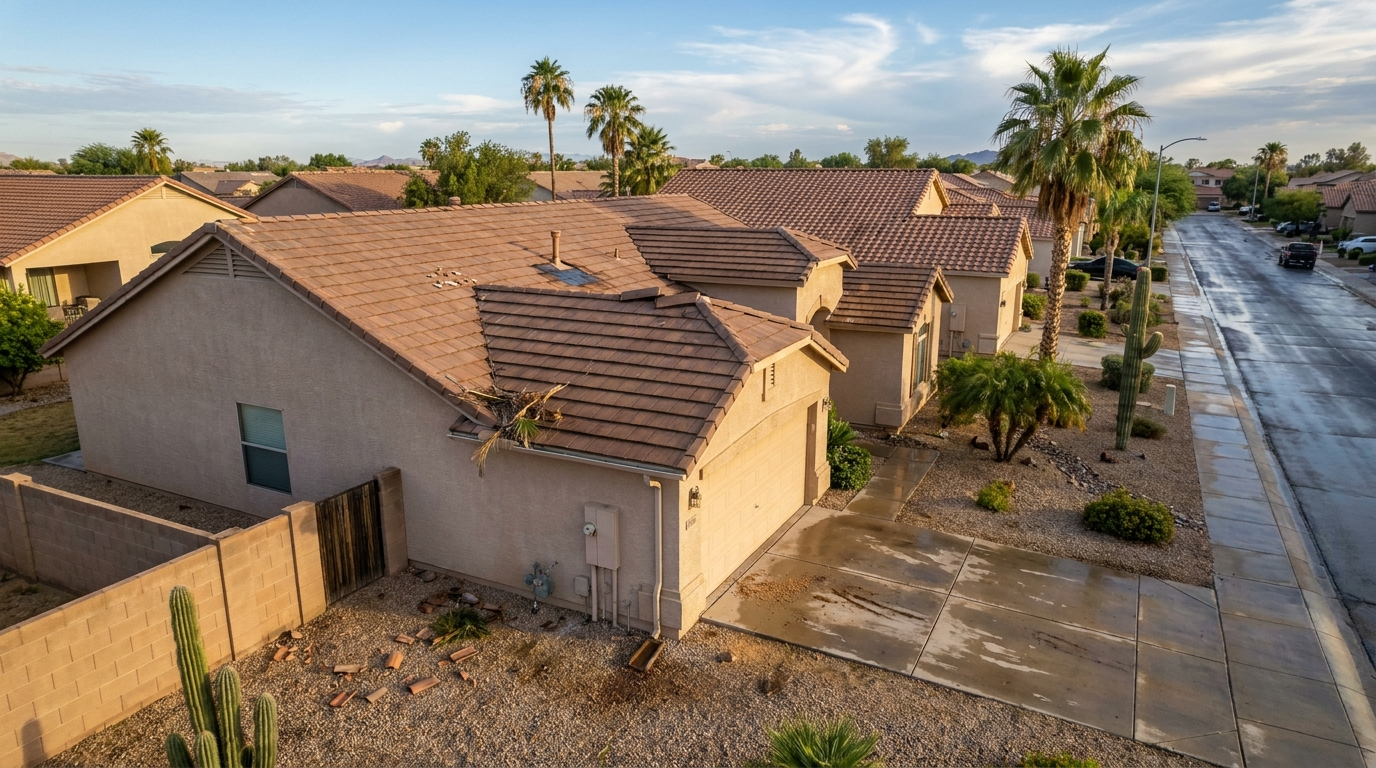
Your roof just took a monsoon hit. Here's what to do in the next 72 hours.
A storm rolled through your neighborhood last night. This morning you're standing in the driveway staring at a displaced ridge tile, a shingle or two in the yard, or maybe a faint stain spreading across the ceiling in the back bedroom. You're not sure how bad it is.
Here's the short answer: the next 72 hours matter more than most homeowners realize. Not because the sky is falling, but because what you do right now determines how your insurance claim goes, how much secondary damage you prevent, and whether you end up working with a real local contractor or some out-of-state crew that showed up with a truck and a sales pitch.
We've worked Gilbert, Chandler, Mesa, and Queen Creek roofs through enough monsoon seasons to know the difference between a roof that actually needs attention and one that just looks bad from the driveway. This is the walkthrough we'd give our own neighbors.
Step 1 (first 2 hours): Safe ground-level assessment
Do not get on the roof. That's the first rule, and it's not overcaution. A wet concrete tile surface after a monsoon is genuinely dangerous. And you won't see meaningfully more from up there than you can from the ground and the attic.
Here's what to check right now.
From the driveway and yard: Walk the full perimeter of the house. Look for displaced or cracked ridge tiles along the peak. That's the highest-exposure section of any roof in a monsoon, and it goes first. If you've got an asphalt shingle roof, look for lifted or missing shingles, and check the yard for granule loss where the downspouts drain. Granules look like coarse sand. Finding them in quantity tells you the storm did something to the shingle surface. Check the gutters too. Dented gutters, gutters pulling away from the fascia, or downspouts clogged with debris all tell a story about wind force and water volume.
From the attic: This is the most useful thing a homeowner can do in the first hour. Grab a flashlight and go up. Look for daylight coming through the decking. Look for wet insulation, water stains on the sheathing, or any active dripping. Attic moisture tells you what the roof surface is hiding. A storm that looks minor from the curb can already be pushing water past the underlayment.
A note on older Gilbert and Chandler homes: If your home was built before 2005, there's a real chance it has felt underlayment under concrete tile. After 15-plus years of Arizona UV and heat cycling, that felt gets brittle. A monsoon doesn't have to crack a single tile to drive water through. The underlayment fails at seams, at the flashing, at the ridge. Newer homes with synthetic underlayment resist this better, but nothing is permanent in this climate.
Write everything down. Take notes in your phone with the timestamp showing. That record matters later.
Step 2 (within 24 hours): Document everything before the next storm hits
The monsoon doesn't run on a polite schedule. Another cell can move through within 24 hours. If that happens before you've documented the current damage, your insurer will have a much harder time separating what the first storm did from what the second one added.
Photograph everything you found in Step 1. Get shots of the full roofline from each corner of the yard. Close-ups of any obvious damage. Attic photos if you went up. Shots of any ceiling or wall stains inside the house. Include surrounding context too: debris in the yard, clogged gutters, anything that places the damage in time and place.
Pull the weather data for your zip code. The National Weather Service and local weather tracking services document storm cell paths across the East Valley with enough detail to show the date, time, and wind speed for a storm that crossed your specific part of Gilbert or Queen Creek. Save that data in the same folder as your photos. Your insurer will ask about the storm date. Having the official record makes that simple.
Call your insurer and open a record. Most Arizona policies require prompt notification of damage. Some spell out 24 to 72 hours in the policy language, others just say "reasonable time." Either way, the move is to call now. You're not committing to a claim yet. You're creating a timestamp that protects you. That's worth doing.
Do not let anyone on your roof yet unless water is actively entering the home.
Step 3 (within 48 hours): Temporary protection and the tarp question
If you have an active leak, a clear opening in the roof, or missing shingles with more rain in the forecast, you need temporary protection. That usually means a tarp.
Most homeowners' insurance policies cover emergency tarping as part of your mitigation obligation. Your policy almost certainly has a "duty to mitigate" clause. That clause means you're expected to take reasonable steps to prevent additional damage after a covered event. If you know your roof has an opening and you don't address it, your insurer can deny coverage for the water damage the next storm brings in.
Get the tarping done by a licensed contractor. Keep the receipt. Photograph the installation before and after. A proper temporary tarp extends several feet past the damaged area on all sides and is secured, not just laid across the surface.
If your damage looks limited to displaced ridge tiles or a minor flashing gap with no active leaking, you may not need emergency tarping. But that's a judgment call that belongs on a licensed roofer's plate, not a storm chaser who showed up at your door.
Step 4 (within 72 hours): Get a licensed East Valley contractor on the roof
This is where it matters who you call.
After every significant monsoon in the East Valley, out-of-state contractors move in fast. They drive through Gilbert and Chandler neighborhoods, knock on doors, and offer inspections or repairs "only available today." The BBB has documented this pattern for years. The pitch sounds urgent and helpful. The reality is that many of these crews don't hold an active Arizona ROC license, carry no local bond, and won't be around to honor any warranty they mention in passing.
You can verify any contractor's license at roc.az.gov in about 30 seconds. Search by company name or license number. Check that the license is active, not expired, and that the license class covers roofing work. If a contractor can't give you their ROC number right then, walk away.
What you want from a licensed contractor within 72 hours: a written inspection report. Photos of what they found, with timestamps. A written scope of any recommended repairs. If they want you to sign something before they've told you what's actually wrong, that's pressure. A real contractor hands you the findings and gives you time to think.
Our crew handles free post-storm inspections across the East Valley. We write up what we find and hand it to you in writing, whether or not you hire us for the repair. If you want to see what a thorough post-storm inspection actually covers, our guide on what a real post-monsoon inspection looks like walks through the full process.
The Arizona insurance catch most homeowners don't see coming
This one trips up Gilbert and Chandler homeowners every monsoon season.
Arizona's extreme climate creates a gray zone between storm damage and pre-existing wear. A concrete tile roof that's 20 years old has been through decades of UV exposure and heat cycling. When a monsoon with 60 to 70 mph microburst winds hits it, some of what fails was already on its way out. The tile cracks. The ridge mortar lets go. The flashing separates. Was it the storm? Was it wear? In Arizona, the honest answer is usually both.
Insurance adjusters know this. Their job is to identify what the storm caused versus what was already failing before it arrived. That's not a simple question on a 20-year Arizona roof, and adjusters' pricing software doesn't always capture the complexity of tile and underlayment systems in this climate.
Having a licensed roofer on-site during the adjuster's inspection changes the outcome. They can walk through the damage, flag items the software undervalues, and provide a written assessment that becomes part of your claim file. That's not adversarial. It's just how a complex claim in Arizona's climate gets documented properly.
One practical move: document wind damage and hail damage separately in your notes and photos, even if both came from the same storm. A cleaner scope makes for a faster settlement. Our monsoon roof damage insurance claim timing guide covers the full filing sequence if you want to understand exactly how the process should go.
What happens when Gilbert homeowners wait too long
Most people who wait are busy. Or the damage doesn't look that bad. Or they're hoping it's a one-time thing.
Here's what actually happens.
Secondary moisture damage builds quietly. A small breach at the ridge lets in water vapor during subsequent storms and during the heavy overnight dew cycles that follow monsoon rain. That moisture works on the decking and insulation over weeks. By the time you see a ceiling stain, you're often looking at decking replacement on top of the roof repair. What might have been a $1,200 repair becomes a larger project.
Your insurance position gets harder. If you knew about damage, didn't document it, didn't notify your insurer, and didn't mitigate, a later claim for secondary damage becomes complicated. The question your insurer asks is: what did you do when you first noticed the problem?
The best local contractors book up fast after a significant storm. Our schedule fills within days. Wait a week and you're choosing from whoever is still available, and that's not always the pool you want to pick from.
Gilbert and Chandler: what our crew sees most after a big storm
On tile roofs in Gilbert and Chandler, the most common call after a monsoon is displaced or cracked ridge and hip tiles. The ridge is the most wind-exposed section of any roof, and the mortar holding ridge tiles in place breaks down over years in the Arizona heat cycle. Gusts of 60 to 70 mph can displace ridge tiles that were already at the end of their mortar life. Sometimes one tile goes. Sometimes a full section comes loose. Our guide on ridge and hip tile monsoon damage in Gilbert covers exactly how adjusters classify these failures if you want to understand what you're dealing with before anyone gets on the roof.
On shingle roofs, which are common in neighborhoods built from the late 1990s through around 2010, we see lifted and missing shingles on the south- and west-facing pitches. Those faces take the hardest UV exposure all year, so they tend to be the most brittle when wind loads arrive. A shingle that looked fine in June can fail under a July monsoon.
On foam roofs, the main concern after a storm is the elastomeric coating. If the coating has cracked from UV exposure, a hard monsoon rain can start lifting sections. Foam itself is durable. The coating is what does the waterproofing work, and it needs attention every 5 to 7 years in the East Valley.
Free inspection, no pressure, East Valley crew
We're based in Gilbert. We work across the East Valley and we've seen these situations hundreds of times.
If something in this post lines up with what you're looking at right now, we're happy to come take a look. Free inspection, no sales pitch. We put our findings in writing and tell you what we actually found.
If you're also trying to vet who to call, our guide on how to choose a roofing contractor in Gilbert AZ has the six questions that separate real local contractors from the crews coming through after a storm.
We're across Gilbert, Chandler, Mesa, and Queen Creek. Give us a call at (602) 806-6806.
AZ ROC #345156.
WRITTEN BY
Tuuta Pulotu is the CEO and co-founder of All Storm Roofing + Construction. He was born and raised in Arizona. His mom is from Hawaii, his dad from Tonga, and Tuuta grew up in the trades working alongside his father, who's been running a landscaping and masonry crew in the Valley for over thirty years. Before founding All Storm in 2021, Tuuta spent years in solar sales. Long enough to watch too many East Valley homeowners get pushed into roof decisions they didn't fully understand. He started All Storm to flip that conversation: be the contractor who tells homeowners what's actually going on with their roof, even when the truth costs him the job. He runs All Storm out of Gilbert, where he lives with his wife and four kids. AZ ROC #345156. Tamko Diamond Certified. The only Tamko Diamond Certified roofing contractor in Arizona.
Worried about your roof?
Get a free, no-pressure inspection from a Gilbert team that gives honest answers — not pressure to replace.
Schedule Free Inspection