Are Arizona Monsoon Storms Getting Worse? What East Valley Homeowners Need to Know
→ QUICK ANSWER
Arizona monsoon storms are getting fewer but more violent. Here's what ASU's 2026 DOE study found, what 60-80 mph microbursts do to tile vs. shingle vs.

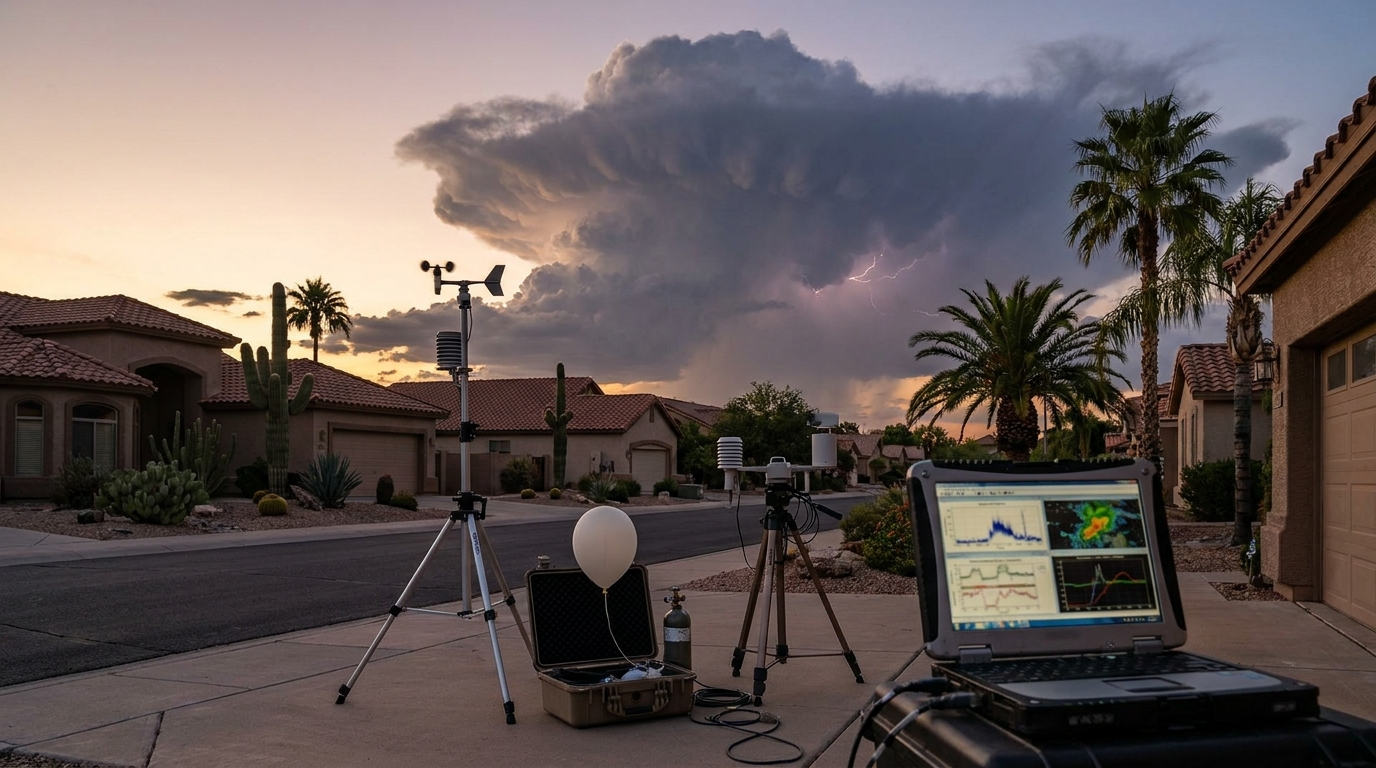
Are Phoenix Monsoon Storms Getting Worse? Here's What the Science Says.
The short answer: storms are becoming fewer but more destructive when they hit. That's not an opinion. That's what researchers from ASU to the University of Arizona have been measuring for years, and it's exactly why ASU launched a $2.5 million DOE-funded study this June to figure out what's actually driving it.
For homeowners in Gilbert, Chandler, and Queen Creek, the practical question isn't whether the science is interesting. It's whether your roof is built for what's coming.
What ASU's New Monsoon Study Found (And Why It Matters for Your Roof)
In June 2026, ASU kicked off one of the most comprehensive severe weather studies ever conducted in the Phoenix metro. It's called DUSTIEAIM (Desert-Urban SysTem IntegratEd AtmospherIc Monsoon), and it's funded by the U.S. Department of Energy. Researchers are deploying weather balloons launched four to six times daily, ground-based laser sensors, and continuous atmospheric monitors to track how Phoenix's extreme heat, rapid growth, and dust are changing how monsoon storms form and behave.
Vernon Morris, the project's lead researcher and associate dean at ASU's New College of Interdisciplinary Arts and Sciences, put it plainly: "We have a rapidly changing environment and a rapidly changing land surface as well, so when you have that many variables that are changing at the same time, predictability becomes very difficult."
That word, predictability, is what matters most if you own a home in the East Valley.
Here's what the research so far consistently shows: Arizona is seeing fewer monsoon storms per season. But the storms that do arrive carry more moisture, generate higher rainfall rates, and produce stronger downdraft winds than storms from the same period decades ago. A University of Arizona study comparing monsoon rainfall from 1950-1970 against 1991-2010 found that Phoenix and much of the low desert saw rain falling in far more intense bursts, even as average daily rainfall across Arizona dropped by as much as 30 percent in some areas.
Dr. Christopher Castro, a researcher at the University of Arizona's Department of Hydrology and Atmospheric Sciences, described the shift this way: storms arrive less frequently, but when they do, they bring higher rainfall amounts, more intense rainfall, and more intense winds.
For homeowners, that pattern is more dangerous than it sounds. A quiet week followed by one violent storm gives you almost no warning. Your roof doesn't get a warm-up round.
What 60-80 mph Microbursts Actually Do to East Valley Roofs
A microburst is a localized column of sinking air that hits the ground and explodes outward in every direction. It's straight-line wind, not rotating like a tornado, but it can do comparable damage in a narrow zone. Microbursts typically cover less than 2.5 miles in diameter, last five to fifteen minutes, and hit with almost no warning.
The East Valley gets them regularly. In July 2024, a Phoenix metro microburst produced localized winds estimated at 70-80 mph by radar, collapsing a warehouse near 47th Ave and Van Buren. A Tempe microburst in October 2025 generated gusts up to 90 mph, ripped roofs off multiple buildings, displaced over 130 residents, and left 22,000 without power. The Chandler Airport recorded 116 mph in a 2016 wet macroburst event. These aren't rare weather curiosities. They're what happens here in July and August.
For residential roofs in Gilbert and Chandler specifically, the open desert exposure east of the 202 means less friction to slow storms down before they reach your neighborhood. That's why the East Valley consistently sees some of the worst microburst damage per event in the metro.
What happens to your roof at these wind speeds depends almost entirely on your material.
At 50-60 mph, asphalt shingles start to experience seal-strip failures. The adhesive bond between shingles begins to break. You may not lose shingles outright, but the seal is compromised. A single compromised shingle lets wind get underneath adjacent ones, and the failure spreads.
At 58-74 mph, even well-maintained shingles can be ripped off entirely. Flashing loosens. Underlayment gets exposed. Ridgeline caps are especially vulnerable.
At 75 mph and above, you're looking at widespread shingle loss, structural flashing damage, and potential deck exposure. At 90-plus mph, semi-trucks flip. Roofs peel back. These aren't theoretical numbers. They're what our crew has driven through after storms in Tempe and Gilbert.
Tile Roofs vs. Shingles vs. Foam in High Wind Events
This is the comparison East Valley homeowners actually need. Here's our honest read:
Concrete tile is the best performer in high wind events, by a meaningful margin. Properly installed concrete tile can withstand winds up to 150 mph. The weight of the tile works in its favor. The challenge in a microburst isn't usually the tile blowing off. It's tile slippage, hairline cracks from debris impact, and the underlayment beneath the tile. Tile lasts 40-50 years in Arizona. The underlayment beneath it often doesn't. When tile looks fine after a big storm but your ceiling is wet two weeks later, it's usually the underlayment that failed, not the tile itself.
Architectural shingles are significantly more wind-vulnerable than tile. Most modern architectural shingles are rated for winds up to 110 mph, sometimes 130 mph under ideal conditions. But "rated for 110 mph" assumes new shingles, proper installation, and intact sealant strips. On a 15-year-old architectural shingle roof in Phoenix, where UV and heat cycles have been degrading the adhesive every summer, the effective wind resistance is lower. Architectural shingles in Phoenix heat typically last 20-25 years. A shingle roof at year 18 in Gilbert doesn't perform like one at year 5.
Foam (SPF) roofs are a different animal. Because SPF is chemically bonded to the roof deck with no seams, no fasteners, and no mechanical attachment points, wind uplift has almost nothing to grab onto. There are no shingle edges to lift. No lap joints to pry open. The foam essentially becomes the structure. This makes SPF particularly resilient to straight-line microburst winds. The tradeoff is that SPF needs its elastomeric topcoat renewed every 5-7 years in the East Valley to protect the foam from UV degradation. Miss that window and you're dealing with a different kind of failure.
The honest answer for Gilbert and Chandler homeowners: if your home has a pitched roof, tile beats shingles in storm performance. Full stop. If your home has a flat or low-slope section, properly maintained SPF is hard to beat.
The Five Most Common Post-Microburst Failures We See in Gilbert and Chandler
After a big storm, we get calls for two reasons: obvious damage and hidden damage. The hidden ones are the ones that cost more.
1. Creased or lifted shingles that look fine from the driveway. Wind lifts a shingle, bends it, and it lays back down. Looks normal from the street. But the seal strip is broken. The next rain event drives water under it. You find out six weeks later when there's a stain on your ceiling.
2. Displaced ridge cap. The ridgeline is the highest-pressure zone on any roof. Ridge caps get knocked loose in microbursts regularly. A gap at the ridge is an open door for wind-driven rain.
3. Cracked tile from debris impact. A microburst can hurl patio furniture, palm fronds, and tree branches at 60-plus mph. Concrete tile doesn't blow off, but it can crack when something hits it. A cracked tile that doesn't fall out is easy to miss in a post-storm visual scan from the ground.
4. Lifted underlayment beneath tile. This is the one we see most often on older East Valley tile roofs. Wind-driven pressure gets under the tile, and over time the felt underlayment lifts at the laps. The tile above looks perfect. The moisture barrier below is compromised. If your tile roof is over 15-20 years old, this is worth a real look after any significant storm event.
5. Foam coating punctures from debris. SPF handles wind well but isn't immune to a flying two-by-four. Debris can puncture the elastomeric topcoat and expose the foam beneath to UV. The roof won't leak immediately since foam is closed-cell and doesn't saturate. But UV will degrade the exposed foam over time if it isn't patched.
How to Make Your Roof More Storm-Resilient This Season
We're not going to tell you your roof could collapse. It probably won't. But there are things that genuinely reduce storm risk, and they're not complicated.
Get eyes on it before a storm, not after. Post-storm inspections are reactive. A pre-monsoon inspection in May or June gives a roofer a chance to look at the ridge, the flashing, the underlayment laps, and the seal strips before the first storm hits. That's where you catch the things that become problems in July. Our pre-monsoon roof inspection checklist covers exactly what to look for on tile, shingle, and foam roofs across the East Valley.
Know your roof age and material. A 15-year-old shingle roof heading into an active season is a different conversation than a 6-year-old tile roof. If your roof is already showing its age and this year's monsoon forecast leans wetter than average, this is the year to stop deferring.
Check the foam coating, not just the foam. If you have an SPF roof, the foam itself is likely fine. The elastomeric topcoat is what protects it. Yellowing foam visible anywhere means the coating has worn through and UV is hitting raw foam. That needs attention before the season starts.
After a storm, look inside before you look outside. Your attic tells you more than your roofline does. Water stains on rafters, wet insulation, or daylight visible through the deck are the real indicators of whether your roof took a hit. We wrote about this in more depth in the attic-first interior inspection guide for post-monsoon damage.
Get ahead of insurance documentation. If you've had a significant storm event and you suspect damage, document it fast. The timing and sequence of how you report monsoon damage matters more than most homeowners realize. Your insurer will look for any reason to attribute damage to pre-existing wear rather than the storm.
Does a Wetter Monsoon Mean More Insurance Claims?
Probably. But not always for the reason you'd expect.
Most homeowners assume that more rain equals more claims. That's true for flooding. For roofs, it's more nuanced. The damage drivers in the East Valley aren't usually the rain. They're the wind. A microburst can drop minimal rain and still strip shingles off half a block. The damage shows up weeks later when the first substantial rain comes through.
What we've seen in Gilbert and Chandler after active monsoon seasons is a surge of claims filed in September and October. Not during the storm itself, but after homeowners do an attic check following the second or third rain event of the season and find water stains they can't explain.
Arizona insurers have gotten sharper at distinguishing storm damage from pre-existing wear. A claim filed two months after a microburst with no documentation of the weather event, no inspection record, and a roof that's 20 years old is a difficult claim to push through. If you're in the East Valley and your roof took a hit this season, file promptly and document carefully. Our post on monsoon roof damage insurance claim timing breaks down the sequence that actually protects your payout.
The Bottom Line for Gilbert and Chandler Homeowners
The DUSTIEAIM study won't have final answers for another year. But the pattern that's already visible in the data is enough to act on: fewer storms, each one hitting harder when it shows up.
Your roof doesn't need to be new. It doesn't need to be perfect. But it does need to be looked at before the season starts, not after. And if you've been putting off a replacement on a shingle roof that's past its prime, the math changes in an active monsoon year.
If you're in the East Valley and want someone to actually get on your roof and tell you what's going on up there, we do free inspections. No sales pitch, no scare tactics. We're based in Gilbert. Give us a call at (602) 806-6806.
Tuuta Pulotu is the CEO and co-founder of All Storm Roofing + Construction. He was born and raised in Arizona. His mom is from Hawaii, his dad from Tonga, and Tuuta grew up in the trades working alongside his father, who's been running a landscaping and masonry crew in the Valley for over thirty years.
Before founding All Storm in 2021, Tuuta spent years in solar sales. Long enough to watch too many East Valley homeowners get pushed into roof decisions they didn't fully understand. He started All Storm to flip that conversation: be the contractor who tells homeowners what's actually going on with their roof, even when the truth costs him the job.
He runs All Storm out of Gilbert, where he lives with his wife and four kids.
AZ ROC #345156. Tamko Diamond Certified. The only Tamko Diamond Certified roofing contractor in Arizona.
WRITTEN BY
Tuuta Pulotu is the CEO and co-founder of All Storm Roofing + Construction. He was born and raised in Arizona. His mom is from Hawaii, his dad from Tonga, and Tuuta grew up in the trades working alongside his father, who's been running a landscaping and masonry crew in the Valley for over thirty years. Before founding All Storm in 2021, Tuuta spent years in solar sales. Long enough to watch too many East Valley homeowners get pushed into roof decisions they didn't fully understand. He started All Storm to flip that conversation: be the contractor who tells homeowners what's actually going on with their roof, even when the truth costs him the job. He runs All Storm out of Gilbert, where he lives with his wife and four kids. AZ ROC #345156. Tamko Diamond Certified. The only Tamko Diamond Certified roofing contractor in Arizona.
Worried about your roof?
Get a free, no-pressure inspection from a Gilbert team that gives honest answers — not pressure to replace.
Schedule Free Inspection