Hail Damage Roof Claims in the East Valley: What Gilbert, Mesa, and Queen Creek Homeowners Need to Know
→ QUICK ANSWER
Hail damage isn't always visible from the ground. Learn how hail affects tile, shingle, and foam roofs, how to document a claim, and why ACV vs. RCV can dramatically impact your payout.

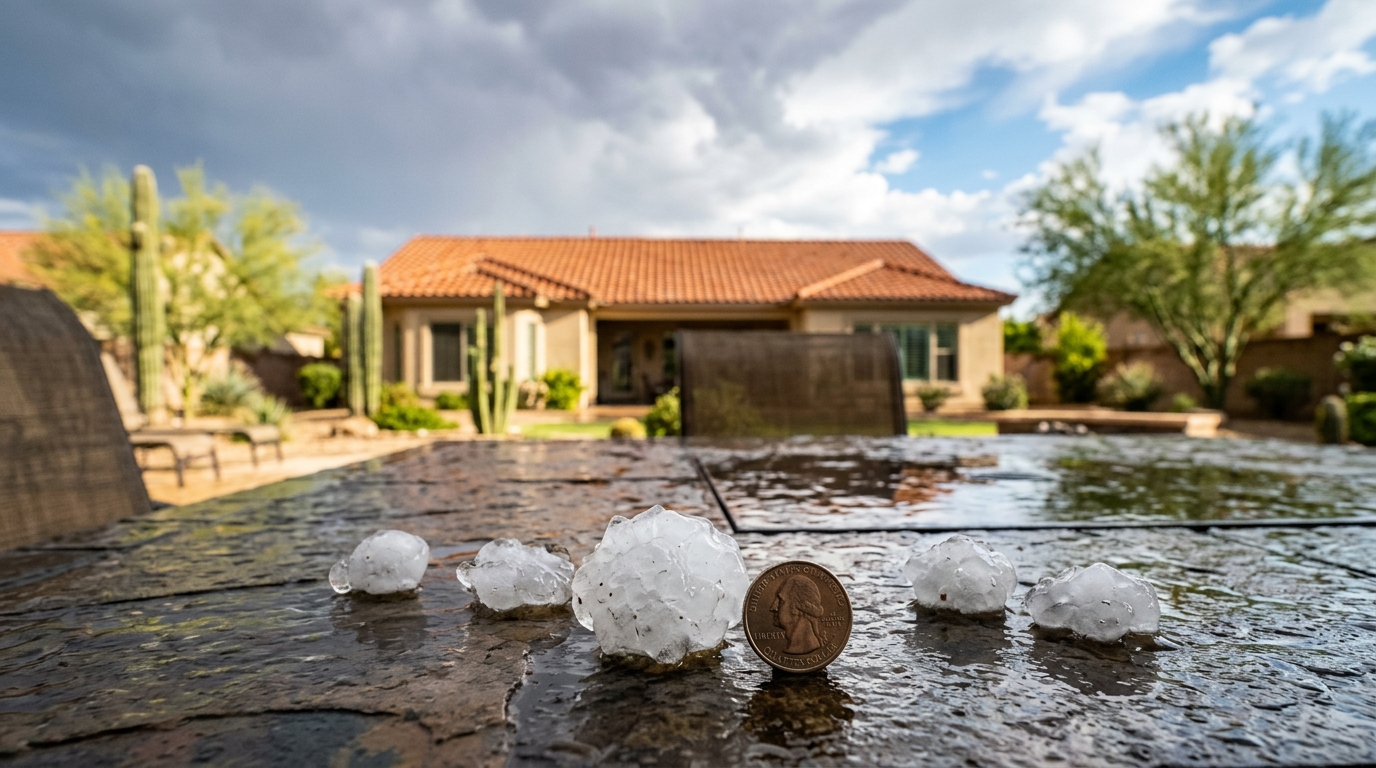
If hail hit your Gilbert, Mesa, or Queen Creek neighborhood, your roof may have taken damage you can't see from the driveway. Hail claims in the East Valley get denied at higher rates than most homeowners expect, and most of those denials come down to two things: wrong documentation and misunderstood insurance coverage. This post walks through exactly what hail does to each roof type, how to build a claim file before you call your insurer, and why the ACV vs. RCV distinction matters more than almost anything else in your policy.
Most standard homeowners insurance policies cover hail when the damage is functional, the roof was in reasonable condition at the time of the storm, and the claim is filed within the policy's notice window. The practical traps are this: if your policy is ACV (Actual Cash Value), depreciation will cut your payout significantly on an older roof. Tile roofs crack from hail but the damage is often invisible from the ground. SPF foam roofs absorb hail differently than shingles or tile, and most adjusters haven't seen many foam roof hail claims. And the SPC storm report from NOAA is your most powerful documentation tool. Most East Valley homeowners don't know it exists.
Why the East Valley Gets Hit Harder by Hail Than the Rest of Phoenix
The storm corridors that roll up from the south and southeast during monsoon season and through the fall transition months don't hit the Valley evenly. They track through Maricopa and Pinal county terrain and hit the East Valley first. Mesa, Gilbert, Queen Creek, Chandler Heights, Apache Junction. NWS Phoenix has documented events that targeted Apache Junction and Queen Creek on nights when the rest of the Valley barely got wet. October 2025 brought a severe thunderstorm warning for Apache Junction and Queen Creek with two-inch hail. That same system rolled through Mesa, Chandler, and Gilbert within hours.
That doesn't make the East Valley unique on a national scale. But it does mean hail is a more regular possibility here than the "Arizona doesn't get hail" assumption would suggest. We've pulled tile off roofs in Gilbert and Chandler Heights where the homeowner had no idea a hail event had occurred. They found out because of a ceiling stain six months later.
What Hail Actually Does to Tile, Shingle, and Foam Roofs
The most common mistake after a hail event is assuming your roof either shows damage or it doesn't. That's not how it works. The damage pattern depends entirely on the material, and each one fails in its own way.
Concrete tile. Tile is durable. It handles Arizona UV better than 3-tab asphalt, full stop. But when hail strikes concrete or clay tile, it cracks. Not always a clean break you can see from the driveway. Sometimes the crack is on the underside of the tile. Sometimes it's a hairline fracture that won't produce a leak until the next heavy rain pushes water through it. We've done inspections after hail events in Queen Creek where tiles looked perfect from the ground but had multiple impact cracks that only appeared when you were standing on the roof with a flashlight. There's another layer to the tile problem: tile is harder to match than asphalt. If hail cracked 40 tiles across two slopes and the manufacturer no longer makes that exact profile, your insurer is looking at a much more expensive claim. That sometimes makes them more aggressive about calling damage cosmetic.
Asphalt shingles. Hail knocks the granules off shingles. That granule layer is what protects the underlying mat from UV degradation. When it's gone, the shingle ages fast. The visual tell is a bruise, a soft spot you can feel with your thumb, plus granule accumulation in your gutters after the event. Older 3-tab shingles are more vulnerable than architectural shingles, and architectural shingles more vulnerable than Class 4 impact-rated products. On a roof that's 12 to 15 years old, granule loss from hail combined with existing UV wear often adds up to a functional total loss. That's exactly the situation where the ACV vs. RCV difference in your policy starts costing real money.
SPF foam. Spray polyurethane foam roofs are common on older ranch homes and flat-roof additions across Mesa and Gilbert. They behave completely differently under hail. According to IBHS guidance, SPF hail damage typically does not cause the roof to leak immediately. The foam absorbs the impact. What happens instead is the protective coating cracks, often in patterns that look like crow's feet or semicircles around the impact point, and the underlying foam gets dented or gouged. Those depressions can run from 1/8 inch to 3/4 inch deep depending on hail size and density. The danger is what comes next: once that coating is breached, UV radiation starts breaking down the exposed foam. That's how you get water intrusion three months after a storm with no obvious cause. An adjuster who hasn't seen many SPF claims will look at the roof, see no active leak, and close the file. That's wrong. The breach is real and needs to be documented.
How to Document Hail Damage for an Insurance Claim
Do this before you call your insurer. Do it before anyone gets on your roof.
Step one: lock in the storm date. Write it down the same day. Your insurer will ask for a date of loss. If you're uncertain, pull your phone's weather app and scroll back to the event. Screenshot the radar and precipitation summary.
Step two: pull the SPC report. The NOAA Storm Prediction Center publishes hail reports at spc.noaa.gov/climo. Search by date and you'll see logged hail events with the largest reported stone size by location. Your carrier uses the same data. When your records match what they're pulling, the claim moves faster and with fewer questions. If there's a NWS Severe Thunderstorm Warning on file for your area on that date, and for Mesa, Chandler, Gilbert, and Queen Creek those show up regularly, that's independent corroboration that's very hard to dispute.
Step three: photograph everything the same day. Roof from the ground, gutters, downspouts, AC condenser fins, window screens, garage door, soft metal vents. If hail is still on the ground, put a coin next to a stone and photograph before it melts. Adjusters treat hail size on the ground as some of the most persuasive evidence in a contested claim. Date-stamp everything.
Step four: don't clean anything. Don't sweep granules out of the gutters. Don't wash the roof. Don't replace the AC fins before the adjuster sees them. Everything you clean or remove before the inspection weakens your file.
Get a roofer out before you file if at all possible. Once a claim is filed with no independent inspection on record, the adjuster's scope anchors everything. A contractor scope of loss in the file from day one changes the dynamic entirely.
For more on how the claim process unfolds after you've filed, our post on homeowners insurance and monsoon roof damage covers the insurer's decision framework in detail.
ACV vs. RCV: The Insurance Detail That Changes Your Payout
Open your declarations page right now and find out which one you have. This single detail matters more than almost anything else about your policy when it comes to a roof claim.
ACV (Actual Cash Value). The insurer pays you the current depreciated value of your roof. They start with the cost to replace the roof today, then subtract an amount based on age and condition. On a 15-year-old asphalt shingle roof, that depreciation hit is substantial. The National Association of Insurance Commissioners illustrates it with a simple scenario: two neighbors, identical homes, identical hail damage. The one with ACV coverage gets a payout reduced by the roof's age. The one with RCV coverage gets full replacement cost minus the deductible. Same storm. Same roof. Very different checks.
Some insurers automatically convert asphalt roofs from RCV to ACV once the roof hits 10 years, regardless of condition. If your policy renewed recently and your roof is older, it's worth checking whether that switch happened quietly.
RCV (Replacement Cost Value). The insurer pays what it costs to replace your roof with comparable materials at today's prices. No depreciation deducted. On most RCV claims, payment comes in two stages: an initial check based on ACV, then a second payment (the recoverable depreciation) released after the work is completed and documented. A lot of homeowners on RCV policies assume the first check is all they get. It's not. That second payment is real money, and skipping the documentation step means it stays with the insurer.
If your shingle roof is over 12 years old and you're on ACV coverage, a legitimate hail claim may net you far less than what replacement actually costs. That's not a mistake. That's how the policy is written. Knowing that now, before the next storm, is the point.
Why Hail Claims Get Denied on East Valley Roofs
The three most common reasons we see denials on East Valley hail claims:
Roof age and pre-existing wear. Insurers cover storm damage, not aging. When an 18-year-old roof takes hail hits, the adjuster has to separate fresh damage from wear that was already there. On an older 3-tab roof that was already shedding granules from UV, that separation is genuinely hard. Some adjusters call the whole thing pre-existing. A dated inspection report from before the storm, ideally from a pre-monsoon inspection that documented your roof's condition at that point, gives you a baseline to argue from. It's much harder to attribute fresh hail damage to prior wear when a report on file says the roof was in reasonable shape two months earlier.
Cosmetic damage exclusions. Some Arizona homeowners insurance policies exclude coverage for cosmetic damage that doesn't affect the roof's functional ability. This gets used a lot on tile roofs after hail. Tiles cracked but not leaking? Some adjusters call that cosmetic. The counter-argument: cracked tile will leak. A roofer who documents that cracked tile compromises waterproofing integrity has a stronger claim than photos alone.
Thin documentation. A claim filed without a NOAA storm report, without pre-storm photos, and without a roofer's independent scope of loss is an easy target. Insurers aren't adversaries by default. But their adjusters work from whatever documentation exists. If the file is thin, the payout reflects it.
Denied or underpaid claims have paths: request a re-inspection with a contractor present, hire a licensed public adjuster to negotiate on your behalf, or file a complaint with the Arizona Department of Insurance. All legitimate. All worth considering when the original denial ignores documented storm damage.
The SPC Storm Report: Proving the Hail Hit Your Zip Code
The NOAA Storm Prediction Center's severe weather reports are free, public, and searchable by date at spc.noaa.gov/climo. Enter your storm date in YYMMDD format and download the hail report. You'll see logged events with the largest reported stone size and approximate location.
Your carrier pulls from the same source. When you arrive at a claim with a printed SPC report showing a documented hail event near your zip code on the date of loss, you've eliminated one of the easiest denial arguments. The storm happened or it didn't. NOAA says it did.
Two things worth knowing: SPC reports depend on spotter observations and take time to finalize. Search the day after the storm and the data may still be incomplete. Wait 48 to 72 hours, then pull and save it. NOAA's Storm Events Database at ncei.noaa.gov/stormevents is a separate system that goes deeper once the data is processed. NWS Phoenix also publishes event-specific summaries with dates, locations, hail sizes, and wind speeds. For a contested claim, these are worth tracking down.
What a Hail Inspection Covers vs. a Standard Roof Inspection
A standard inspection looks at overall condition: tile alignment, flashing, underlayment, visible wear, penetration seals. A hail inspection is looking for something specific.
Impact evidence. On shingles, that means soft-spot bruising, granule displacement concentrated on the slopes facing the storm track, and dents in flashing. On tile, it's hairline fractures on the surface and underside of tiles, with attention to which slopes absorbed the impact concentration. On foam, the inspector is looking for coating breaches, crow's-foot crack patterns around impact points, and any exposed foam.
A good hail inspection includes a slope diagram noting which direction the storm came from. The damage distribution should match the storm track. If the north-facing slope took the hits and the south-facing slope is clean, that's a coherent story. Damage scattered randomly across the roof with no correlation to the storm track actually works against a claim.
Test squares are the standard on shingle roofs. Adjusters measure damage density in 10x10 foot test areas on the most exposed slopes. A roofer who marks those areas with chalk before the adjuster arrives keeps the inspection efficient and focused.
Have the contractor there during the adjuster visit. A roofer who can explain on the roof, in real time, what they're looking at makes for a cleaner inspection and a more complete file.
Choosing a Roofer for a Hail Claim in Gilbert, Mesa, or Queen Creek
Storm chasers show up after hail events. They're door-knocking before the hail has melted sometimes. The pitch usually involves them "working with your insurance company" to get your roof replaced at no out-of-pocket cost. That framing should make you cautious.
What you actually want in a contractor for a hail claim is straightforward.
They're local and licensed with the Arizona ROC. Look up the license number on the ROC website before anyone gets on your roof. An out-of-state contractor working on a temporary license has no stake here. When something goes wrong six months out, they're not around.
They inspect before you file. The sequence matters. A contractor scope of loss in the file from day one changes how the adjuster's visit goes.
They know East Valley materials. Concrete tile, 3-tab asphalt, architectural shingles, foam. Each one is a different claim. A contractor who can identify crow's-foot coating cracks on SPF is not the same as one who runs shingle replacements in a hail corridor.
They don't promise a free roof. The deductible is yours. Arizona law prohibits contractors from waiving or paying your deductible. If that's the pitch, end the conversation.
Our team is based in Gilbert. We've handled hail claims in Mesa, Chandler, and Queen Creek and we do free inspections with no pressure to file. If the damage doesn't warrant a claim, we'll say so. Our post on how to choose a roofing contractor in Gilbert covers what to ask before you sign anything.
And if you're seeing something on your roof after a storm but aren't sure what it is, our hidden monsoon roof damage post covers exactly the signs that show up weeks or months after the event.
We work across Gilbert, Chandler, Mesa, and Queen Creek. If you want eyes on your roof before you file a claim or after you've been denied, we can be out within the week. Free inspection, no sales pitch.
About the Author
Tuuta Pulotu is the CEO and co-founder of All Storm Roofing + Construction. He was born and raised in Arizona. His mom is from Hawaii, his dad from Tonga, and Tuuta grew up in the trades working alongside his father, who's been running a landscaping and masonry crew in the Valley for over thirty years.
Before founding All Storm in 2021, Tuuta spent years in solar sales. Long enough to watch too many East Valley homeowners get pushed into roof decisions they didn't fully understand. He started All Storm to flip that conversation: be the contractor who tells homeowners what's actually going on with their roof, even when the truth costs him the job.
He runs All Storm out of Gilbert, where he lives with his wife and four kids.
AZ ROC #345156. Tamko Diamond Certified. The only Tamko Diamond Certified roofing contractor in Arizona.
WRITTEN BY
Tuuta Pulotu is the CEO and co-founder of All Storm Roofing + Construction. He was born and raised in Arizona. His mom is from Hawaii, his dad from Tonga, and Tuuta grew up in the trades working alongside his father, who's been running a landscaping and masonry crew in the Valley for over thirty years. Before founding All Storm in 2021, Tuuta spent years in solar sales. Long enough to watch too many East Valley homeowners get pushed into roof decisions they didn't fully understand. He started All Storm to flip that conversation: be the contractor who tells homeowners what's actually going on with their roof, even when the truth costs him the job. He runs All Storm out of Gilbert, where he lives with his wife and four kids. AZ ROC #345156. Tamko Diamond Certified. The only Tamko Diamond Certified roofing contractor in Arizona.
Worried about your roof?
Get a free, no-pressure inspection from a Gilbert team that gives honest answers — not pressure to replace.
Schedule Free Inspection