The 2026 Monsoon Roof Prep Checklist Every East Valley Homeowner Needs Before July 1
→ QUICK ANSWER
Phoenix just had its hottest spring on record and the 2026 monsoon forecast leans wetter than normal. Here is the 10-point East Valley roof checklist our crew runs before July 1 on tile, shingle…

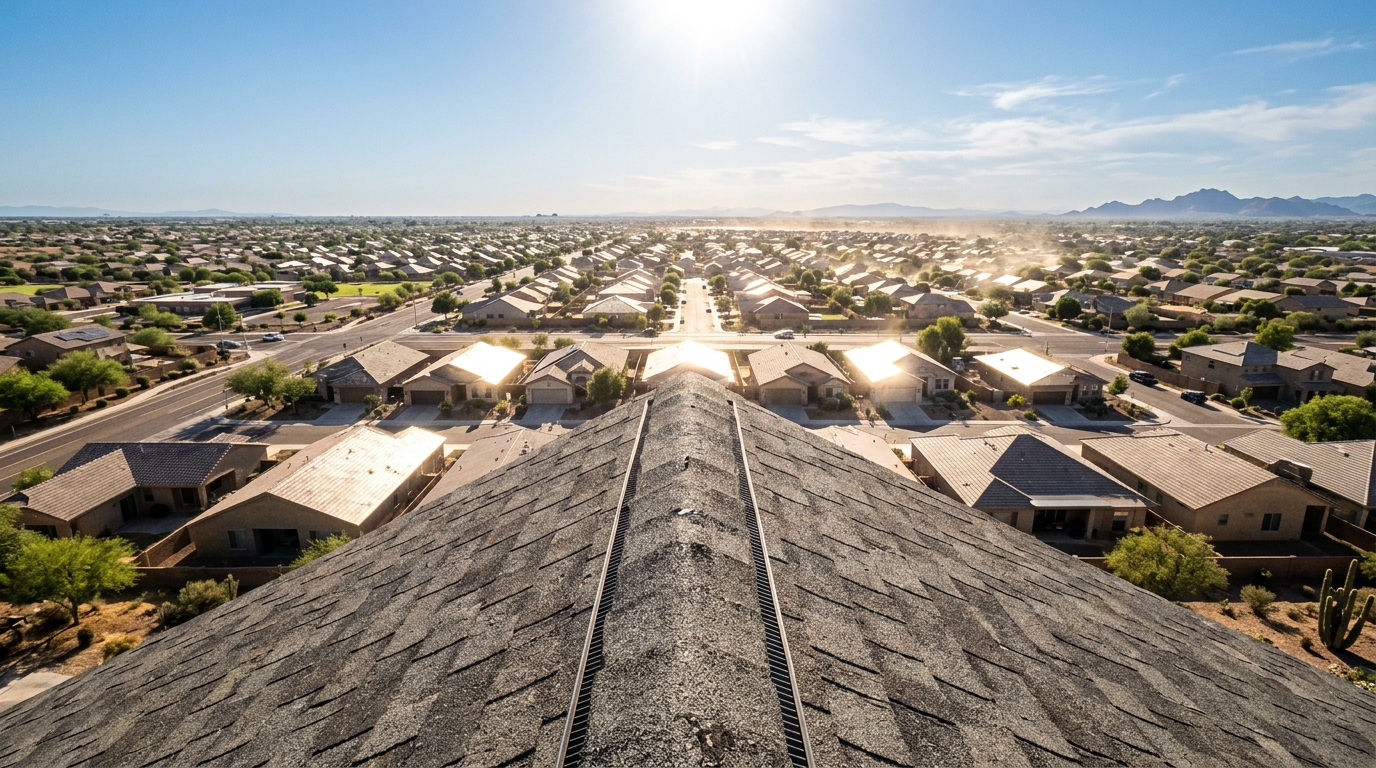
The 2026 Monsoon Forecast Changes What You Should Be Doing Right Now
Monsoon season officially starts June 15. The 2026 forecast leans wetter than normal, backed by NOAA's Climate Prediction Center and confirmed by the National Weather Service. Multiple forecasters point to record-dry soils from one of Arizona's driest winters on record as the main driver of increased storm intensity this year.
On top of that, Phoenix just finished its hottest spring ever recorded. The average temperature from March through May was 80.2 degrees, more than six degrees above normal, shattering a record that had stood since 1989. March 18 was the earliest triple-digit day in Phoenix history.
None of that is background information. It is the reason your roof needs a real look before July.
Three months of record heat means three months of accelerated material stress. Sealants that might have had another year in them are likely dried out. Underlayment that was borderline last October may have crossed the line since then. The heat does the damage quietly. The first monsoon storm finds it fast.
What the Heat Already Did Before the Rain Starts
Roof surfaces in Arizona regularly hit 160°F on summer days. Daily expansion and contraction at those temperatures stresses fasteners, shrinks sealants, and works underlayment seams until they develop micro-cracks. In a normal year, that process builds over summer. In 2026, it started in March, running two full months early.
For tile roofs, the primary concern is the mastic and mortar at ridge caps and hip tiles. In Arizona's UV, sealants and adhesives typically degrade within five to seven years even under normal conditions. After a spring like this one, anything past four years is worth looking at closely.
For shingle roofs, granules are the UV armor on the asphalt mat. Heat accelerates granule release, especially on south- and west-facing slopes. Check your gutters. Heavy granule accumulation at the bottom is a warning you can read without getting on the roof.
For foam and flat roofs, the elastomeric coating is what stands between the foam and UV destruction. The recoat window in Arizona is roughly every five to seven years. If yours is past that window, this spring may have pushed it closer to failure than you realize.
The 10-Point East Valley Roof Checklist Before July 1
This is what we check on every pre-monsoon inspection across Gilbert, Chandler, Mesa, and Queen Creek. Not all of it requires getting on the roof. Some of the most important checks happen from the ground or inside your attic.
1. Ridge caps and hip tiles. Walk the perimeter of your house and look up at every hip and ridge line. Any tile that is visibly shifted, cracked, or sitting at a different angle than its neighbors needs attention. These are the highest-exposure points on the roof and the first place wind-driven rain enters.
2. Mastic and ridge mortar. Check the mortar bed under ridge and hip tiles. Dried, cracking, or pulling-away mortar is an open invitation for water. Binoculars from the ground can get you a decent look on a single-story home.
3. All flashing terminations. Vents, skylights, HVAC equipment curbs, any wall-to-roof transition. Flashing fails in two main ways: sealant dries out and cracks, or the metal expands and contracts until it pulls away from the substrate. Wind-driven rain in a monsoon finds either failure immediately.
4. Gutters and downspouts. Clear them before the first storm. A blocked gutter when a storm drops an inch of rain in twenty minutes can back water up under the eave and saturate the drip edge. Check that downspouts terminate away from the foundation.
5. Your attic. Go up there before monsoon season. Look at the underside of the roof sheathing. Brown streaks or water stains mean water has already been getting in, probably last season. Rusted nail tips are a sign of moisture accumulation from below. Either finding tells you something is failing.
6. Granule accumulation. Grab a handful of debris from the base of each gutter section and look at how much granule material is in it. Some is normal. Sand-level accumulation from specific slope sections is not. That slope is degrading faster than it should.
7. Scuppers and flat-section drainage. Run a garden hose on any flat or low-slope section of your roof and watch where the water goes. Every scupper and drain needs to be clear and free-flowing. A partially blocked scupper turns a flat section into a pond during a two-inch-per-hour monsoon event.
8. Overhanging trees. A palo verde or mesquite branch over your roof does not need to be large to cause damage. During a microburst, East Valley wind gusts regularly reach 60 to 70 mph. A branch that clears your roofline by less than six feet can come down on tile or foam during those conditions. Trim it now.
9. South- and west-facing slopes. These take the most UV and thermal punishment all year. Spend extra time here looking for cracked tiles, lifted shingle edges, thinning granule coverage, and gaps in the ridge or valley flashing.
10. Inside ceiling stains. A water stain on your drywall or attic insulation does not automatically mean an active leak. Sometimes it is a dry-season ghost from last year's monsoon. But it tells you exactly where to look on the exterior. Any stain that has grown or smells musty is a current problem, not a historical one.
Tile Roofs: What the Heat Does That You Cannot See
Most tile roofs in the East Valley are concrete tile installed between 1995 and 2010. The tiles hold up. Concrete tile typically lasts 40 to 50 years in Arizona's climate. What fails is the underlayment beneath them.
Traditional felt underlayment in Arizona typically lasts 15 to 20 years under normal conditions. The tiles are the armor. The underlayment is the actual waterproof barrier. When it fails, the tiles above it can look completely fine while water soaks into your framing below.
Fine desert dust accumulates under tiles year after year, holding moisture against the underlayment and speeding up wear. You cannot see it from the street. You cannot see it standing on the roof. That is why the attic check and probing suspicious sections matter more than assessing tile cosmetics.
Displaced tiles are the other concern. Thermal cycling over decades causes tiles to creep out of their overlap pattern. A tile that has shifted even an inch exposes the underlayment edge to direct rain. With monsoon moisture coming in sideways at 50 mph, that gap lets in water immediately.
Ridge and hip mortar is the most common failure we find on pre-monsoon inspections. Once it dries out and cracks, the ridge tile is effectively sitting loose. It does not take much wind to rotate or lift a tile that has lost its mortar bed. When that happens mid-storm, the underlayment beneath is fully exposed.
If you have a tile roof that is leaking but every tile looks intact from the ground, this is almost always why. For a full explanation of what is actually happening in those cases, read our post on why tile roofs leak when every tile looks perfect.
Shingle Roofs: The Honest Assessment if Yours Is Over 18 Years Old
If your Gilbert or Chandler home has an asphalt shingle roof installed before 2008, here is the straight answer: you are probably past the point where you have a comfortable buffer heading into a wetter-than-normal monsoon.
Asphalt shingles in Arizona age faster than in temperate climates because of the UV load and thermal cycling. An 18-year-old 3-tab shingle in Phoenix has absorbed the equivalent heat stress of a 25-year-old shingle somewhere with a milder climate. The granules thin out, particularly on south- and west-facing slopes. Once that granule layer gets thin, the asphalt mat absorbs heat directly and breaks down faster. You get blistering, cracking, and eventually exposed mat.
The gutter test: pull debris from the base of each gutter section and look at granule accumulation. A little mixed in is normal wear. Sand-level granules concentrated from specific slopes means those slopes are degrading. If you can see the weave pattern of the mat on any shingle, that one has failed.
Flashing on shingle roofs follows the same degradation timeline as tile mastic. Valley flashing, step flashing at wall transitions, and chimney counter-flashing all depend on sealant that dries out in Arizona UV on a five to seven year cycle. After the spring we just had, every flashing termination deserves a careful look.
If your shingle roof is 18 years or older and you are wondering whether to repair or replace before this monsoon, the decision framework matters. Read our roof replacement before monsoon guide before you commit to just patching.
Flat and Foam Roofs: Scuppers First, Coating Second
Flat and low-slope sections show up on a lot of East Valley homes built in the 1980s and 1990s, typically as garage extensions or covered entries. Foam (SPF) roofs are also common throughout the region on both single-family homes and older construction.
For any flat section, drainage is the first check. Run water and watch where it goes. If scuppers are partially blocked by debris, dried mortar, or nesting material, that section will pond during a monsoon. Water sitting on foam or flat roofing material for more than 48 hours starts accelerating coating breakdown. Repeated ponding creates low spots that wear through first. That is where leaks eventually develop.
For foam roofs specifically, check the coating. Visible yellowing of the foam surface through the topcoat means the UV-protective layer has worn through in that spot. Exposed foam degrades quickly under Arizona UV. The recoat cycle runs every five to seven years in this climate. If yours is outside that window, doing it before monsoon is smarter and cheaper than doing it after a leak opens up.
Also look at the perimeter where foam meets any parapet wall. The foam and wall materials expand and contract at different rates in extreme heat, and that movement eventually opens gaps at the perimeter seal. It is one of the more common leak points we find on East Valley foam roofs.
What You Can Check Yourself vs. When to Call
Here is the realistic breakdown.
From the ground or a safe ladder position, you can check: granule accumulation in gutters, visibly shifted or cracked ridge tiles, attic ceiling staining, scupper flow with a garden hose, and overhanging branches.
Get a roofer for: mortar and mastic work at ridges and hips, flashing repair or replacement, underlayment inspection that requires lifting tiles, foam recoating, and any repair around a penetration. These are not complicated jobs. But doing them wrong, specifically applying hardware-store sealant directly over failed substrate, creates something that looks patched and fails after the first good rain.
One thing we see consistently in Gilbert and Queen Creek: homeowners apply roof caulk or sealant from a box store directly over cracked or dried-out flashing. It looks fixed. It usually fails inside one monsoon season because the sealant is bonding to a substrate that no longer adheres to anything solid underneath it. A real flashing repair either replaces the metal or properly prepares and re-establishes the bond.
Tile is also more fragile underfoot than most people expect. Walking directly on concrete or clay tile without knowing the right step placement can crack tiles you cannot see from below. A cracked tile is now a water entry point you did not have before you walked on it.
For guidance on vetting the contractor you call, here is what the six questions actually look like when a good roofer answers them.
East Valley Neighborhoods That Get Hit Hardest
The East Valley is not uniformly exposed during monsoon season. Microbursts, which produce the most sudden and concentrated roof damage, tend to track along the same geographic corridors year after year.
Gilbert's southeast quadrant, especially around Val Vista Drive south of Higley Road, sees regular microburst activity. Queen Creek and San Tan Valley sit at the base of the San Tan Mountains, where storm cells that build over the mountains descend with concentrated force. The Chandler Heights and Queen Creek Road corridors see similar exposure.
NWS has documented East Valley microburst events with wind gusts reaching 60 to 70 mph and higher. That is enough to rotate an unseated ridge tile, lift 3-tab shingle tab edges, and bring down any branch that clears a roofline.
South- and southeast-facing slopes on homes along north-south streets in these areas take the brunt of arriving storm fronts. If you live in Gilbert or Queen Creek with a south-facing main pitch, that is the slope that deserves the most attention this season.
For a deeper look at what typically stays hidden until October, read our post on hidden monsoon roof damage in the East Valley.
What Generic Checklists Miss
Most online monsoon prep checklists focus on what is visible. Check for missing shingles. Look for cracked tiles. Clean your gutters. All of that is correct and worth doing.
What they miss is the invisible damage that a record heat spring creates before the monsoon arrives.
A tile roof where every tile looks intact from the street can have underlayment two years past its effective life. A shingle roof with a full granule layer on the north-facing slope can have a completely degraded south-facing slope. A foam roof with a solid-looking white coating can have a perimeter seal that pulled away from the parapet wall during March's heat events and has been sitting open for three months.
The 2026 pre-monsoon window is different because of the sustained, record-breaking spring heat. The normal assumption that a roof that survived last monsoon is fine for this one does not hold as well when the intervening spring was the hottest on record.
If your roof is more than ten years old, get eyes on it before July 1.
Get a Second Opinion Before the Season Starts
If you are in the East Valley and want a second opinion on your roof, we do free inspections. No pressure, no hard sell. Our team is based in Gilbert, and we work across Gilbert, Chandler, Mesa, and Queen Creek. Schedules fill up fast once the first storms arrive, so reach out now if you want someone to take a real look before the season starts. Give us a call at (602) 806-6806.
Tuuta Pulotu is the CEO and co-founder of All Storm Roofing + Construction. He was born and raised in Arizona. His mom is from Hawaii, his dad from Tonga, and Tuuta grew up in the trades working alongside his father, who's been running a landscaping and masonry crew in the Valley for over thirty years.
Before founding All Storm in 2021, Tuuta spent years in solar sales. Long enough to watch too many East Valley homeowners get pushed into roof decisions they didn't fully understand. He started All Storm to flip that conversation: be the contractor who tells homeowners what's actually going on with their roof, even when the truth costs him the job.
He runs All Storm out of Gilbert, where he lives with his wife and four kids.
AZ ROC #345156. Tamko Diamond Certified. The only Tamko Diamond Certified roofing contractor in Arizona.
WRITTEN BY
Tuuta Pulotu is the CEO and co-founder of All Storm Roofing + Construction. He was born and raised in Arizona. His mom is from Hawaii, his dad from Tonga, and Tuuta grew up in the trades working alongside his father, who's been running a landscaping and masonry crew in the Valley for over thirty years. Before founding All Storm in 2021, Tuuta spent years in solar sales. Long enough to watch too many East Valley homeowners get pushed into roof decisions they didn't fully understand. He started All Storm to flip that conversation: be the contractor who tells homeowners what's actually going on with their roof, even when the truth costs him the job. He runs All Storm out of Gilbert, where he lives with his wife and four kids. AZ ROC #345156. Tamko Diamond Certified. The only Tamko Diamond Certified roofing contractor in Arizona.
Worried about your roof?
Get a free, no-pressure inspection from a Gilbert team that gives honest answers — not pressure to replace.
Schedule Free Inspection