Roof Repair vs. Replacement in Queen Creek AZ: The Decision Most Roofers Get Wrong
→ QUICK ANSWER
Queen Creek homes built 2000-2010 are in the underlayment replacement window right now. Here's the three-factor test that tells you if you need a repair, a relay, or a full replacement.

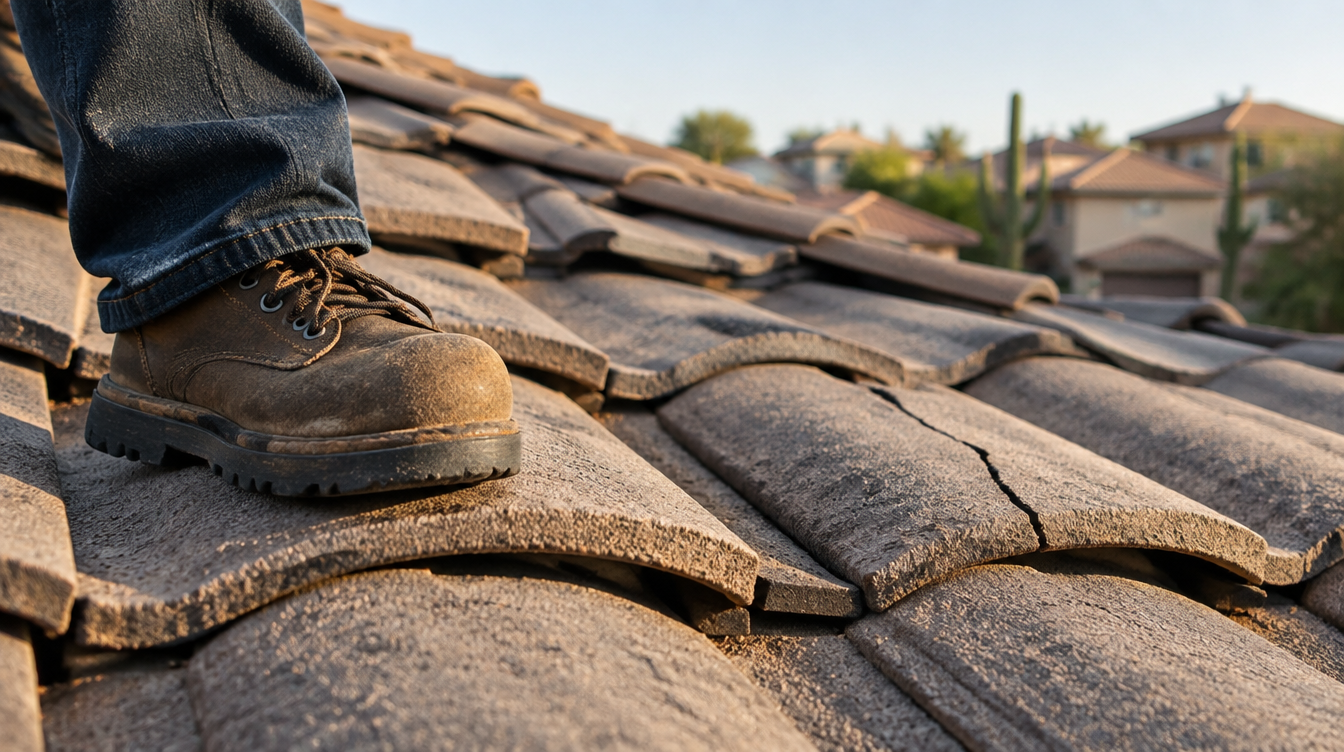
Repair or Replace? The Queen Creek Version of This Question Is Different
If your Queen Creek home was built between 2000 and 2010, there's a real chance your roof is in a window right now that most roofers won't explain clearly. The tiles look fine. The roof seems fine. But the underlayment underneath those tiles may be failing. Whether you need a repair, an underlayment relay, or a full replacement comes down to a three-factor test that most quotes skip entirely.
The short answer: in Queen Creek specifically, the most common right answer is neither a simple repair nor a full replacement. It's a lift-and-relay. Pull the existing concrete tiles, replace the failed underlayment, and set the tile back down. Homeowners who get quoted for full replacements when only the underlayment needs work are paying $8,000 to $15,000 more than they should.
Here's how to know which situation you're actually in.
The Queen Creek Housing Stock Reality: Why Tile Decisions Dominate Here
Queen Creek was mostly empty desert and farmland until the late 1990s. The building boom that followed ran hard from 2002 through about 2010, producing subdivisions like Hastings Farms, Spur Cross, Pecan Creek, Sossaman Estates, and Cortina, along with larger San Tan Valley communities including Johnson Ranch and Ironwood Crossing. About 32% of Queen Creek homes were built between 2000 and 2009. Almost all of them got concrete tile roofs.
That's not an accident. The Spanish and Mediterranean architectural styles that dominate Queen Creek call for tile. Terracotta profiles, S-curves, the whole look. Most HOAs in those planned communities require tile or lock you to whatever material was installed originally. So when something goes wrong with a Queen Creek roof, the question isn't really "tile or shingles?" It's "how much of the tile system actually needs replacing?"
The tiles themselves can last 40-50 years in Arizona conditions. Concrete holds up well against UV and the heat cycling our desert puts it through. What doesn't hold up is the felt underlayment installed beneath those tiles. That's the actual waterproofing layer. In the East Valley, felt typically runs 15-20 years before Arizona's UV and heat bake it brittle. Synthetic underlayment products run longer, 25-35 years, but felt was standard on most 2002-2008 construction.
Which means a lot of Queen Creek homes built during that boom are in the underlayment replacement window right now. The tiles look fine from the street. The underlayment below them is done.
The Three-Factor Test: Age, Scope, and What the Underlayment Says
We run three questions on every Queen Creek roof before we say anything about repair or replacement. They work together, and you can't answer one and skip the others.
How old is the roof? If the home was built between 2000 and 2008 and hasn't had an underlayment replacement, the felt is at or past its reliable service window. That doesn't automatically mean full replacement. It means any assessment needs to specifically look at underlayment condition, not just tile condition. A roofer who only looks at the tile surface is missing the thing that's most likely to be failing.
How wide is the damage? A few cracked tiles after a microburst is a repair. A handful of broken ridge caps is a repair. Widespread tile displacement across multiple planes, cracked field tiles with no clear single cause, or water intrusion at multiple points, that's a different story. The line we use: once repair scope is pushing past $3,000-$3,500, the conversation needs to include replacement cost before you commit to patching.
What does the underlayment actually look like? This is the question most homeowners never ask, and the one that matters most for a Queen Creek home built in the 2000s. You can't see underlayment from the ground. You need someone on the roof, lifting tiles in a few representative spots and actually looking at the felt beneath. If it's cracked, brittle, or separating, you're looking at underlayment work regardless of how good the tiles appear.
These three together tell you whether you're fixing something small, relaying the waterproofing layer, or replacing the full system. A quote that never mentions underlayment condition isn't giving you the real picture.
For a complete breakdown of the repair-vs-replace framework across all Arizona roof materials, see our full repair-vs-replace decision guide. What follows here is the Queen Creek-specific layer on top of that.
When Repair Is the Right Call in Queen Creek
Repairs make sense when the damage is isolated and the underlying system is still sound.
The most common post-monsoon repair scenarios in Queen Creek are broken or displaced ridge and hip tiles, cracked field tiles from debris impact, and lifted flashing at valleys or penetrations. All of those are patchable, as long as the underlayment beneath them hasn't failed.
The key is localized versus systemic. One cracked tile on the south-facing slope after a storm is a repair. A dozen cracked tiles scattered across three planes with no single obvious cause, that's a symptom of something bigger. Possibly underlayment shrinkage pulling the tile system, possibly tile that's been walking for years without anyone checking it.
Repairs are right when the roof is under 15 years old, the underlayment is still intact, and the damage is genuinely limited. Most post-storm Queen Creek repairs land in the $350-$1,500 range. For cost specifics by repair type, our monsoon repair cost breakdown for Queen Creek covers the numbers.
When Replacement Is the Right Call (And Why Waiting Costs More)
There are situations where repair is the wrong answer, and pushing through them costs more every season you wait.
If the tiles themselves are failing, widespread cracking, UV spalling on concrete that's lost structural integrity, or profiles that are no longer manufactured for color-match repairs, you need a full tear-off and new tile system. You can't relay tiles that are breaking apart. And you can't match tiles that don't exist anymore.
If the deck has wood rot from long-term moisture getting through failed underlayment, a relay won't fix it. The compromised sections of decking have to come out before anything new goes on top.
And if you've got a 22-year-old felt underlayment that has failed in multiple locations, spotting the most visible leak doesn't fix the rest of the membrane. You're patching the leak you know about while the rest of the underlayment keeps deteriorating through every monsoon season. A full underlayment relay, or a complete system replacement if the tile is also at end of life, is the only honest answer.
The financial case for acting: deferred moisture intrusion creates deck rot. That adds $1,500-$4,000 in scope to whatever replacement comes next. Every monsoon season on a failed underlayment is another season of water reaching the wood.
The Underlayment Trap: Getting Quoted for a Replacement You Don't Need
This is the one we see most often in Queen Creek, and it costs homeowners real money.
A homeowner gets a ceiling stain after a monsoon. A roofer comes out, walks around, and writes up a full replacement. The homeowner figures that must be the scope because the roofer said so. They spend $18,000-$25,000 on new tile when a lift-and-relay would have done it for $10,000-$16,000.
The difference is whether anyone actually assessed the tile condition separately from the underlayment condition.
If the tiles are intact, no widespread cracking, consistent color, profile still available, a lift-and-relay is almost always the right call when the underlayment is what's failing. The crew lifts and stages the existing concrete tiles, strips the old felt down to the deck, installs new high-heat synthetic underlayment, and sets your original tiles back down. Same tiles. Fresh waterproofing system underneath them. The job typically runs 30-40% less than a full replacement with new tile.
One question to ask any roofer who quotes full replacement on a Queen Creek tile home: "Are the tiles themselves the problem, or is it the underlayment?" If they can't answer that clearly, or if they never actually got on the roof and lifted tiles to check, get a second opinion.
We cover the underlayment question in more depth at how long does tile roof underlayment last in Gilbert AZ. The material reality is the same across Queen Creek and the East Valley.
HOA Considerations: How Material Restrictions Affect the Repair-vs-Replace Math in Queen Creek
Most of Queen Creek's planned communities have active HOAs with architectural review committees. Encanterra, Seville, and similar communities require ARC approval before roofing work begins. That approval covers material type, color match, and tile profile. It applies to full replacements. It does not apply to repairs or lift-and-relay jobs where the existing tile stays on the roof.
That's a meaningful piece of the math. A lift-and-relay typically skips HOA review entirely because you're putting the same tile back. Same material. Same color. Same profile. No ARC submission, no waiting 30-60 days for approval, no sourcing a discontinued tile profile.
A full replacement is different. You submit tile samples, color chips, and contractor documentation to the ARC. If your original tile profile is no longer manufactured, you're negotiating a substitution. That process takes time and sometimes limits your options to whatever the HOA will approve from what's currently available.
In Queen Creek, HOA restrictions don't just determine what material you're allowed to use. They affect the timeline and the real cost of going the full-replacement route versus an underlayment relay. If you're weighing those two paths and your home is in a planned community, the HOA calendar is a legitimate factor in the decision.
What a Real Assessment Looks Like Out Here
A real assessment for a Queen Creek tile home means a roofer physically on the roof. Not eyeballing from the driveway. Not reviewing satellite imagery on a tablet. On the roof, lifting tiles in representative spots, checking underlayment condition firsthand. Looking at ridge and hip attachment points. Checking flashing at every valley and penetration. Noting soft spots in the deck at visible nail holes or low drainage areas.
At the end of that, you should get a clear answer on three things: is the underlayment still intact, are the tiles sound enough for relay, and does the deck have any moisture damage? Those answers drive the recommendation. If the recommendation doesn't trace back to those three answers, it's not a real assessment.
One more thing specific to Queen Creek: the open desert exposure east of Gilbert means microbursts reach neighborhoods here with fewer natural windbreaks slowing them down. Routinely 60-70 mph gusts during monsoon events, with the strongest microbursts exceeding 70-80 mph. Ridge and hip tiles are the first place that shows up. After any significant storm, that's where to start looking.
We do free inspections across Queen Creek, San Tan Valley, and the East Valley. If your home was built in that 2002-2010 window and nobody has specifically looked at your underlayment condition, it's worth getting eyes on it before monsoon forces the decision.
If you're vetting contractors before calling anyone, our guide to roofing companies in Queen Creek covers what to ask and what to look out for.
Our team is based in Gilbert. We work across Queen Creek and the East Valley. If you want a roofer who'll tell you what's actually going on up there rather than defaulting to the biggest quote, give us a call. Free inspection, no pressure.
WRITTEN BY
Tuuta Pulotu is the CEO and co-founder of All Storm Roofing + Construction. He was born and raised in Arizona. His mom is from Hawaii, his dad from Tonga, and Tuuta grew up in the trades working alongside his father, who's been running a landscaping and masonry crew in the Valley for over thirty years. Before founding All Storm in 2021, Tuuta spent years in solar sales. Long enough to watch too many East Valley homeowners get pushed into roof decisions they didn't fully understand. He started All Storm to flip that conversation: be the contractor who tells homeowners what's actually going on with their roof, even when the truth costs him the job. He runs All Storm out of Gilbert, where he lives with his wife and four kids. AZ ROC #345156. Tamko Diamond Certified. The only Tamko Diamond Certified roofing contractor in Arizona.
Worried about your roof?
Get a free, no-pressure inspection from a Gilbert team that gives honest answers — not pressure to replace.
Schedule Free Inspection