Monsoon Roof Repair Costs in Queen Creek and San Tan Valley: What You're Actually Looking At
→ QUICK ANSWER
Most post-monsoon repairs in Queen Creek and San Tan Valley run $350 to $3,500. Here's what each repair type actually costs by material, and when insurance pays vs. when it doesn't.

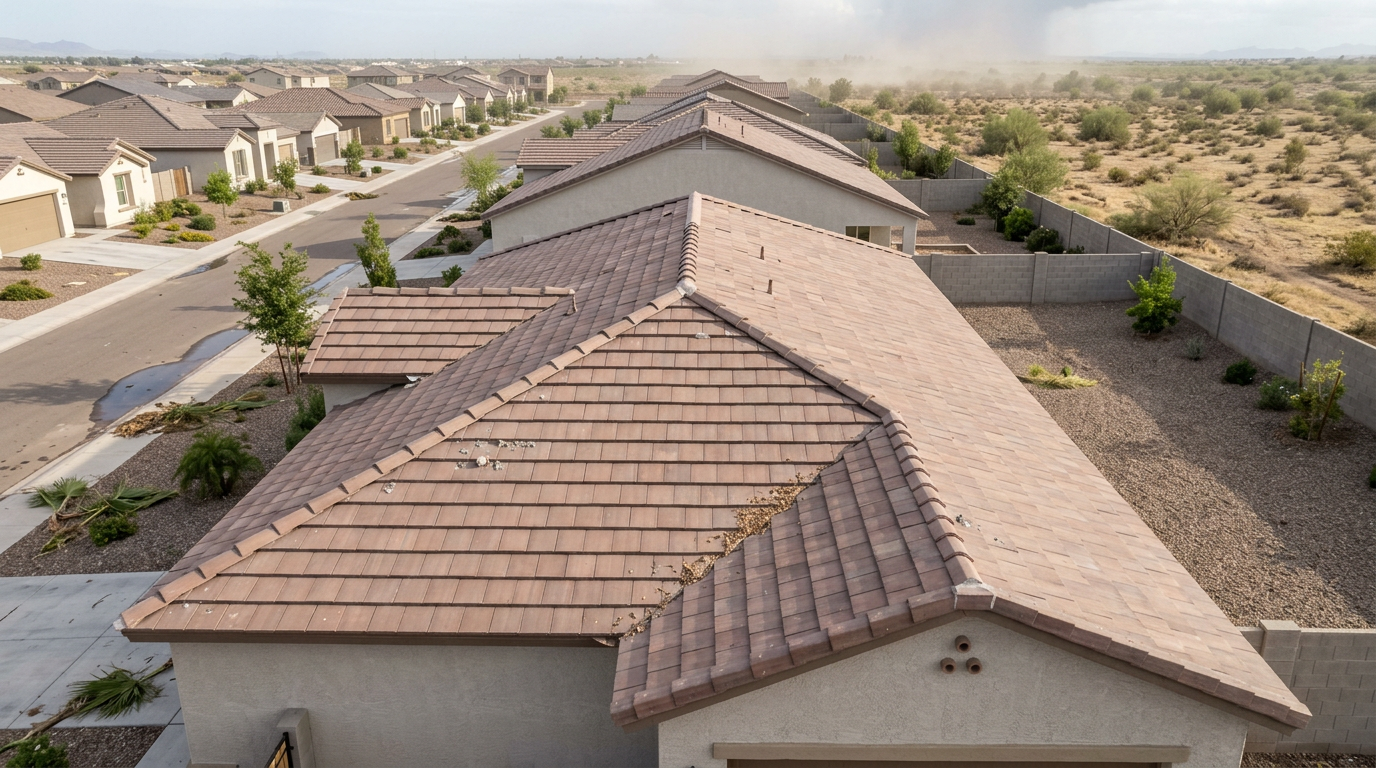
What Monsoon Roof Repairs Actually Cost in Queen Creek and San Tan Valley
A storm tears through your neighborhood at 11 p.m. You hear it. The next morning you walk outside and start looking up. Maybe you see a few ridge tiles shifted. Maybe you see nothing but you know something felt wrong. The first question in your head is the same one we hear every July: what is this going to cost me?
Here's the real answer for Queen Creek and San Tan Valley homeowners: most post-monsoon repairs run between $350 and $3,500 depending on what got hit and what your roof is made of. A handful of jobs push higher than that. Widespread underlayment damage, bad decking, major flashing failures on a big roof. Those are different conversations. But the most common repairs we see after a monsoon land in that middle range, and a lot of them are more straightforward than people expect.
The harder question isn't the total. It's which costs land on you versus which ones your insurance carrier picks up. That depends on decisions made well before the storm showed up.
The 5 Most Common Post-Storm Repairs Queen Creek Roofers See
Queen Creek and San Tan Valley sit far enough east that haboobs often hit them before they hit central Phoenix. Less friction from developed land, more open desert exposure. Roofs out here take a different kind of punishment than roofs in Tempe or Mesa.
The five repairs we see most often after a monsoon, in order of how frequently they show up: ridge and hip tile displacement, flashing separation at walls or chimneys or skylights, underlayment puncture or lifting from wind-driven debris, decking damage where water found a seam, and foam surface breach at ponding zones.
Not every storm produces all five. Most jobs involve one or two. But it's worth knowing what each one costs and how roofers decide whether to repair or go further.
Ridge and Hip Tile Reset: What It Costs and When It's Enough
The ridge is always the first thing to go in a monsoon. It's the most exposed part of the roof, and on a concrete tile system, which is what the majority of Queen Creek and San Tan Valley homes have, the ridge tiles are set in mortar or foam adhesive that dries out and loses grip over time. A strong monsoon microburst, which out here routinely runs 60 to 70 mph, can displace a dozen ridge tiles on a house that looked completely fine the day before.
A simple ridge tile reset, where the tiles are still intact and the underlying system is sound, typically runs $300 to $800 for a standard East Valley house. That covers pulling the displaced tiles, cleaning the seating, reseating with fresh mortar or foam adhesive, and checking the adjacent tiles for movement. If a few tiles cracked in the fall and need replacement, you're looking at more. Usually $600 to $1,500 depending on the tile profile and how many need to be sourced.
Here's the thing about ridge tiles: the fix is usually simple, but the inspection behind it matters. When ridge tiles slip in a monsoon, it's worth checking whether the mortar bed across the whole ridge has degraded. If it has, you're not doing a one-time reset. You're going to be out there again after the next storm. A good roofer will tell you which scenario you're in before they price the job.
When it's enough: if the tiles are still in good shape and this is an isolated failure, a reset is the right call. When it isn't: if the same ridge has slipped two monsoons in a row, or if you're finding cracked tiles in multiple areas, there's a larger story underneath that needs to be addressed.
Flashing Failure After a Monsoon: Repair Costs and What Gets Exposed
Flashing is the metal at every joint on your roof. Where the roof meets a wall, around a chimney, around a skylight, along the valleys where two pitches meet. In the East Valley, sealants and flashing caulk typically degrade within 5 to 7 years of Arizona UV exposure. A big monsoon doesn't cause the flashing to fail. It reveals that the flashing already failed.
Minor flashing repair, resealing a small section or re-bedding a popped step flashing, usually runs $200 to $500. If the flashing has actually separated or corroded enough that new metal is needed, you're looking at $500 to $1,500 depending on how many linear feet are involved and how accessible the area is. A high-pitch roof with a complex skylight situation adds labor time.
The bigger cost risk isn't the flashing repair itself. It's what gets exposed when the flashing fails. Water running past failed chimney flashing doesn't stop at the roof deck. It finds the framing, the attic insulation, the drywall. We've been on Queen Creek roofs where the homeowner thought they had a $400 flashing repair and it turned out the water had been tracking for two seasons already. The ceiling stain didn't show up until year three.
If you're seeing a water stain inside after a monsoon and your roof looks fine, the flashing around a chimney, skylight, or wall penetration is the first place we check. Nine times out of ten, that's the answer.
Our post on what a real post-monsoon inspection covers in Gilbert and the East Valley walks through exactly how to think about this from the inside out.
Underlayment Patching vs. Full Underlayment Replacement: How the Decision Gets Made
Most Queen Creek homeowners don't know the underlayment exists until it fails. It's the waterproof layer under your tiles, invisible from the ground, doing all the actual leak prevention. The tiles are mostly decorative weight. The underlayment is what keeps water out.
Felt underlayment in the East Valley typically lasts 15 to 20 years. Synthetic underlayment runs 25 to 35 years. A lot of homes in Queen Creek and San Tan Valley built in the 2003 to 2010 window are right at the edge of that felt range. A monsoon can punch through underlayment that was already on borrowed time.
A localized underlayment patch, where damage is confined to a small area and the surrounding material is still sound, runs roughly $500 to $1,500 including tile lift and reset. You're paying for the labor to pull the tiles, replace the membrane section, and relay.
Full underlayment replacement is a different job entirely. That's the whole tile lift, full membrane tear-off and replacement, then relay. On a 2,000 square foot tile roof, budget $6,000 to $10,000 depending on the underlayment product, tile condition, and how much breakage happens during the lift.
The decision point is pretty straightforward when you're actually up there. If the breach is isolated and the rest of the membrane is still flexible with no visible cracking or delamination, patch it. If the underlayment crumbles when you bend a corner, or if you find multiple failure points in a walkthrough, you're patching a roof that's going to leak again within 12 months. Full replacement is the honest answer in that case.
For a deeper look at how underlayment fails and what the timeline looks like in East Valley homes, our post on how long tile roof underlayment lasts in Gilbert AZ covers this in detail.
Foam Roof Repair After a Monsoon: What the Bill Looks Like
Foam roofs handle monsoons differently than tile or shingle. They're one continuous membrane, so there's no ridge tile to displace and no individual shingles to lift. What they're vulnerable to is surface breach. Small punctures or gouges from windblown debris, delamination at penetrations, ponding damage in low spots that weren't properly sloped.
Minor foam repair, patching a puncture or two or resealing a penetration, typically runs $300 to $800. The materials aren't expensive. You're mostly paying for a contractor who actually knows foam and won't slap a patch over a spot that needs to be properly cleaned and primed first.
If the coating has worn down and the monsoon exposed bare foam in multiple areas, you're looking at a recoat, not a repair. Recoating in the Phoenix metro runs roughly $1.50 to $4.50 per square foot depending on the coating type and roof size. Silicone coatings run toward the top of that range but outlast acrylic in the East Valley heat. For most homes out here, a recoat every 5 to 7 years is what keeps the system performing.
One thing foam homeowners get wrong: they see the foam look OK after a monsoon and assume they're fine. What you can't see from the ground is whether debris scoured the coating thin in certain areas. An actual foam inspection after a major monsoon is worth doing. It takes 20 minutes and saves you from finding out in October that your coating failed in July.
When Insurance Pays and When It Doesn't for Queen Creek Storm Damage
Arizona homeowners insurance generally covers monsoon damage. Wind, hail, falling debris are standard covered perils. The issue isn't usually whether the damage is covered. It's whether the claim can survive the adjuster's second question: was this a storm event, or was this just your old roof finally giving out?
Arizona's UV exposure and heat make this argument easy for insurers to make. They look at a 15-year-old shingle roof with granule loss and say deferred maintenance. They look at crumbling flashing and say pre-existing condition. Getting a professional inspection with dated photos immediately after a storm, before the adjuster arrives, is the single most effective thing you can do to protect your claim.
The second variable is your policy type. RCV (Replacement Cost Value) pays what it actually costs to fix the roof. ACV (Actual Cash Value) pays the depreciated value of your old roof, which on a 20-year-old tile system can be a fraction of the actual repair cost. RCV is the better policy. Check your declarations page before you assume you know what you're getting.
Standard deductibles on Arizona policies typically run $500 to $2,500. Some newer policies in high-wind corridors like Queen Creek and San Tan Valley have percentage-based deductibles tied to your home's insured value. One or two percent of a $350,000 home is $3,500 to $7,000. Know what you have before you file.
One thing Arizona law does protect you on: insurers cannot apply hurricane deductibles to monsoon damage. Your standard deductible applies to monsoon claims, even on big storms.
Our post on does homeowners insurance cover monsoon roof damage in Arizona goes deeper on claim sequencing and what documentation to collect before the adjuster shows up.
Why Queen Creek Repair Costs Sometimes Run Higher Than Gilbert or Chandler
Three reasons, and they're worth understanding before you get a quote.
Distance from the labor pool. Most roofing crews in the East Valley stage out of Gilbert, Mesa, or Chandler. A job in far south Queen Creek or San Tan Valley adds real drive time, especially post-monsoon when every crew in the region is running flat out. Some contractors fold that into overhead. Others quote it as a trip fee. Either way, you may see $150 to $400 more on a Queen Creek quote than on an identical job two miles inside the Gilbert city limits.
Home size and pitch. Queen Creek and San Tan Valley have a high concentration of newer homes, many built in the 2005 to 2015 window. Those homes tend to be larger than comparable East Valley homes from earlier eras. More square footage and steeper or more complex pitches mean more labor time on every repair type.
Haboob exposure. Queen Creek and San Tan Valley sit in the direct path of haboobs rolling up from the southeast. That open exposure translates to more frequent and more severe flashing and ridge damage than you'd see on a comparable home in central Chandler. Repeated monsoon damage on a 15-year-old roof compounds faster here than it does in more sheltered neighborhoods.
None of this means getting a fair price is hard. It means knowing these factors helps you read the quotes you receive.
Getting a Real Quote vs. a Storm-Chaser Estimate in Queen Creek
Every big monsoon brings a wave of out-of-state contractors into Queen Creek and San Tan Valley. They show up within 48 hours of a storm, usually in unmarked trucks, offering free inspections and promising insurance can cover everything. Some of them do decent work. Most of them won't be here in six months if something goes wrong.
A real quote from a local contractor looks different. It's itemized by repair type. It shows materials and labor separately. It includes a permit line item if the work requires one. Roofing permits in Queen Creek are issued through the town's online portal, which out-of-town contractors sometimes skip because they don't know the local process. A contractor who skips permits is leaving you holding the liability.
Before you sign anything post-monsoon, verify the ROC license number. Every licensed contractor in Arizona has one you can look up at the Arizona ROC website in about 30 seconds. If a contractor can't produce a license number, they're not licensed.
The post on roofing companies near you in Queen Creek: why local matters after a monsoon storm gets into the vetting questions in more detail. Worth reading before you take the first estimate that shows up at your door.
We work across Gilbert, Chandler, Mesa, and Queen Creek. If you want eyes on your roof before the next storm hits, we can usually be out within the week. Free inspection, no pressure, no sales pitch. Just an honest look at what's actually going on up there.
(602) 806-6806
WRITTEN BY
Tuuta Pulotu is the CEO and co-founder of All Storm Roofing + Construction. He was born and raised in Arizona. His mom is from Hawaii, his dad from Tonga, and Tuuta grew up in the trades working alongside his father, who's been running a landscaping and masonry crew in the Valley for over thirty years. Before founding All Storm in 2021, Tuuta spent years in solar sales. Long enough to watch too many East Valley homeowners get pushed into roof decisions they didn't fully understand. He started All Storm to flip that conversation: be the contractor who tells homeowners what's actually going on with their roof, even when the truth costs him the job. He runs All Storm out of Gilbert, where he lives with his wife and four kids. AZ ROC #345156. Tamko Diamond Certified. The only Tamko Diamond Certified roofing contractor in Arizona.
Worried about your roof?
Get a free, no-pressure inspection from a Gilbert team that gives honest answers — not pressure to replace.
Schedule Free Inspection